

Top Commercial Faucets for Stadiums Statistics: USA 2026
Top Commercial Faucets for Stadiums Statistics: USA 2026
Commercial faucets may not grab the headlines, but they are a critical part of every stadium's operation. As venues strive to improve efficiency, sustainability, and the fan experience, stadium facilities managers are making more strategic decisions about the commercial faucets they install than ever before.
To find out what 191,918 opinions of stadium facilities managers in the US were about the top commercial faucets for their venues, we utilized AI-driven audience profiling to synthesize insights from online discussions over 12 months, ending on June 22nd, 2026, to a high statistical confidence level. Here's what their opinions reveal about the commercial faucet market.
Index
- League or compliance-driven upgrades are a significant factor affecting 54% of stadium facilities managers' annual faucet budget allocation, while they are a minor factor for 23%, and 23% agree that renovation or expansion project timelines have a minor impact on their budgets too
- For 57% of stadium facilities managers, frequent breakdowns or repairs are a minor reason for replacing faucets, while the need for water efficiency upgrades is a strong factor for 43%
- Budget constraints unique to new construction are the most important consideration when choosing faucets for 54% of stadium facilities managers, and the ability to standardize faucets with existing venue fittings is most important for 46% managers when renovating
- For 26% of stadium facilities managers, league or conference compliance plays an absolutely essential role in faucet selection, and it’s somewhat important for 28%, 21% agree that influence varies by league requirements, and a further 17% say this is somewhat important to them too, while the general guidelines used as a reference as crucial for adhering to for 2%, and 4% say that these are somewhat important when choosing faucets
- Sustainability certification, such as LEED, is an important factor for 44% of stadium facilities managers when selecting faucets, and it’s absolutely essential for 14%, 20% say it's absolutely essential as they’re working toward future sustainability certifications, 9% require these certifications to meet venue sustainability goals and 6% say they are an important factor for doing so, but 6% cite sustainability certificate as an important factor only for new construction projects, and 1% state that this plays a minor role in their current decisions
- For 93% of stadium facilities managers, faucet brand reputation matters only for high-visibility areas, and 7% are open to newer brands with strong reviews
- Touchless or sensor-activated operation is an important factor when choosing faucets for high traffic restrooms for 57% of stadium facilities managers and less important for 6%, while low-flow or water saving technology is less important for 13% and not a priority for 10%, and a durable finish resistant to corrosion is important for 6%, but has less importance for 8%
- 47% of stadium facilities managers evaluate how important touchless or sensor technology is when selecting faucets for restrooms based on a case-by-case basis, depending on their budget, and another 47% prioritize manual durability over this technology, while 6% say it is essential for hygiene and crowd flow
- When selecting faucets, 29% of stadium facilities managers rely on contractor expertise for compliance to alleviate concerns about backflow or cross-contamination, while this is also an important concern for 25%, a further 25% have minimal concerns beyond standard code requirements, and 21% are not concerned, as they strictly comply with backflow prevention standards
- For 41% of stadium facilities managers, standard faucet options without customization are preferable, and 21% feel that customization is unnecessary, while adjustable flow rates for different areas are essential for 17%, and preferable for 20%
- 93% of stadium facilities managers typically sourced replacement parts for installed faucets through their installation contractor, 6% get them directly from the original manufacturer, and 1% from local plumbing supply distributors
- 76% of stadium facilities managers don’t prioritize touchless or sensor activation in soap dispensers; however, compatibility with foam, liquid, gel, or soap is an important factor for 14%, and 10%’s top priority is a large capacity refill reservoir
- Touchless or sensor technology is prioritized depending on budgets for 45% of stadium facilities managers; it's less important than refill capacity for 41%, while 6% prefer it in high-traffic areas only, and another 6% evaluate the need for it depending on location, and just 2% say it’s essential for hygiene in all restrooms
- For 10% of stadium facilities managers, counter-mounted soap dispenser units are a good option, but they’re not the top pick for 22%, and 23% would not choose them, 9% prefer recessed or built-in units, but 8% don’t like them, while 15% like wall-mounted fixed units and only 1% would pick them first, and 12% have no strong preferences, making a choice based on layout needs
- 46% of stadium facilities managers' primary job title is stadium operations director, 39% are maintenance managers, and 14% are the director of facilities or operations
- 43% of stadium facilities managers’ venues are in Houston, 27% in Chicago, 24% in Miami, 3% in New York, and 3% in LA
- Commercial faucet trends shaping stadiums
- About the Data
What affects stadium facilities managers' annual faucet budget allocation?
League or compliance-driven upgrades are a significant factor affecting 54% of stadium facilities managers' annual faucet budget allocation, while they are a minor factor for 23%, and 23% agree that renovation or expansion project timelines have a minor impact on their budgets too
The impact on budgets is two-fold:
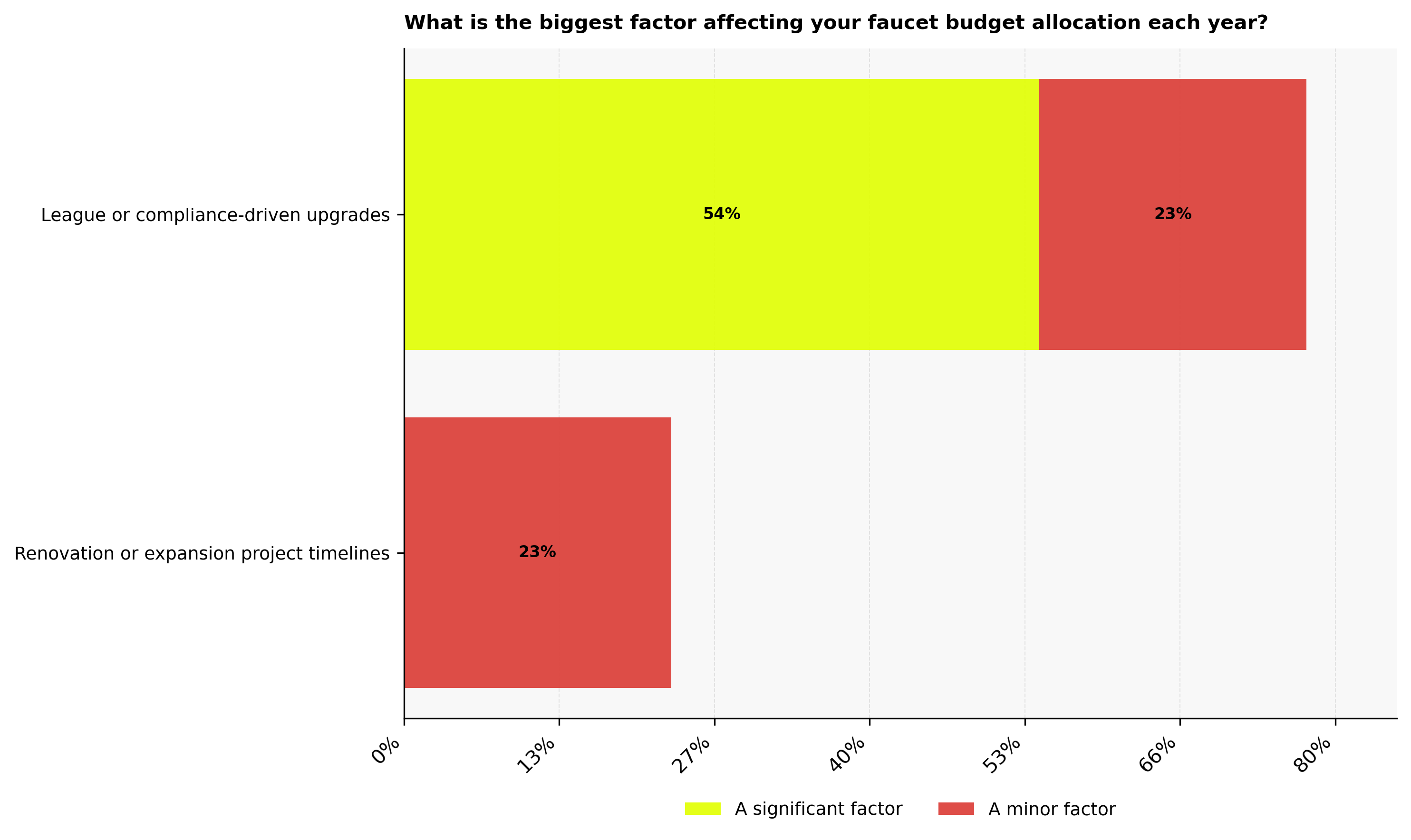
Every year, different factors impact how stadium facilities managers allocate their faucet budget. In many cases, these factors don’t change much from year to year. For 54%, League or compliance-driven upgrades are a significant factor affecting their faucet budget allocation each year. This is also a minor factor for 23%.
In some cases, these upgrades may be aimed at improving accessibility in line with the Americans with Disabilities Act (ADA), while others are made to meet sustainability goals. For example, some stadiums may be replacing existing faucets with WaterSense labeled bathroom sink faucets that can reduce a sink’s water flow by 30% or more from the standard flow of 2.2 gallons per minute to 1.5 gallons per minute without compromising performance. Faucets with the WaterSense label have been independently certified to ensure they meet Environmental Protection Agency (EPA) criteria.
Many compliance-driven upgrades can deliver multiple operational benefits at once. Chicago Faucets touchless faucet platforms help facilitate hygiene, reduce water consumption, and simplify maintenance while supporting LEED®, CAL Green, WaterSense, and ADA goals depending on the product selected. Chicago Faucets offers one of the widest ranges of EPA WaterSense faucets as listed in the ICC Evaluation Service (ICC-ES) as listed in the ICC Report PMG-1460.
The remaining 23% of our audience describes renovation or expansion project timelines as a minor factor affecting faucet budget allocation every year. This suggests that some stadium facilities managers may be choosing faucets that cost more than they actually want to pay in order to meet project deadlines.
Rather than replacing products solely because they fail, many facilities now use renovation cycles to standardize on durable, low-maintenance fittings that reduce operating costs over the long term.
Chicago Faucets manual faucets easily convert to low flow metering faucets with the MVP metering kit without replacing the fitting body. In renovation projects, it is a practical path to improved hygiene and water control without the cost or disruption of full faucet replacement.
What motivates stadium facilities managers to replace existing faucets?
For 57% of stadium facilities managers, frequent breakdowns or repairs are a minor reason for replacing faucets, while the need for water efficiency upgrades is a strong factor for 43%
Water efficiency a major motivator for faucet replacement:
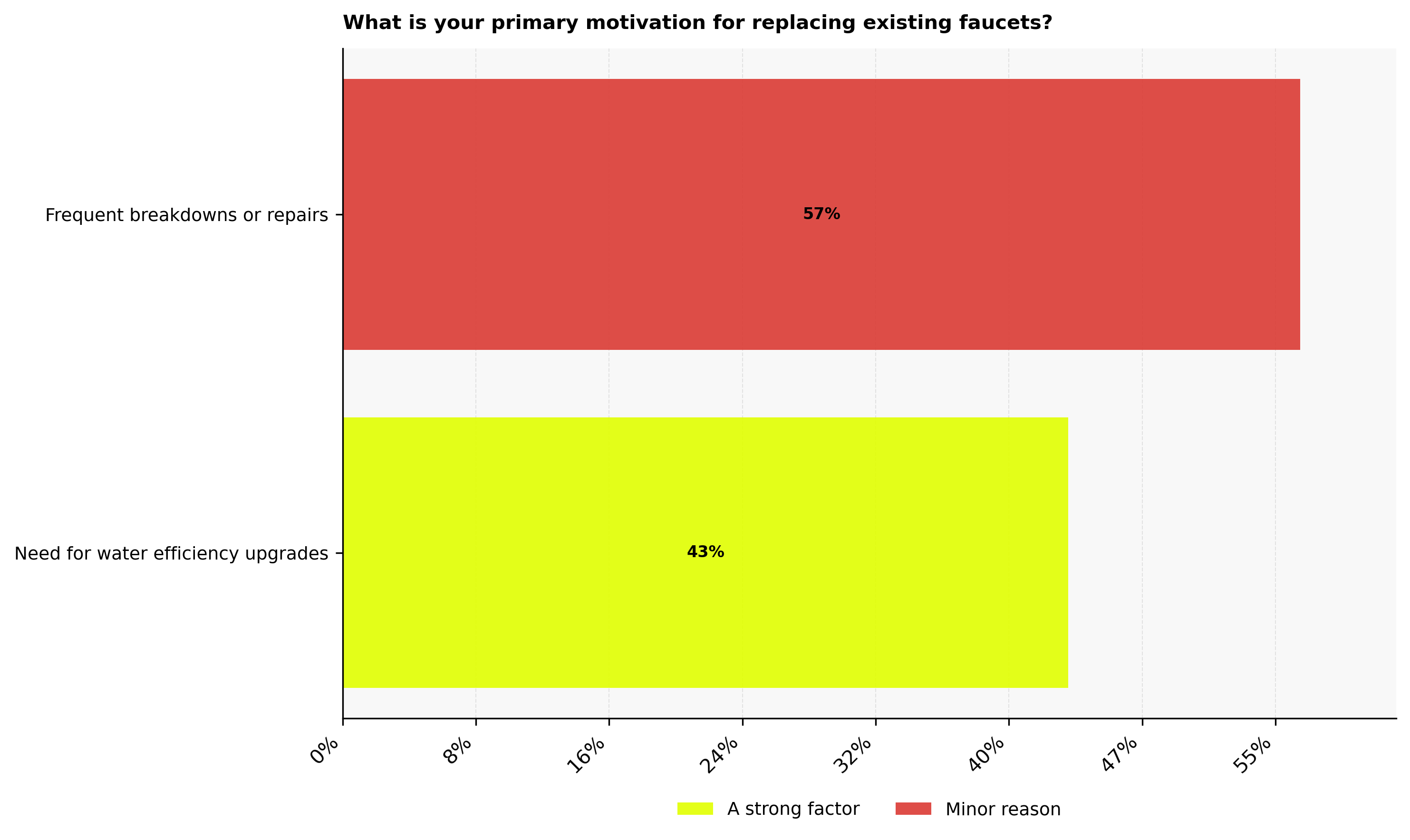
57% of our audience points to frequent breakdowns or repairs as a minor reason for replacing the existing faucets at their venues. Some of this repair work may be a result of old infrastructure wearing out. However, it’s also possible that some repairs are a result of faucets being damaged accidentally or deliberately (vandalism) by visitors to the stadiums.
The data shows water efficiency is becoming as important as replacing worn fittings. Chicago Faucets offers several options designed specifically for high-use stadiums and public assembly facilities, including:
These products help reduce unnecessary water use while minimizing maintenance and improving hygiene. Many models are available with 0.35 GPM or 0.50 GPM low flow rates to support aggressive conservation goals. It is easy to calculate water savings by switching to more sustainable flow faucets.
43% say the need for water efficiency upgrades is a strong factor motivating them to replace their stadiums’ existing faucets. This, however, may become less of a factor in the future, as last year, the Department of Energy (DOE) published a notice of proposed rulemaking to rescind its amended water use standards for faucets under the Energy Policy and Conservation Act.
If the current standards are rescinded, water use standards will be reset to the statutory standard. The motivation given by the DOE was that the maximum water use values from ASME/ANSI Standard A112.18.1M-1996 were not economically justified.
What is most important for stadium facilities managers when selecting faucets for new construction versus renovations?
Budget constraints unique to new construction are the most important consideration when choosing faucets for 54% of stadium facilities managers, and the ability to standardize faucets with existing venue fittings is most important for 46% managers when renovating
Priorities depend on new builds or renovations:
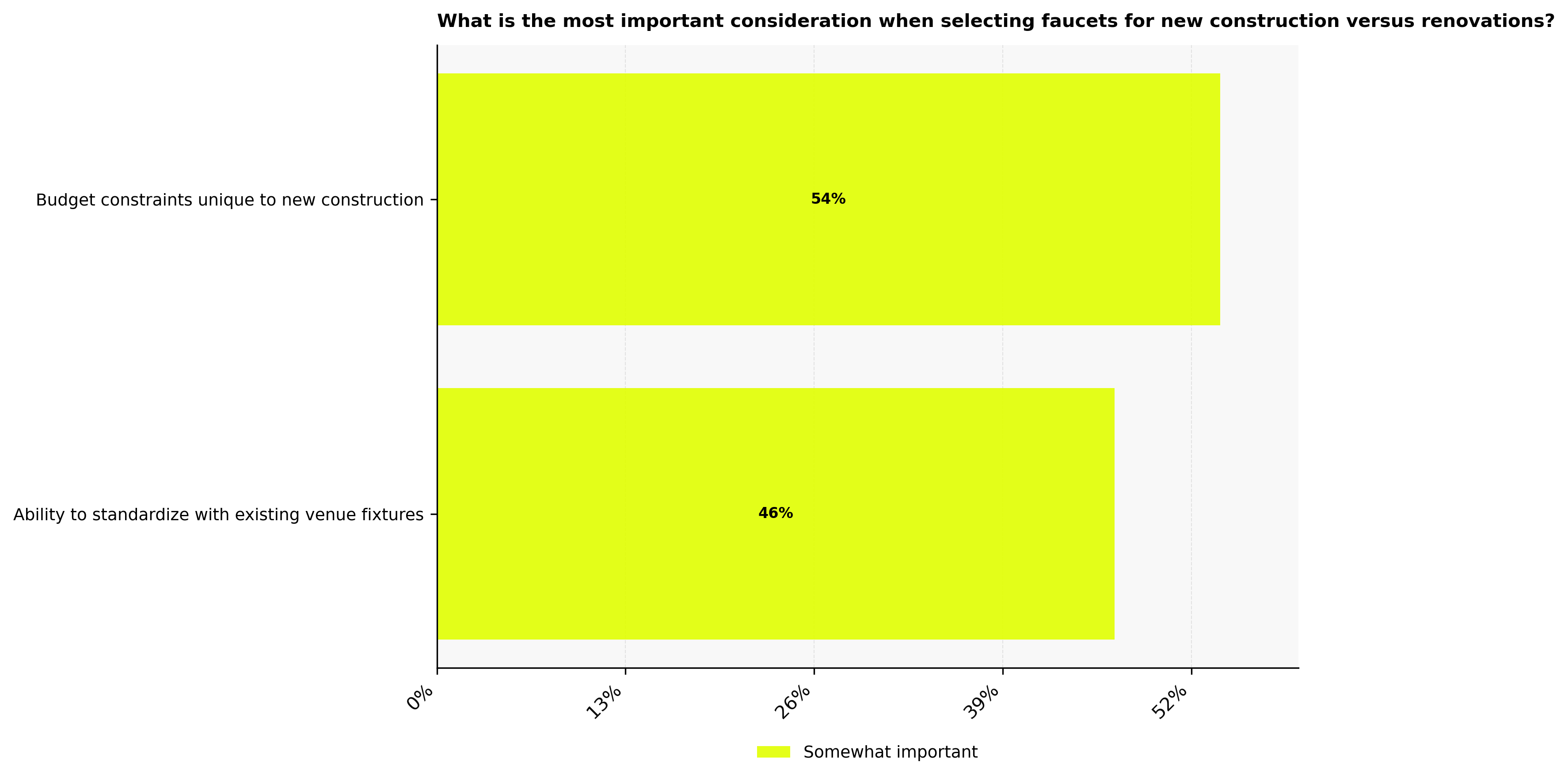
Stadium facilities managers need to keep several things in mind when selecting faucets for new construction, compared to when choosing faucets for renovations. Some of these considerations carry more weight than others. According to 54% of our audience, budget constraints unique to new construction are somewhat important. This makes sense, as it’s vital that managers stay within budget.
For the remaining 46%, the ability to standardize with existing venue fittings is an important consideration. This is understandable, as new faucets should stay with their venues’ existing look and feel and compatible with the existing infrastructure to avoid unnecessary upgrades.
Project Spotlight: Hilmer Lodge Stadium – Mt. SAC
Following a $118 million stadium renovation, Mt. San Antonio College selected Chicago Faucets EQ® Touchless Faucets to support heavy restroom traffic while reducing maintenance requirements for a small three-person plumbing team. The project also improved water efficiency through low-flow operation and incorporated ASSE 1070 thermostatic protection for user safety.
What role does league or conference compliance play in stadium facilities managers' faucet selection? What role does league or conference compliance play in stadium facilities managers' faucet selection?
For 26% of stadium facilities managers, league or conference compliance plays an absolutely essential role in faucet selection, and it’s somewhat important for 28%, 21% agree that influence varies by league requirements, and a further 17% say this is somewhat important to them too, while the general guidelines used as a reference as crucial for adhering to for 2%, and 4% say that these are somewhat important when choosing faucets
Compliance has a variable impact:
With the majority of our audience having mentioned League compliance above, it’s worth looking at the role it or conference compliance (such as NFL or NCAA) plays in stadium facilities managers’ faucet selection. Some refer to compliance having minimal direct influence on their choices, although this influence remains either absolutely essential for 26% or somewhat important for 28%. Others indicate that, while the influence varies by league requirements, it’s absolutely essential for 21% or somewhat important (17%).
2% of conversations mention that the general guidelines they use as a reference are absolutely essential, although 4% say they’re somewhat important. Others touching on these guidelines describe them either as not a major factor (less than 1%) or as having no influence at all (less than 1%). Less than 1% of stadium facilities managers’ posts online explain that they’re not subject to league specifications, while another less than 1% say there are mandatory specifications they must follow.
Small fitting changes can deliver major water savings
Whether faucets are chosen to comply with League or conference requirements or because stadium facilities managers are taking steps to improve water usage at their venues, a few relatively small changes can go a long way. According to a report by the National Institute of Building Sciences and the Green Sports Alliance, the BB&T Center (now the Amerant Bank Arena) in Sunrise, FL, reduced restroom sink water consumption by almost 75% from baseline levels through retrofitting more than 400 sinks in public restrooms.
Petco Park in San Diego, CA, installed new automated devices in sinks and installed automated low-flow flushers in 60% of urinals and toilets, resulting in 390,000 gallons of water being saved. Low-flow fittings also saved almost 6 million gallons of water (a 37% decrease) at the US Bank Stadium in Minneapolis.
What role does sustainability certification play in stadium facilities managers' faucet selection?
Sustainability certification, such as LEED, is an important factor for 44% of stadium facilities managers when selecting faucets, and it’s absolutely essential for 14%, 20% say it's absolutely essential as they’re working toward future sustainability certifications, 9% require these certifications to meet venue sustainability goals, and 6% say they are an important factor for doing so, but 6% cite sustainability certificate as an important factor only for new construction projects, and 1% state that this plays a minor role in their current decisions
Sustainability certification doesn’t always feature heavily in decision-making:

Some sustainability certifications are highly regarded by individuals in various roles and industries, stadium facilities managers among them. LEED, for example, is the world’s most widely recognized green building rating system, offering a framework for buildings that are cost-effective, efficient, and healthy. Despite this, LEED and other sustainability certifications do not always play an important or incredibly influential role in stadium facilities managers’ choice of faucets.
For 14%, sustainability certifications such as LEED are absolutely essential, even if they’re not mandatory. 44% have a similar opinion, regarding them as an important but optional factor. 20% regard these certifications as absolutely essential, as they’re working toward future sustainability certifications. This tells us they make choices in line with certification requirements to make it easier to obtain those certifications in the future.
These certifications are absolutely essential for 9% and an important factor for 6%, as they’re required to meet venue sustainability goals. While they’re also an important factor for another 6%, they’re considered only for new construction projects, not for renovations. The remaining 1% opine that, while sustainability certifications are an important factor, they play a minimal role in their current decisions.
Chicago Faucets Sustainable Project Spotlights
Mt. SAC chose touchless EQ faucets to support hygiene and reduce waste in a very high-use setting. The EQ faucets help lower water consumption with low-flow rates and support CAL Green and LEED water-efficiency goals, while also reducing maintenance for a small facilities team.
The arena renovation focused on efficiency and long-term performance in premium spaces. The Alpina faucets were selected to help conserve water through programmable sensor operation and to reduce heated water use with thermostatic mixing valves, while also improving hygiene and reliability for heavy event traffic.
The Eagles complex uses multiple faucet types designed for conservation and durability. The 3500 Series metering faucet conserves water with timed shutoff, and the touchless E-Tronic 40 and HyTronic models add vandal resistance, easy maintenance, and reduced waste through programmable operation.
This project is less explicitly sustainability-focused than some others, but it still leans toward water-conscious equipment. At Wintrust Field manual metering faucets with pressure-compensating aerators support controlled water use and dependable performance in suite restrooms.
To download the complete Chicago Faucets stadium and venue eBook click here.
What role does brand reputation play in stadium facilities managers' selection process?
93% of stadium facilities managers, faucet brand reputation matters only for high-visibility areas, and 7% are open to newer brands with strong reviews
Brand reputation often reflects decades of product performance rather than marketing alone. Facilities with limited maintenance staff frequently prioritize manufacturers with proven durability, replacement part availability, and long service life because operational reliability ultimately becomes more important than purchase price.
Reputation is only important when on show:

Brand reputation matters to consumers. According to Salsify’s 2025 Consumer Report, 69% of shoppers name brand reputation among their top reasons for trusting a brand. This begs the question of how much of a role it plays in stadium facilities managers’ faucet selection process.
93% admit that, while reputation matters only for high-visibility areas, it’s less important than other factors. The idea here seems to be about making a good impression on stadium visitors by placing faucets with a good brand reputation in those areas, while using less well-known options in other areas. The remaining 7% are open to newer brands with strong reviews. These brands may offer good quality performance at a lower cost.
Which faucet feature do stadium facilities managers prioritize most for high-traffic restrooms?
Touchless or sensor-activated operation is an important factor when choosing faucets for high traffic restrooms for 57% of stadium facilities managers and less important for 6%, while low-flow or water saving technology is less important for 13% and not a priority for 10%, and a durable finish resistant to corrosion is important for 6%, but has less importance for 8%
Faucet feature preferences are of variable importance:

For 57% of stadium facilities managers, touchless or sensor-activated operation is an important factor they prioritize for high-traffic restrooms, although this is less important for 6%. There are a few reasons why they look for these features, with efficiency, water conservation, and cost savings being among them. Hygiene is another reason, as touchless faucets can help limit the spread of germs.
According to Grand View Research, the global smart faucets market was estimated at $3,804.2 million in 2024 and is projected to reach $6,368.2 million by 2030, growing at a CAGR of 9.1% from 2025 to 2030. This growth is a result of consumer preferences for greater automation, convenience, and efficiency.
Low-flow or water-saving technology is less important for 13% and isn’t a priority at all for 10%, while a durable finish resistant to corrosion is an important factor for 6% and less important for 8%. This puts the focus firmly on touchless or sensor-activated operation overall.
How important is touchless/sensor technology when stadium facilities managers select restroom faucets?
47% of stadium facilities managers evaluate how important touchless or sensor technology is when selecting faucets for restrooms based on a case-by-case basis, depending on their budget, and another 47% prioritize manual durability over this technology, while 6% say it is essential for hygiene and crowd flow
The importance of touchless or tech faucets is divided:

More than half of our audience mentioned touchless/sensor technology as an important factor, but how important is it really when stadium facilities managers select restroom faucets? 47% make it clear that this technology is less important than manual durability, while another 47% evaluate it on a case-by-case basis, based on budget. The remaining 6% think touchless/sensor technology is essential for hygiene and crowd flow.
This suggests that touchless technology is viewed as a valuable enhancement rather than a universal requirement. Many major sports venues have selected Chicago Faucets sensor faucets for high-traffic applications, including:
Hilmer Lodge Stadium
CFG Bank Arena
Kinnick Stadium
Lincoln Financial Field
These projects demonstrate how electronic faucets can improve hygiene while reducing maintenance and supporting water conservation.
Today's electronic faucets offer more than touch-free activation. Features such as programmable run times, adjustable flow rates, hygiene flush capabilities, temperature monitoring, and remote diagnostics can help facilities better manage water use while simplifying maintenance across hundreds of fittings.
As stadiums and large public venues place greater emphasis on water management, operational efficiency, and regulatory compliance, connected plumbing technology is becoming an essential part of modern facility operations. Chicago Faucets' CF Connect PLUS transforms electronic faucets into an intelligent, networked water management system by automating routine hygiene flushing, monitoring water temperatures, and providing centralized visibility across connected fittings.
Powered by the CF Connect Gateway, the system securely communicates with connected faucets and integrates with Building Automation Systems (BAS) through BACnet/IP over a facility's local area network, allowing water management data to become part of the building's overall operational ecosystem. Rather than relying on manual inspections and paper logs, facility teams can remotely configure fittings, generate audit-ready documentation, monitor system performance, and access actionable data that supports water management programs, reduces maintenance labor, and helps maintain safe, reliable water systems throughout the venue.
What concerns do stadium facilities managers have about backflow prevention or cross-contamination when selecting faucets?
When selecting faucets, 29% of stadium facilities managers rely on contractor expertise for compliance to alleviate concerns about backflow or cross-contamination, while this is also an important concern for 25%, a further 25% have minimal concerns beyond standard code requirements, and 21% are not concerned, as they strictly comply with backflow prevention standards
Backflow and cross-contamination concerns are well managed:

Stadium facilities managers have good reason to be concerned about backflow prevention and cross-contamination when selecting faucets.
A legendary case emphasizing the importance of this occurred in February 1972, when 90 of the 97 men on the Holy Cross football team got hepatitis by drinking water contaminated by backflow. 29% insist that preventing backflow and cross-contamination is a top priority, while it’s an important consideration for 25%, although these segments rely on contractor expertise for compliance.
Although it’s also an important consideration for another 25%, they have minimal concerns beyond ensuring they meet the standard code requirements. The remaining 21% reckon it’s not a concern as they ensure strict compliance with backflow prevention standards.
Beyond backflow prevention, many facilities are also evaluating fitting designs that reduce opportunities for bacterial growth within the faucet itself. Faucet designs that integrate thermostatic mixing within the faucet body can reduce the amount of tempered water sitting in downstream piping while also minimizing leak points and simplifying installation.
Chicago Faucets offers this integrated thermostatic valve approach across several product lines, including the E-Tronic® 80, HyTronic® TempShield®, and 410-T and 420-T Series manual faucets, helping facilities improve safety while reducing installation complexity and long-term maintenance.
To learn more, download the scald protection brochure.
Scald protection has become an increasingly important consideration in public assembly facilities, particularly in stadiums, schools, healthcare environments, and other high-traffic venues where user safety is paramount. Specifying faucets with an integrated ASSE 1070-certified thermostatic mixing valve provides point-of-use scald protection while simplifying installation.
By incorporating the thermostatic valve directly into the faucet body, these designs can reduce installation time, eliminate multiple under-deck connections, and minimize potential leak points compared to traditional installations that require a separate mixing valve.
What level of customization do stadium facilities managers look for in commercial faucets?
For 41% of stadium facilities managers, standard faucet options without customization are preferable, and 21% feel that customization is unnecessary, while adjustable flow rates for different areas are essential for 17%, and preferable for 20%
Customization requirements are clear:

With commercial faucets offering different levels of customization, stadium facilities managers have different ideas about what to look for. For 41%, standard options without customization are preferable. 21% also look for these standard options, believing customization to be unnecessary.
Adjustable flow rates for different areas are essential for 17% and preferable for 20%. This customizable feature can help conserve water and reduce costs. To save water, stadium facilities managers should look for a 0.5 gpm flow rate and a 15-second shut-off, according to the US General Services Administration. Chicago Faucets has solutions from 0.35 GPM ultra-low flow to 0.50 GPM low flow fittings available here.
Chicago Faucets offers interchangeable flow outlets, multiple power options: long term battery, self-sustaining with water turbine, hardwire, and emergency back-up power, numerous faucet styles, finishes, and activation technologies, allowing facilities to standardize maintenance while selecting products appropriate for different applications.
How do stadium facilities managers source replacement parts for installed faucets?
93% of stadium facilities managers typically sourced replacement parts for installed faucets through their installation contractor, 6% get them directly from the original manufacturer, and 1% from local plumbing supply distributors
One source for replacements dominates:

Repairs and replacements come with the territory, and there are various ways stadium facilities managers can source the parts they need to repair installed faucets. 93% do this through their installation contractor, which makes sense, as they’re generally assured of receiving replacement parts from the same manufacturer.
6% source replacement parts directly from the original manufacturer, which may be a more affordable option than going via a contractor. The remaining 1% source replacement faucet parts through local plumbing supply distributors, putting them firmly in the minority.
Standardization can significantly simplify maintenance across large venues. Chicago Faucets products are designed with long-term serviceability in mind, allowing facilities to standardize replacement parts and reduce inventory requirements.
Chicago Faucets Standardization Project Spotlight: California State University–Dominguez Hills
For large venues with hundreds of plumbing fittings, standardization can significantly reduce operational complexity and long-term maintenance costs. Selecting a consistent faucet platform simplifies installation, minimizes replacement parts inventory, streamlines technician training, and creates a more predictable maintenance program across the entire facility. Standardization also allows maintenance teams to become familiar with a single product family, improving service efficiency and reducing downtime.
At California State University–Dominguez Hills, where the facilities team standardized Chicago Faucets' HyTronic® touchless faucets as part of its campus modernization efforts. With more than 250 buildings to maintain, the university sought a durable, reliable solution that would simplify maintenance while improving consistency across campus. By standardizing as a single faucet platform, the university reduced the variety of replacement parts required, simplified staff training, and improved overall maintenance efficiency. The project demonstrates how standardization can deliver long-term operational benefits beyond the initial installation, making it an effective strategy for stadiums, arenas, convention centers, and other large public venues where maintenance efficiency and lifecycle costs are key considerations.
Which soap dispenser feature do stadium facilities managers prioritize most?
76% of stadium facilities managers don’t prioritize touchless or sensor activation in soap dispensers; however, compatibility with foam, liquid, gel, or soap is an important factor for 14%, and 10%’s top priority is a large capacity refill reservoir76% of stadium facilities managers don’t prioritize touchless or sensor activation in soap dispensers; however, compatibility with foam, liquid, gel, or soap is an important factor for 14%, and 10%’s top priority is a large capacity refill reservoir
Features are not hugely important in soap dispensers:

76% of stadium facilities managers mention touchless or sensor activation in relation to soap dispensers at their venues, although these features are not a priority. This is surprising, as Stadia magazine names these among the top five stadium restroom features that keep fans moving and enhance the game-day experience.
The other features that every stadium restroom needs include high-capacity paper towel and toilet paper dispensers, smart tech enabling crews to stay ahead of issues and keep restrooms clean and well-stocked, clear signage and intuitive layouts, and aesthetic touches such as team colors and sponsor-branded fittings.
As for the rest of our audience, compatibility with foam, liquid, or gel soap is an important factor for soap dispensers in their venue restrooms for 14%, while large-capacity refill reservoirs are the top priority for 10%, which is in keeping with Stadia’s suggestions.
How important is touchless/sensor technology in stadium facilities managers' selection?
Touchless or sensor technology is prioritized depending on budgets for 45% of stadium facilities managers; it's less important than refill capacity for 41%, while 6% prefer it in high-traffic areas only, and another 6% evaluate the need for it depending on location, and just 2% say it’s essential for hygiene in all restrooms.
The importance of touchless and sensor tech is varied:

Our audience has mentioned touchless or sensor technology several times, but that doesn’t mean they consider it one of the most important features or use it as much as possible. 45% of stadium facilities managers use touchless/sensor technology selectively, basing their use of it on budget. This is understandable, as the technology can be expensive, depending on the application, and our audience does not have an unlimited budget.
41% think that touchless/sensor technology is less important than refill capacity, which tells us they’ve had issues with running out of soap, toilet paper, or paper towels on busy days, which undoubtedly led to unhappy visitors, complaints, and (potentially) reputational damage. 6% indicate that they prefer touchless/sensor technology in high-traffic areas only, as it helps keep people moving.
Another 6% evaluate the need for this technology on a case-by-case basis, depending on the location. This implies they see this technology as valuable for improving efficiency rather than for reducing the spread of germs. For the remaining 2%, touchless/sensor technology is essential for hygiene in all restrooms at their stadiums, showing a small but significant number who focus on this area.
Which soap dispenser mounting or installation style matters most to stadium facilities managers?
For 10% of stadium facilities managers, counter-mounted soap dispenser units are a good option, but they’re not the top pick for 22%, and 23% would not choose them, 9% prefer recessed or built-in units, but 8% don’t like them, while 15% like wall-mounted fixed units and only 1% would pick them first, and 12% have no strong preferences, making a choice based on layout needs
Opinions about soap dispensers mounting and installation are divided:
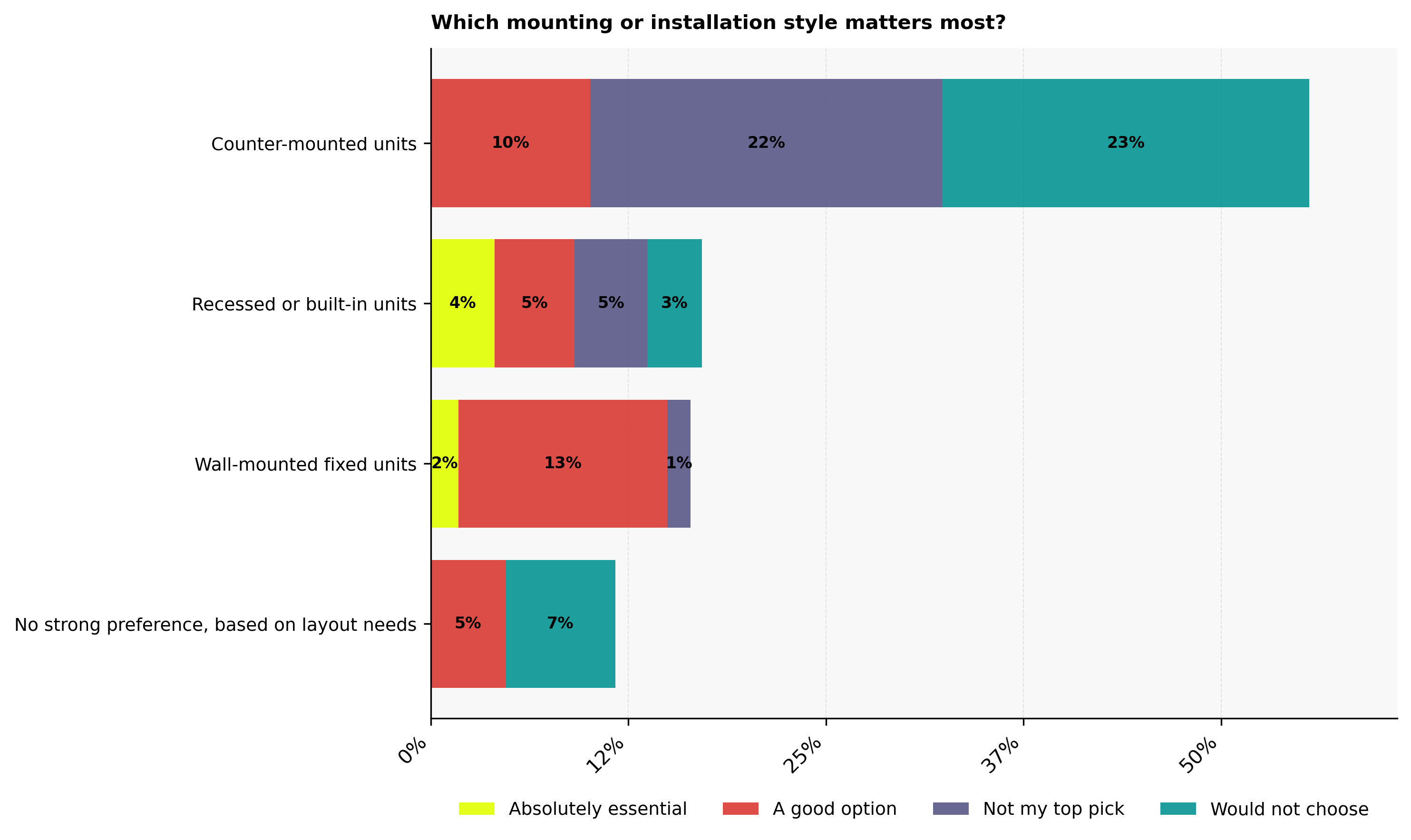
Stadium facilities managers can choose from a range of soap dispenser mounting or installation styles, with some styles mattering more to some managers than others. 10% think counter-mounted units are a good option, although this isn’t the top pick for 22%, while 23% wouldn’t choose it at all. For 4%, recessed or built-in units are absolutely essential, while these are a good option for 5%. However, this isn’t the top pick for another 5%, while 3% wouldn’t choose this style.
Wall-mounted fixed units are absolutely essential for 2% and are a good option for 13%. However, this isn’t the top pick for 1%. 5% have no strong preference, basing their choice on their restrooms’ layout needs, although 7% wouldn’t choose to base their choices on layout needs.
With so many different options available, the soap dispenser market is strong. According to Grand View Research, the global soap dispenser market size was valued at $1.40 billion in 2022 and is projected to reach $2.64 billion by 2030, growing at a CAGR of 8.3% from 2023 to 2030.
Emerging Trend
While many facilities continue to prioritize refill capacity, centralized soap dispensing systems are beginning to change maintenance practices. Chicago Faucets' E-Tronic® 80 SoapBank™ centralized soap dispensing system allows multiple dispensers to share one large reservoir, reducing refill frequency while improving maintenance efficiency across high-traffic restrooms.
Which soap dispenser refill or maintenance feature most influences stadium facilities managers' choice?
Large capacity reservoirs that reduce refill frequency are the most important factor for 26% of stadium facilities managers when choosing soap dispensers, and 35% strongly consider compatibility with bulk soap refills, with another 39% somewhat considering this factor. That makes centralized systems like E-Tronic®80 SoapBank™ multi-feed soap system especially valuable in large venues because at 3.4 gallons size central container it supports bulk refills, minimize service interruptions, and help maintenance teams keep multiple restrooms supplied from one central source
Compatibility with bulk soap refills dominated:

Given how frequently visitors, athletes, stadium employees, and concession stand workers use soap dispensers, they need to be refilled or maintained regularly. It’s understandable that stadium facilities managers look for specific refill or maintenance features when choosing dispensers for the venues’ restrooms.
35% strongly consider compatibility with bulk soap refills, although 39% consider this only somewhat. For 26%, the most important factor is large-capacity reservoirs that reduce refill frequency, as this keeps things running smoothly for longer and frees staff up to focus on other tasks.
For faucets and showers, which control or temperature feature most influences stadium facilities managers' fitting choice?
Pre-set or fixed temperature limiting is strongly considered by 34% of stadium facilities managers when choosing fittings, and 54% somewhat consider these features, with the remaining 11% strongly considering anti-scald thermostatic valves
Control and temperature feature preferences lean one way:

Beyond preventing scald injuries, integrated thermostatic protection can help simplify installations and reduce downstream tempered water volume. Chicago Faucets offers ASSE 1070-certified TempShield® faucets that incorporate thermostatic mixing directly into the faucet assembly, providing point-of-use scald protection while reducing installation complexity.
The Auto-Drain® Shower System by Chicago Faucets is available with thermostatic mixing valve or thermostatic/pressure balancing mixing valve to meet facility needs. It also adds an important benefit for stadium showers by automatically purging standing water after use, which helps reduce stagnation in the infrequently used locker-room environment while complementing temperature-limiting and anti-scald safety features.
According to Hot Water Safety, tub-shower valves with integral maximum-temperature limit stops are code-required in almost every US building. With this in mind, it makes sense that 34% of stadium facilities managers strongly consider pre-set or fixed temperature limiting controls or features when choosing showers for their venues, while 54% somewhat consider these features. 11% strongly consider anti-scald thermostatic valves.
These features enable stadium facilities managers to comply with code requirements intended to improve the safety of those who use stadium showers.
Which commercial faucet brands would stadium facilities managers recommend?
The 2023 AIM Influencer Focus Group Study confirmed Chicago Faucets’ reputation among commercial plumbing decision-makers. Architects, contractors, designers, engineers, and facilities professionals identified Chicago Faucets as a preferred brand, largely due to its quality, existing client preference, and strong representative support.
The study also found that durability, reliability, and manufacturer responsiveness were among the most important factors influencing long-term brand preference and specification retention. In addition, the study noted that some reasons manufacturers are often removed from preferred specification lists include slow response times, product failures, or an inability to resolve issues. Respondents repeatedly associated Chicago Faucets with strong performance and support in all these areas.
Which commercial soap dispenser brands would stadium facilities managers recommend?
Stadium facilities managers put careful thought into their choice of soap dispensers, as their venues’ restrooms require high-performance systems that operate continuously with minimal maintenance. The idea is to provide athletes, fans, and stadium and concession employees with hygienic, easy-to-use soap dispensers that allow stadium staff to focus on other tasks rather than constantly refilling dispensers every few minutes.
According to Wiki Home Improvements, the top 10 commercial soap dispenser brands include Gojo/Purell, ASI, Rubbermaid Commercial, Bradley Corp, TOTO, Sloan, and Kimberly-Clark.
What is the primary job title of stadium facilities managers?
46% of stadium facilities managers' primary job title is stadium operations director, 39% are maintenance managers, and 14% are the director of facilities or operations
Three primary job titles emerge:

The stadium facilities managers in our audience have different primary job titles. 46% are high-ranking Stadium Operations Directors, while 39% have the lower-ranking title of Maintenance Manager. In most cases, Maintenance Managers report to the Stadium Manager, Facilities Director, or Director of Operations.
The remaining 14% hold the title of Director of Facilities or Director of Operations. Directors of Facilities and Operations are executives responsible for the stadium’s functionality, safety, and profitability. Specifically, the Director of Facilities oversees the stadium’s physical infrastructure and maintenance, and the Director of Operations coordinates the logistics and visitor experience during events.
In which city are stadium managers' venues located?
43% of stadium facilities managers’ venues are in Houston, 27% in Chicago, 24% in Miami, 3% in New York, and 3% in LA
Houston leads the way for stadium location:

This audience represents stadiums located in several major US cities. 43% of the venues of these stadium facilities managers are located in Houston, Texas. While Houston’s stadiums aren’t among the top 25 stadiums by seating capacity in the US, several others in the Lone Star State are, such as Kyle Field in College Station and Darrell K Royal-Texas Memorial Stadium in Austin. 27% name Chicago, Illinois, as the city in which their venue is located. The venues of 24% are located in Miami, Florida. Although none of Miami’s stadiums are among the top 25 by seating capacity, others in the Sunshine State are, such as Ben Hill Griffin Stadium in Gainesville and Doak Campbell Stadium in Tallahassee.
3% say their venue is in New York City, and another 3% say it is in Los Angeles, California. Their venues aren’t among the top 25 biggest stadiums, but the Rose Bowl in Pasadena, CA, is.
Commercial faucet trends shaping stadiums
These findings show that stadium facilities managers are taking a long-term, strategic approach to faucet selection. Rather than focusing on price alone, they are balancing durability, compliance, maintenance requirements, water efficiency, and visitor experience to ensure every investment delivers lasting value.
As stadiums continue to modernize, commercial plumbing fittings are becoming an increasingly important part of creating efficient, sustainable, and high-performing venues. Manufacturers combining reliable products with strong support and solutions built for demanding, high-traffic environments will be best placed to meet the evolving needs of today's facilities managers.
Future restroom maintenance may rely less on scheduled inspections and more on connected monitoring and predictive maintenance such as the CF Connect PLUS for restroom water management across the entire stadium, integrated thermostatic valves such as TempShield® to help limit scalding and control water temperature, along with Auto-Drain shower systems that automatically clear standing water to reduce stagnation and the bacterial growth it can encourage.
While many facilities continue to prioritize refill capacity, centralized soap dispensing systems are also beginning to change maintenance practices. Chicago Faucets' SoapBank™ centralized soap dispensing system allows multiple dispensers to share one large reservoir, reducing refill frequency while improving maintenance efficiency across high-traffic restrooms.
About the data
Sourced using Artios from an independent sample of 191,918 opinions of Stadium Facilities Managers in the USA across X, Quora, Reddit, Bluesky, TikTok, and Threads. Responses are collected within a 95% confidence interval and 5% margin of error. Results are derived from what people describe online, from opinions expressed, not actual questions answered by people in the sample.