

Stadiums Attendee Experience Statistics: USA 2026
Stadium Attendee Experience Statistics: USA 2026
Behind every successful game day is a complex operation designed to keep thousands of attendees safe, comfortable, and engaged. From entry to exit, stadium facilities managers play an integral role in coordinating the dozens of interconnected moving parts that impact the fan experience, overseeing everything from infrastructure and crowd flow to amenities like restrooms, connectivity, and safety systems that keep venues running smoothly under intense pressure.
To find out what 193,286 opinions of stadium facilities managers in the US were about attendee experiences, we utilized AI-driven audience profiling to synthesize insights from online discussions over 12 months, ending on June 23rd, 2026, to a high statistical confidence level. These statistics explore the factors that stadium facilities managers say have the greatest impact on the attendee experience.
Index
- 40% of stadium facilities managers primarily host NFL or college football games, but for 9%, this isn’t the main focus, 18% mostly host MLB, MLS, or soccer, while this isn't the focus for 10%, and 16%’s stadiums host NBA or NHL games or indoor sports, but 6% don’t tend to have these activities on their rosters
- 46% of stadium facilities managers’ venues have seating capacity for between 20,000 and 50,000 people, 14% can handle crowds of between 50,002 and 80,000, and 13% over 80,000 people, while 28% seat under 20,000
- Surveillance and real-time monitoring are especially important security priorities for 51% stadium facilities managers, while they are somewhat important for 44%, and just 1% say they are not a priority; staff training and incident response are mentioned as very important by 1%, and conversations around bag screening and accuracy are minimal
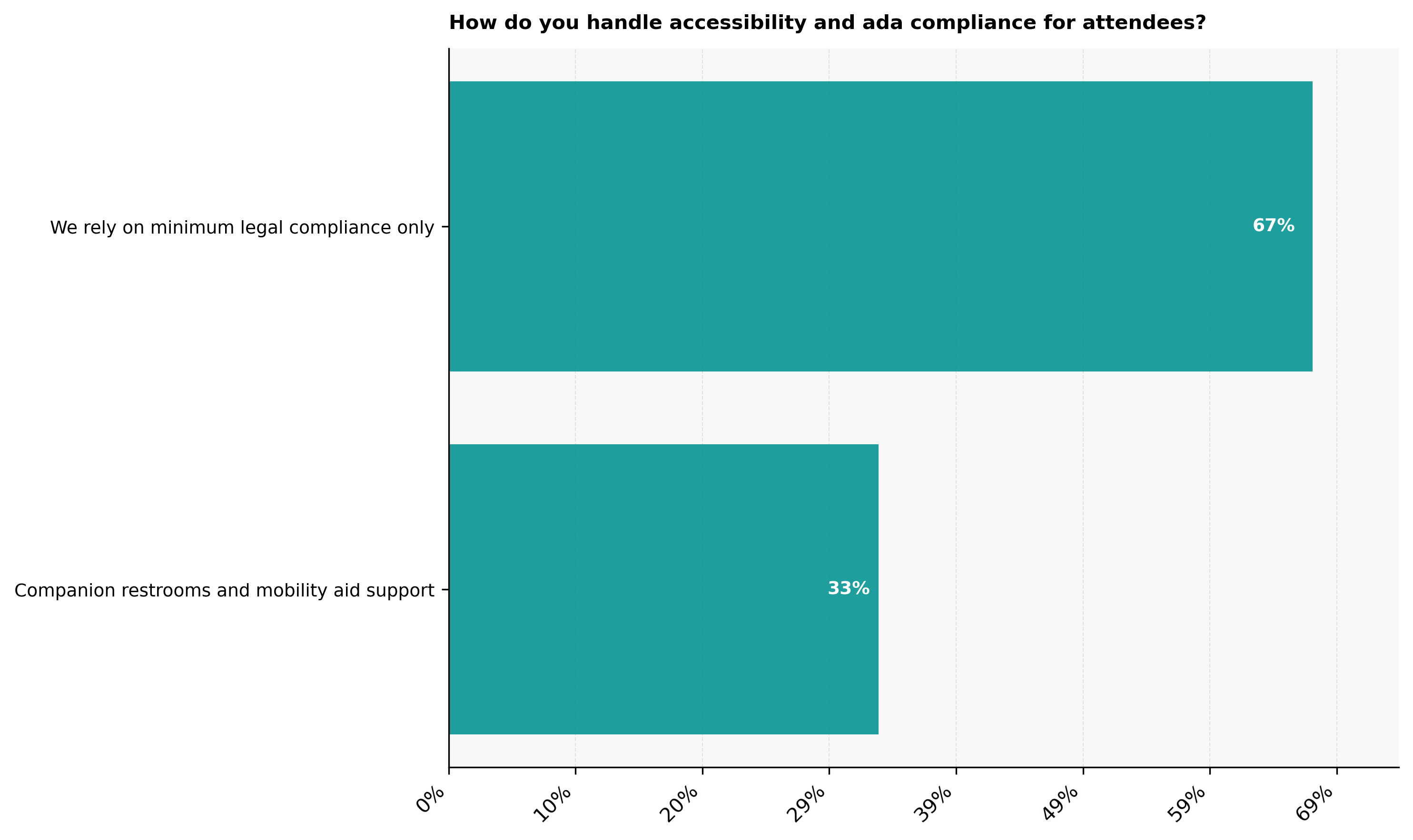
- 67% of stadium facilities managers rely on the minimum legal accessibility requirements and ADA compliance for attendees, and 33% also offer companion restrooms and mobility aid supports
- Reserved lots with staff direction are used by 81% of stadium facilities managers to manage parking, and 19% use dynamic pricing and pre-booking to maintain control
- 64% of stadium facilities managers manage queue times at food and beverage concessions with mobile pre-ordering via apps, and 36% do so by offering an in-seat delivery service
- Vendor variety and quality are a major food and beverage (F&B) challenge for 12% of stadium facilities managers, somewhat challenging for 68%, and a minor issue for 4%; but for 10%, speed of service is somewhat of a challenge, and a minor issue for 7%
- Gender-neutral or accessibility facility gaps are a major restroom pain point for 14% of stadium facilities managers, somewhat of an issue for 64%, and a minor concern for 18%; while 2% cite insufficient faucet count for peak demand as somewhat of an issue, and no one voiced issues with maintenance supply and restocking
- Fans have a lot to say about their experience depending on the facility cleanliness. A study by Nationwide Waste Service analyzed more than 200,000 fan Google reviews and ranked all 30 NFL stadiums on bathroom quality from cleanliness to wait times
- Currently, social media monitoring is used by 94% of stadium facilities managers to manage attendee satisfaction, and 6% use Net Promoter Scores (NPS) to gauge satisfaction levels
- 56% of stadium facilities managers have a neutral NPS between 0 and 39, and 44% don’t track NPS, so they cannot measure how satisfied attendees are with their overall experience
- Parking and transportation are a major challenge for 8% of stadium facilities managers, somewhat challenging for 79%, a minor issue for 9%, and not a challenge for 1%; while food and beverage service speed is a minor issue for 2%, and 0% voiced opinions about restroom cleanliness and capacity being an operational challenge
- 34% of stadium facilities managers rate their current Wi-Fi and connectivity infrastructure as excellent, as they have no attendee complaints, 32% say theirs is good, but they do have occasional issues at peak times, and 30% agree it’s fair but with consistent complaints at peak times, while just 4% have a poor connection or infrastructure with a known or unresolved problem causing this rating
- 53% of stadium facilities managers have no specific first-timer support for attendees; however, 47% have an interactive stadium app with maps to help first-time visitors
- In their venues, 50% of stadium facilities managers currently use AI-powered chatbots for attendee support, 35% use AI for dynamic pricing for parking or concessions, 1% for predictive maintenance and alerts; however, AI is not on 8% of managers’ current roadmaps, and 5% are still exploring it, but haven't deployed any AI functions as yet
- 16% of stadium facilities managers are leading the way in their sustainability journeys, 64% are making good progress with sustainability initiatives, &% are seeing some progress in their journey, and 4% are not yet advanced, 6% are also making good progress with green-certified vendors, and 2% are leading the way with waste sorting and recycling programs
- 100% of stadium facilities managers use social media follow-up campaigns to engage with attendees after an event, leaving no one without a post-event engagement strategy
- Facility renovation or expansion is a top budget priority for 17% of stadium facilities managers, an important consideration for 52%, and a lower priority for 13%, while technology infrastructure upgrades are a top priority for 8%, an important consideration for 3%, and a low priority for 4%, while sustainability and green initiatives are considered a top budgeting priority for 1%
- Stadiums are adapting to rising fan expectations
- About the Data
What is the primary sport or event type at stadium facilities managers' venues?
40% of stadium facilities managers primarily host NFL or college football games, but for 9%, this isn’t the main focus, 18% mostly host MLB, MLS, or soccer, while this isn't the focus for 10%, and 16%’s stadiums host NBA or NHL games or indoor sports, but 6% don’t tend to have these activities on their rosters
Major sports leagues dominate in stadiums:

Well over a third of stadiums' facilities managers indicate that National Football League (NFL) and/or college football are absolutely the focus (14%) or most likely the main event (26%) at their venues. This makes perfect sense, as football is the most popular sport in America, and it fits in with SP Global’s findings that approximately half of surveyed internet adults watch the sport and 43% watch the NFL. That said, 7% indicate that football is not the main event, and 2% say it’s definitely not the main event at their venues.
Major League Baseball (MLB), Major League Soccer (MLS), or soccer absolutely are the main focus at 11% of venues and are most likely the main event at 7%, also reflecting the popularity of these sports. However, they’re not the main event at 6% of venues, and definitely not at 4%.
The rest of our audience describes National Basketball Association (NBA) games, National Hockey League (NHL) games, or indoor sports as either absolutely the main event (8%), most likely the main event (8%), not the main event (2%), or definitely not the main event (4%), putting these sports in the minority.
What is the seating capacity of stadium facilities managers' venues?
46% of stadium facilities managers’ venues have seating capacity for between 20,000 and 50,000 people, 14% can handle crowds of between 50,002 and 80,000, and 13% over 80,000 people, while 28% seat under 20,000
Bigger seating capacity stadiums are more common:

The venues of 46% of stadium facilities managers are mid-sized, with seating capacities of 20,000-50,000, indicating they’re likely home to MLS or mid-major college football programs. The venues of 28% are considered small, with seating capacities under 20,000, so they’re likely used for lower-tier collegiate sports, minor league baseball, or USL soccer.
14% have large stadiums with 50,001-80,000 seats, which is standard for NFL and major Division I college football programs.
The stadiums of 13% have a seating capacity greater than 80,000. Venues of this size are usually limited to historic college programs in conferences like the SEC and Big Ten. According to the New York Times, college football stadiums are eight of the 10 biggest in the world – and 14 of the top 25 biggest stadiums.
What is the top security priority for stadium facilities managers?
Surveillance and real-time monitoring are very important security priorities for 51% stadium facilities managers, while they are somewhat important for 44%, and just 1% say they are not a priority; staff training and incident response are mentioned as very important by 1%, and conversations around bag screening and accuracy are minimal
Keeping an eye on what's happening in real-time is a unanimous concern:

Security at stadiums is multifaceted, with some aspects being more important to some stadium facilities managers than others. For 51%, surveillance and real-time monitoring are very important, although this is only somewhat important for 44% and not a priority for 2%. Keeping an eye on things as they unfold is how US agencies were able to seize more than 300 drones near World Cup venues since the beginning of the tournament.
Very few online posts and conversations mention bag screening speed and accuracy. When they do, it’s either absolutely essential (less than 1%), very important (less than 1%), or not a priority (less than 1%). Staff training and incident response are very important to 1%, suggesting that previous incidents have uncovered shortcomings in these areas.
How do stadium facilities managers handle attendee accessibility and ADA compliance?
67% of stadium facilities managers rely on the minimum legal accessibility requirements and ADA compliance for attendees, and 33% also offer companion restrooms and mobility aid support
Compliance baselines are met:
Under the Americans with Disabilities Act (ADA), all new stadiums must be accessible to people with disabilities. The compliance requirements impact seating, concessions such as food service areas, restaurants, and souvenir stands, access to playing fields, lockers, and spaces used by players and performers, parking spaces, entrances, restrooms, and other facilities. Older stadiums must also comply with ADA, although this is done through readily achievable barrier removal rules.
67% of stadium facilities managers handle accessibility and ADA compliance for attendees by relying on minimum legal compliance only. This points to these managers’ stadiums being older facilities, rather than being new builds. For compliance, the remaining 33% describe their stadiums as having companion restrooms and mobility aid support.
How is parking managed at stadium facilities managers' venues?
8Reserved lots with staff direction are used by 81% of stadium facilities managers to manage parking, and 19% use dynamic pricing and pre-booking to maintain control
Not everyone feels the same way about the challenges faced when ensuring water systems support airports’ sustainability targets:

Given that our audience’s venues accommodate tens of thousands of people, parking management is essential to prevent chaos on game days and other events. The overwhelming majority (81%) of stadium facilities managers manage parking through reserved lots with staff direction.
Rather than needing to drive around looking for available parking, attendees are directed to specific lots that were either pre-booked or pre-assigned, making the process much smoother and simpler. The remaining 19% have a similar approach, utilizing dynamic pricing and pre-booking to streamline the process
How do stadium facilities managers manage food & beverage concession queue times?
64% of stadium facilities managers manage queue times at food and beverage concessions with mobile pre-ordering via apps, and 36% do so by offering an in-seat delivery service
There’s a wide variety of challenges involved in multiple terminal water management:

The thousands of people who visit our audience’s stadiums also need to be fed and refreshed. If the queue times at food and beverage concessions aren’t managed effectively, they can drag on, which means other visitors, servers, and stadium facilities managers are faced with frustrated, “hangry” patrons.
However, there’s more to this than keeping visitors in a good mood. Oracle reported that 58% of fans would spend more on food and drink if waiting times were shorter, with 10 minutes being the maximum acceptable waiting time. Additionally, 76% think in-seat delivery of their order to their seat would improve the stadium experience, while 74% would pick up an order from an express line at a concession stand.
Our audience seems to be well aware of this, as two definite segments emerge, both of which echo some of the findings in the Oracle report. 64% offer mobile pre-ordering via an app, so visitors simply need to collect their food and beverage orders when ready. In contrast, 36% offer an in-seat delivery service.
What is the biggest F&B challenge for stadium facilities managers?
Vendor variety and quality are a major food and beverage (F&B) challenge for 12% of stadium facilities managers, somewhat challenging for 68%, and a minor issue for 4%, but for 10%, speed of service is somewhat of a challenge for 10%, and a minor issue for 7%
One F&B challenge is more common than others:

While the statistics above focus on managing food and beverage queue times, this isn’t necessarily the biggest F&B challenge facing stadium facilities managers. Instead, 12% of our audience’s conversations identify vendor variety and quality as a major challenge, while others don’t feel quite the same way: 68% find it somewhat challenging, and 4% find it a minor issue.
Among those who discussed service speed at peak times, 10% describe it as somewhat challenging and 7% as a minor issue. Given what we saw about managing queue times, the hold up here might be the time required to prepare and cook food, rather than the speed at which orders are taken, paid for, and delivered.
What is the biggest restroom management pain point for stadium facilities managers?
Gender-neutral or accessibility facility gaps are a major restroom pain point for 14% of stadium facilities managers, somewhat of an issue for 64%, and a minor concern for 18%, while 2% cite insufficient faucet count for peak demand as somewhat of an issue, and no one voiced issues with maintenance supply and restocking
While the majority says peak travel periods don’t change water systems’ performance much, some have a different opinion:

IRestroom management also presents challenges for stadium facilities managers. For 14%, gender-neutral/accessible facility gaps are a major pain point, although 64% say this is somewhat an issue, while it’s only a minor concern for 18% and isn’t a problem for less than 1%. The more than 70% who say this is an issue have good reason to do so, as stadium design traditionally doesn’t include gender-neutral facilities, and the separate-gender facilities that do exist usually under-cater for women.
An article in The New York Times explains how, in some stadiums, restroom facilities are based on an 80:20 ratio of men to women, with one seated toilet per 250 men, one urinal per 125 men, and one seated toilet per 125 women. However, this is starting to change, with architecture firms such as Populous acknowledging that gender-neutral designs help increase revenue, as venues with these designs maximize an audience that traditionally wouldn’t attend games.
Although some in our audience mentioned an insufficient faucet count for peak demand, this is either a minor issue for less than 1% or a minor concern for 2%, indicating it hasn’t caused any serious problems to date. Lastly, maintenance and supply restocking is somewhat an issue for less than 1% or a minor concern for less than 1%, making it the least discussed challenge.
But how do attendees feel about bathroom quality?
Nationwide Waste Service analyzed more than 200,000 Google reviews across all 30 NFL stadiums to see which venues deliver on this essential—but often overlooked—part of the fan experience
A study by Nationwide Waste Service analyzed more than 200,000 fan Google reviews and ranked all 30 NFL stadiums on bathroom quality from cleanliness to wait times. According Nationwide Waste Service the results showed that ‘Big Games Need Big Bathrooms’. When fans pack NFL stadiums, bathroom access can make or break the game-day experience. The number and layout of restrooms is determined by several factors: total stadium capacity, parity requirements between men’s and women’s facilities, and design choices intended to optimize flow and minimize wait times.
While newer stadiums often benefit from thoughtful layouts, improved traffic flow, and modern plumbing solutions, many older venues face challenges including long lines, outdated fixtures, limited accessibility, and increased maintenance demands. The lesson for stadium owners and facility managers is clear: restroom renovations are not simply cosmetic upgrades they are investments in operational efficiency, guest comfort, and the overall brand experience of the venue.
Modern restroom improvements can include:
- Touchless faucets that reduce touchpoints and improve hygiene in high-traffic environments
- Water-efficient fittings that help manage operating costs without sacrificing performance
- Durable commercial-grade products designed to withstand thousands of daily users
- Accessible solutions that support ADA requirements and create more inclusive spaces
- Connected technologies that help facility teams monitor usage, maintenance needs, and water management goals
As stadiums compete for attendees’ attention and loyalty, the restroom experience has become another opportunity to demonstrate thoughtful design and operational excellence. The best venues understand that every part of the fan journey matters from the first entrance into the stadium to the moment fans return to their seats.
How is FIFA providing a framework for designing and operating modern venues for the future?
According to FIFA's Stadium Guidelines, modern venues should be planned and operated as long-term, high-performance facilities not just event spaces.
Accessibility – Designing inclusive spaces that are easy for everyone to use.
Sustainability – Conserving water and resources while supporting long-term environmental goals.
Operational Efficiency – Selecting systems that simplify maintenance and improve facility performance.
Technology Integration – Using intelligent building systems to enhance operations and the fan experience.
Long-Term Performance – Investing in durable, retrofit-friendly infrastructure that extends the life of existing venues.
Fan Experience – Recognizing that every touchpoint—including restrooms and showers—contributes to the overall perception of the venue.
How do stadium facilities managers measure attendee satisfaction?
Currently, social media monitoring is used by 94% of stadium facilities managers to manage attendee satisfaction, and 6% use Net Promoter Scores (NPS) to gauge satisfaction levels
Social media is the top way to measure stadium attendee satisfaction:

It can be difficult for stadium facilities managers to know where and how to make improvements if they don’t know how attendees feel about their experience at these venues. The good news is that everyone in our audience measures attendee satisfaction, with 94% doing this through social media monitoring. This allows them to see what attendees are saying about their venues and to interact with them, which may act as a form of damage control when negative comments are made.
The remaining 6% use the Net Promoter Score (NPS) to measure attendee satisfaction. This research metric measures customer enthusiasm, loyalty, and satisfaction by asking attendees how likely they are to recommend the venue to a friend or colleague.
Are attendees satisfied with the overall experience at stadium facilities managers' venues?
56% of stadium facilities managers have a neutral NPS between 0 and 39, 44% don’t track NPS, so they cannot measure how satisfied attendees are with their overall experience
NPS scores are neutral or unavailable:

A small percentage of stadium facilities managers mention NPS above, but this doesn’t mean they’re the only ones who pay attention to it. 56% track it and say that attendees have neutral feelings regarding the overall experience at their venues, giving them an NPS between 0 and 39.
Having said this, the remaining 44% do not track NPS. This indicates that these managers don’t actually know how attendees feel about the overall experience.
What drives attendee complaints most at stadium facilities managers' venues?
While pricing of food and beverages is the main complaint for only 6% of stadium facilities managers, 85% agree that it is a significant factor in attendee satisfaction, and only 6% agree it’s a minor issue, while wayfinding and signage is a significant factor in complaints for 2%, and 1% see it as a minor issue
There's one clear driver of complaints:

Of all the complaints that attendees make about stadium facilities, the majority of them are focused on the pricing of food and beverages. 6% identify this as the main complaint driver, while 85% call it a significant factor. However, this is only a minor issue for another 6%.
The attendees who complain about F&B prices have good reason to do so, as the prices are usually nothing less than exploitative. A University of Wisconsin-Madison Law School newsletter explains that stadiums basically trap attendees, creating a captive-audience monopoly. By preventing attendees from shopping around, F&B vendors can charge whatever they want, and if attendees don’t want to go hungry or thirsty, they’ll pay for it. Even though some states have statutes that could be used to challenge those prices, many regulators are too complacent to enforce those laws.
Comparatively, 2% of stadium facilities managers’ conversations mention wayfinding and signage as a significant factor driving attendee complaints, while the remaining 1% label them as a minor issue. This puts the emphasis clearly on food pricing as the most common talking point.
How do stadium facilities managers rate their Wi-Fi and connectivity infrastructure?
34% of stadium facilities managers rate their current Wi-Fi and connectivity infrastructure as excellent, as they have no attendee complaints, 32% say theirs is good, but they do have occasional issues at peak times, and 30% agree it’s fair but with consistent complaints at peak times, while just 4% have a poor connection or infrastructure with a known or unresolved problem causing this rating
Overall, stadium Wi-Fi and connectivity are good:

Wi-Fi and connectivity are important parts of the attendee experience in stadiums, enabling smooth digital interaction and allowing fans to enjoy personalized event enhancements in real time. Unfortunately, not everyone in our audience rates their current Wi-Fi and connectivity infrastructure very highly. 34% reckon theirs is excellent as they haven’t received any attendee complaints about it. A further 32% rate their experience as good, acknowledging that there are occasional issues during peak moments.
Yet, 30% are less positive, rating theirs as fair. According to these stadium facilities managers’ posts, connectivity is generally good, although there are consistent complaints at peak times as the infrastructure cannot cope with high numbers of fans using their devices simultaneously.
A far smaller number of managers (4%) rate their Wi-Fi and connectivity poorly, saying it’s a known and unresolved problem. The lack of resolution may be because these managers are waiting for signoff on costly upgrades or because other issues are higher priorities.
How do stadium facilities managers handle first-time visitors?
53% of stadium facilities managers have no specific first-timer support for attendees; however, 47% have an interactive stadium app with maps to help first-time visitors
First timer support is split:

There’s a good chance that every event held at our audience’s venues attracts first-time visitors, so how do stadium facilities managers handle those visitors?
53% have no specific first-timer support. This shouldn’t be too much of an issue if first-time visitors are visiting these stadiums with friends or family who are familiar with them. However, things might be confusing, frustrating, or overwhelming if they’re visiting alone or with other first-timers.
Luckily, things are different at the rest of our audience’s venues. The remaining 47% offer interactive stadium apps with maps, making it much easier for first-time visitors to find their way around.
How is AI currently used at stadium facilities managers' venues?
In their venues, 50% of stadium facilities managers currently use AI-powered chatbots for attendee support, 35% use AI for dynamic pricing for parking or concessions, 1% for predictive maintenance and alerts; however, AI is not on 8% of managers’ current roadmaps, and 5% are still exploring it, but haven't deployed any AI functions as yet
AI use and adoption vary:

AI has the potential to transform the stadium experience for attendees and for stadium facilities managers themselves, but not all managers are using it, and those who do make limited use of it. 50% use AI-powered chatbots for attendee support, which can help improve their experience. However, 35% have another approach, using it for dynamic pricing for parking or concessions. As dynamic pricing often sees prices increase with demand, this may fuel some of the attendee complaints discussed above.
For 8%, AI isn’t on their current roadmap, so they’re not making any use of it at all, while 5% are exploring it but haven’t yet deployed it for anything. The remaining 1% of online conversations focus on AI being used for predictive maintenance and equipment alerts, which can improve efficiency and safety while reducing costs.
Chatbots, dynamic pricing, and alerts aren’t the only uses of AI in a stadium context. According to Sports Business Journal, some stadiums in the US use AI to offer fans experiences that begin at home with personalized content and the option of pre-arranging their parking, continuing through to the venue with ticketing and entrance technology for fast, hands-free entry, facial authentication systems for age verification enabling faster alcohol sales, and self-checkout concession options allowing fans to move through the lines quicker. The results aren’t happier attendees only. One stadium management company has seen a 43% increase in transactions at grab-and-go concession stands and a 50% increase in overall concessions revenue.
Which sustainability initiative is most advanced at stadium facilities managers' venues?
16% of stadium facilities managers are leading the way in their sustainability journeys, 64% are making good progress with sustainability initiatives, &% are seeing some progress in their journey, and 4% are not yet advanced, 6% are also making good progress with green-certified vendors, and 2% are leading the way with waste sorting and recycling programs
Sustainability initiatives are well underway:

Sustainability has become an important consideration in every sphere, stadiums included. However, some venues are doing more than others in this regard. 16% of stadium facilities managers say they’re leading the way, even if they are early in their sustainability journey. 64%, who’ve also only just embarked on the journey, are making good progress, while 7% are making some progress. 4% explain that their initiatives are not advanced at all.
The rest of our audience seems to be further along in their sustainability journey. 6% are making good progress toward green-certified food vendors, while others highlight their waste-sorting and recycling programs as leading the way. Less than 1% of online posts describe these programs as not being advanced.
When it comes to sustainability and stadiums, the possibilities are seemingly endless. Auburn University’s Jordan-Hare Stadium in Alabama placed 100 recycling bins around the stadium and more than 200 at tailgating areas in 2010. By 2019, the facility had recycled around 47 tons of materials. The university also installed water stations so fans could refill their water bottles, and it installed two solar arrays and LED lighting. The University of Arizona’s Lowell-Stevens Football Facility was built using recycled and low-VOC materials, and 75% were recycled. The facility also features high-efficiency lighting, water-conservation measures, and HVAC systems, which helped it earn LEED certification. Water-efficient plumbing solutions help venues reduce consumption while maintaining the performance expected in commercial environments.
For the 2026 World Cup, FIFA and host cities partnered with the EPA to target sustainable water measures, focusing on stadium building certification, smart irrigation, leak detection, and water-efficient fixtures. Notably, 13 of 16 host stadiums hold LEED certification, reducing potable water usage by over 100 million gallons annually.
How do stadium facilities managers engage attendees post-event?
100% of stadium facilities managers use social media follow-up campaigns to engage with attendees after an event, leaving no one without a post-event engagement strategy
Social media is the go-to for post-event engagement:

We saw earlier how the majority of stadium facilities managers use social media monitoring to measure attendee satisfaction. Social media popped up again in conversations about how our audience engages attendees after events.
Post-event, 100% of our audience uses social media follow-up campaigns to keep attendees engaged. This approach taps into a powerful trend. According to Deloitte, 42% of social media users follow sports and recreation topics on social platforms, and 54% of fandom members want brands to engage with them on social media through loyalty programs. This points to social media as the best option for engaging with attendees after events.
What is the budget priority for next year for stadium facilities managers?
Facility renovation or expansion is a top budget priority for 17% of stadium facilities managers, an important consideration for 52%, and a lower priority for 13%, while technology infrastructure upgrades are a top priority for 8%, an important consideration for 3%, and a low priority for 4%, while sustainability and green initiatives are considered a top budgeting priority for 1%
Budgeting priorities are clear:

Facility renovation or expansion is the top priority for 17% of stadium facilities managers, although this is only an important consideration for 52% and a lower priority for 13%. Some of these renovations may be aimed at improving compliance with ADA or closing gender-neutral/accessibility gaps.
8% explain that technology infrastructure upgrades are their top priority. These are also important considerations for 3%. These segments may be among those in our audience who rated their Wi-Fi and connectivity infrastructure as fair or poor. That said, tech infrastructure upgrades are a lower priority for 4%. Lastly, sustainability and green initiatives are a top priority for 1%. Less than 1% of online conversations name these as an important consideration.
Stadiums are adapting to rising fan expectations
Creating a memorable stadium experience takes far more than putting on a great game. From parking and accessibility to concessions, restrooms, connectivity, and post-event engagement, every touchpoint impacts how attendees remember a venue.
These findings show that facilities managers are balancing rising expectations with operational realities, investing where improvements can have the greatest impact while continuing to adapt to changing fan needs. As technology, sustainability, and accessibility become increasingly important, the stadiums that deliver the best experiences will be those that treat every part of the visitor journey as an opportunity to improve satisfaction and build lasting loyalty.
About the Data
Sourced using Artios from an independent sample of 193,286 opinions of stadium facilities managers in the USA across X, Quora, Reddit, Bluesky, TikTok, and Threads. Responses are collected within a 95% confidence interval and 5% margin of error. Results are derived from what people describe online, from opinions expressed, not from actual questions answered by people in the sample.