

With more than a century of experience in commercial plumbing, Chicago Faucets continues to lead the evolution of restroom technology with durable, intelligent, and sustainable solutions. As facilities demand higher standards of hygiene, performance, and efficiency, the company’s engineering expertise helps organizations modernize restrooms into smarter, more resilient spaces.
In this interview, Greg Hunt, Commercial Product Manager, discusses the changing state of restroom maintenance, the role of technology, and what the next decade holds for facility operations.
1. What is the current state of restroom maintenance in commercial and institutional facilities today?
Facility teams are under growing pressure to balance cleanliness, uptime, and sustainability—all while managing limited staff resources. Restroom maintenance has evolved from reactive service calls to proactive, data-informed management. To stay ahead facility managers are turning to reliable touchless fittings and digital monitoring tools to simplify maintenance and ensure consistent performance across multiple buildings.
2. How can outdated, worn, or dirty fixtures impact how occupants and visitors perceive a building or brand?
Restrooms are often seen as a reflection of a building’s overall condition and management quality. Outdated or poorly maintained fittings can quickly erode public confidence in a facility’s operations. By contrast, modern touch-free technology that maintains its appearance and delivers consistent performance projects professionalism and attention to detail—key factors in how occupants perceive both a brand and a space.
3. What does a good restroom design that functions well look like? How can design impact maintenance needs and public perceptions?
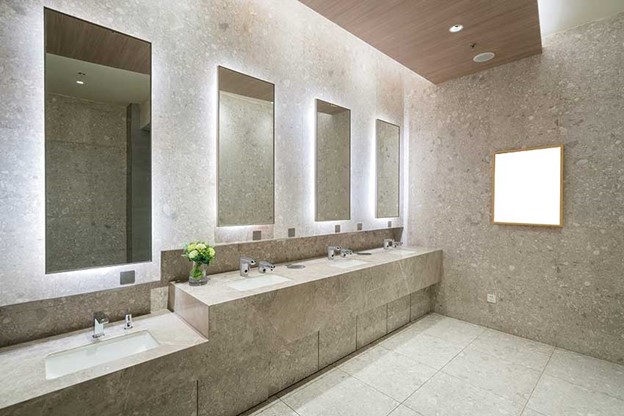
A high-performing restroom design blends accessibility, simplicity, and durability. Well-planned layouts that minimize touchpoints, allow for easy cleaning, and promote efficient user flow can dramatically reduce maintenance needs. A space that looks clean and operates smoothly reinforces user confidence while extending the life of the building’s plumbing infrastructure.
4. How have touchless and sensor-enabled fixtures changed restroom maintenance and user expectations over the last few years?

Touchless technology has become an expected standard. Modern sensor-enabled fittings reduce cross-contamination risks, support public health goals, and simplify cleaning protocols. For facility teams, reliable touchless systems mean fewer service calls and more predictable performance—an essential advantage in high-traffic environments.
5. Beyond hygiene, what operational or cost benefits can sensor-enabled systems offer?
Sensor-based fittings do more than improve hygiene; they create measurable operational value. Some systems now collect usage data, allow for changes in user settings, and enable remote flushing. These capabilities help facility teams detect issues early, conserve water, and optimize maintenance schedules—reducing both downtime and resource costs over time.
6. What trends are you seeing in terms of technology adoption — for example, data monitoring, predictive maintenance, or IoT integrations?
The industry is increasingly moving toward smarter, connected restrooms. Facilities are adopting fittings that pair with digital tools or building management systems to deliver actionable data. Predictive maintenance—powered by usage analytics—is shifting from aspiration to standard practice, helping teams anticipate service needs before disruptions occur. This results in fewer emergency calls and efficient use of staff resources.
7. How can integrating this technology into overall building management systems have a big impact?
Integrating restroom data into building management systems transforms facility operations from reactive to strategic. Facilities gain real-time visibility into water consumption, maintenance patterns, and hygiene performance alongside HVAC, lighting, fire, and security data enabling truly smart building management. This unified view delivers measurable impact: facility teams can reduce water and energy costs, eliminate costly emergency service calls through early fault detection, and generate automated compliance reports that previously required manual audits. More importantly, when restroom performance data sits alongside other building systems, facility managers can optimize resource allocation across the entire building.
8. What are some best practices for facility managers looking to improve or modernize their restroom maintenance programs?
Start with a comprehensive assessment to identify your highest-impact opportunities—whether that is reducing water waste, minimizing service calls, or addressing occupant complaints. Prioritize high-traffic restrooms where improvements will be most visible and measurable.
When selecting technology, look beyond initial cost to total cost of ownership: choose fittings and sensors with proven durability, readily available parts, and straightforward servicing requirements. Touchless technology can significantly improve hygiene and reduce maintenance, but only if it is properly specified for your needs.
Engage your maintenance team early in the process—they will be living with these decisions daily and often have valuable insights about what works, and what does not. Provide training on new systems, including troubleshooting and routine maintenance protocols.
Finally, establish regular performance reviews that go beyond reactive maintenance. Use data from connected systems to optimize cleaning schedules, predict component replacement, and continuously improve operations.
9. Where do you see restroom maintenance and fixture design headed in the next 5–10 years?

The next decade will bring broader use of connected technologies and sustainable materials. Expect fittings to include self-monitoring functions, adaptive water controls, and flushing systems that maintain hygiene automatically. These advancements will make restrooms more energy-efficient, safer, and easier to manage—essential traits for future-ready facilities.
10. Are there any innovations or approaches you believe will have the biggest long-term impact on facility operations and user satisfaction?
Automation and self-sustaining power systems are poised to have the greatest impact. Fittings that minimize manual intervention and power themselves through water generated power are reducing both environmental impact and maintenance labor. Combined with durable construction and advanced safety features, these innovations deliver consistent performance while supporting sustainability goals.
11. What advice would you give facility leaders who want to elevate their restroom standards but don’t know where to start?
Start by defining what "elevated standards" means for your organization. Are you primarily addressing occupant complaints? Reducing maintenance costs? Meeting sustainability targets? Improving hygiene? Your specific drivers will shape your approach and help you measure success.
Before spending money on upgrades, invest time in understanding your facility. Gather data: How many service calls do your restrooms generate monthly? What are your water and supply costs per building? What do occupants complain about? This will help you identify high-impact opportunities and justify investments to leadership.
Engage your stakeholders early—particularly your maintenance team and cleaning staff. They have invaluable insights about what fails most often, what is difficult to service, and where occupants struggle. Their buy-in is also critical for successful implementation.
Start small with a pilot program in one or two high-visibility, high-traffic locations. This allows you to assess solutions, work out the kinks, and build a business case with real data before rolling out and document everything: costs, time savings, user feedback, and maintenance metrics.
When evaluating solutions, look beyond the fitting itself: installation requirements, compatibility with existing fixtures, spare parts availability, and service network. The cheapest upfront option often becomes more expensive long-term when it requires specialized service or frequent replacement.
Finally, think in systems rather than products. A truly elevated restroom program integrates fittings, monitoring technology, maintenance protocols, and staff training. Piecemeal upgrades rarely deliver transformative results.
12. Anything else?
Restrooms may represent a small fraction of building square footage, but their impact on occupant experience, operational costs, and environmental footprint is disproportionately large. The gap between outdated, reactive maintenance and modern, data-informed management is not just about technology—it is about recognizing that these spaces fundamentally shape how people experience your facilities every single day.
Positive note, you do not need to transform everything overnight. Start with the basics —reliable fittings, clear maintenance protocols, and better visibility into what is happening in these spaces. As you learn more about your needs, you can layer in more sophisticated monitoring, automation, and optimization.
The facilities that will lead in the next decade will not necessarily be those with the most advanced technology. They will be the ones that view restroom management as a discipline where decisions are driven by data, investments are measured, and continuous improvement is their culture.

Greg Hunt, Commercial Product Manager, Chicago Faucets
See all of our Commercial Faucets.