

Stadiums Water Management Statistics: USA 2026
Stadiums Water Management Statistics: USA 2026
Water management is becoming a defining challenge for stadium operations across the US. As venues face growing pressure to reduce waste, control costs, and maintain peak performance on event days, commercial faucets are playing a far bigger role than ever before in shaping efficiency and reliability behind the scenes.
To find out what 214,584 opinions of stadium facilities managers in the US were about water management, we utilized AI-driven audience profiling to synthesize insights from online discussions over 12 months, ending on June 23rd, 2026, to a high statistical confidence level. The results show how stadium facilities managers are approaching water management, where their pain points are, and how attitudes are changing.
As stadiums prepare for larger crowds, stricter sustainability goals, and rising operational costs, water systems are becoming a critical part of overall facility performance. Today's commercial plumbing solutions go far beyond delivering water they help reduce consumption, improve hygiene, simplify maintenance, and provide greater operational visibility. From touchless faucets, centralized multi-feed soap dispensing systems, anti-stagnation showers, and bottle filling stations to connected water management systems, investing in modern plumbing technologies can help stadium operators create a better experience for fans while improving long-term efficiency and reliability.
Index
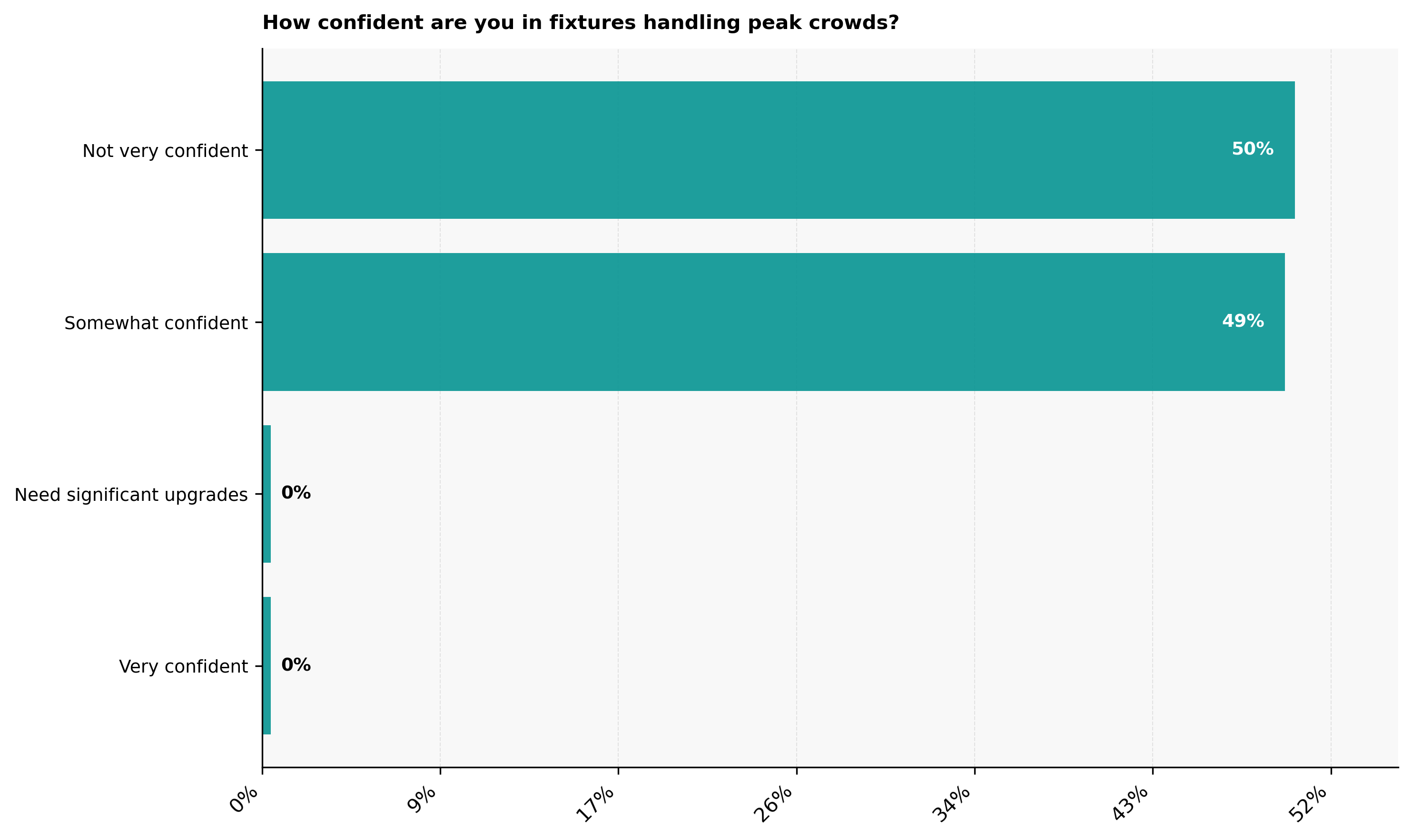
- 49% of stadium facilities managers are confident in their fittings being able to handle peak crowds, but 50% are not very confident they are up for the task
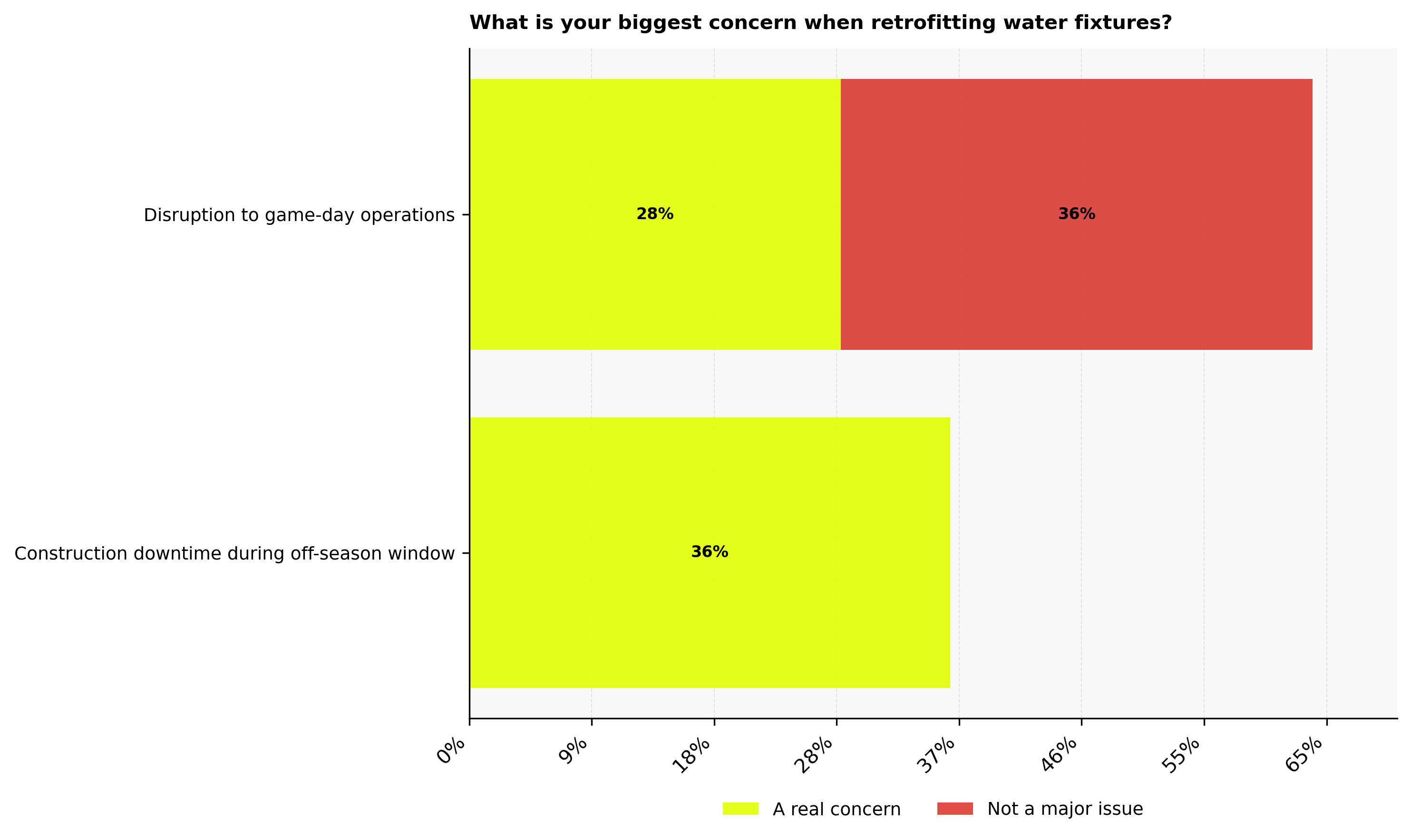
- Construction downtime during the off-season is a real concern for 36% of facilities managers when retrofitting water fittings, 28% feel the same about disruption to game-day operations, but 36% don’t see this as a major issue
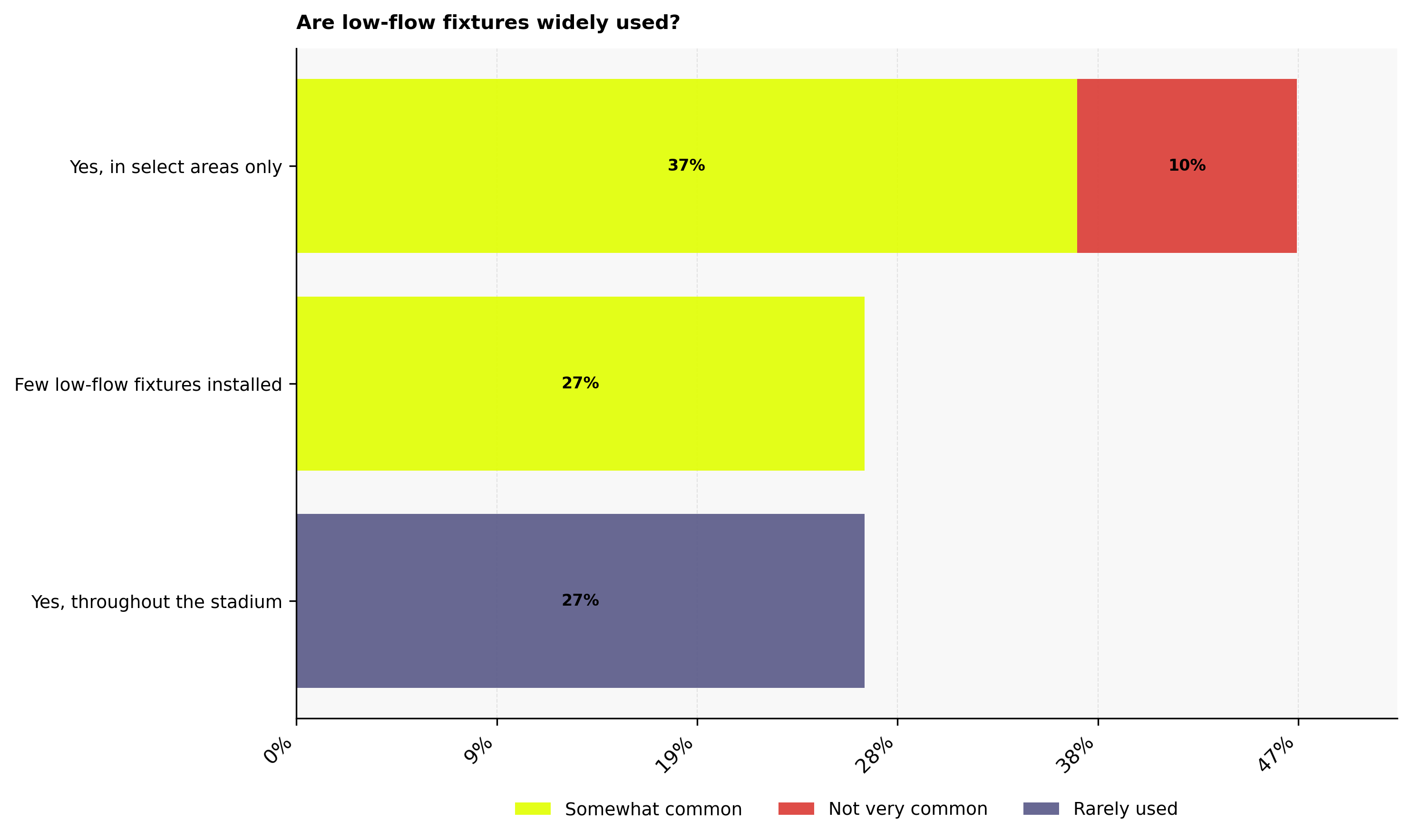
- 37% of stadium facilities managers commonly have low-flow fittings in select areas only, but for 10%, these fittings aren't very common, 27% somewhat commonly have few low-flow fittings installed, and 27% have low-flow fittings throughout the stadium, but they’re rarely used
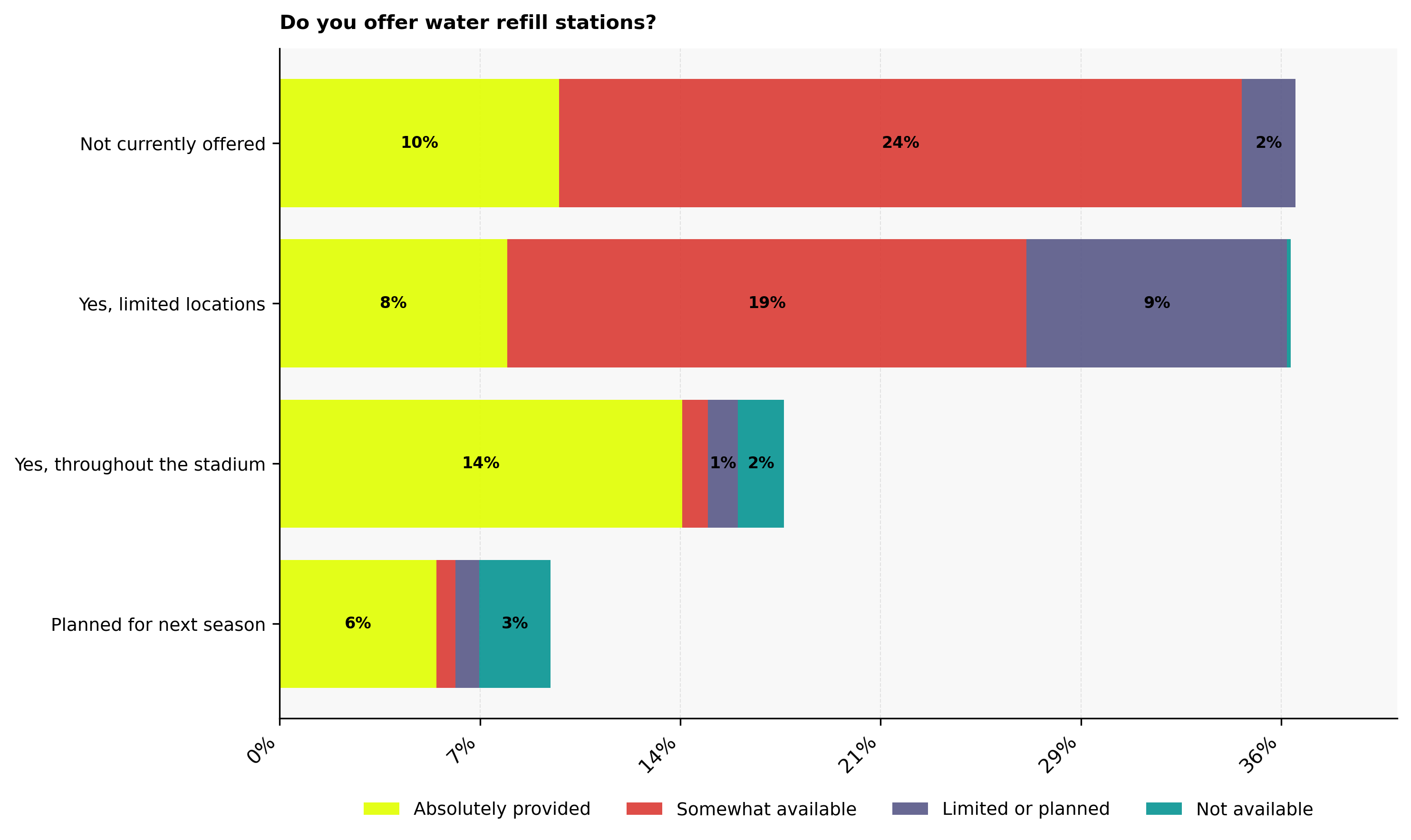
- 36% of stadium facilities managers don’t currently offer water refill stations at all, 10% absolutely do, and 24% have some available, while 2% have them in future plans or limited availability, 8% definitely provide these stations, and 9% have plans that are still in the works, and a further 19% have stations only somewhat available to fans
- 34% of stadium facilities managers have emergency shutoff valves that are not regularly tested, 26% have these valves in some areas only, or not really at all, and 14% are unsure of valve locations, while only 12% have valves that are fully mapped and tested, and 5% are not ready for these emergencies
- 12% of stadium facilities managers are considering using AI for leak detection, 12% have no plans for doing so, and 77% have fully implemented this technology
- 64% of stadium facilities managers don’t track restroom use digitally at all, 14% do so mostly manually, 2% have partially digitized this process, and 2% are fully digital, while 15% only do manual checks, 2% use mostly manual processes, and 1% rely fully on digitized methods with no manual input whatsoever
- For 17% of stadium facilities managers, between 26 and 50% of their restroom fittings are touchless or sensor-activated, and for 10%, less than half this number are, 17% have more than half of 51-75% fittings with this technology, but 5% have less than half this, and 5% have almost none that are touchless, while those with between 76-100% have 7% more than half touchless and 20% with fewer than half, and those with between 0 and 25% have more than half touchless for 10%, and another 10% less than half
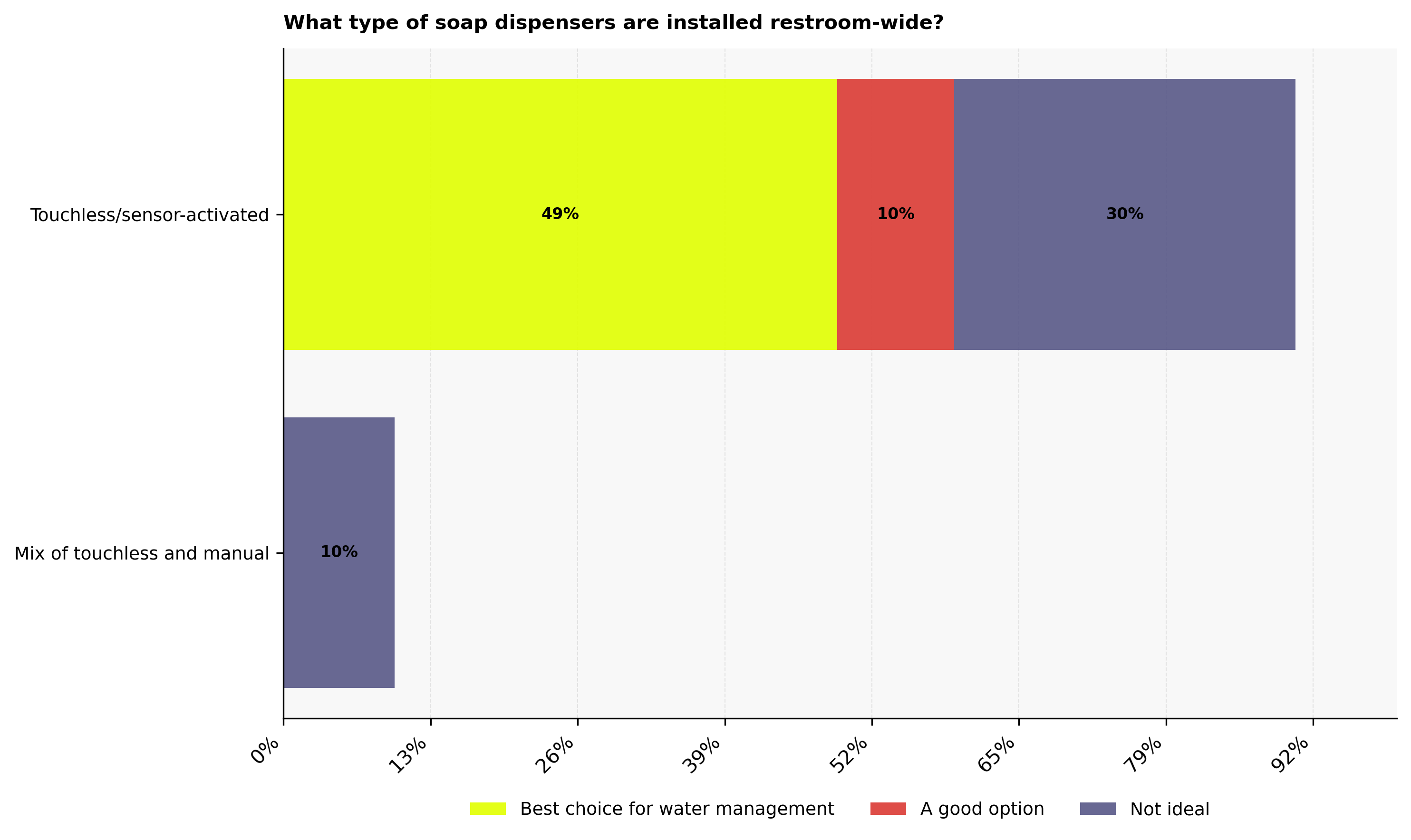
- Touchless or sensor-activated soap dispensers are the best choice for 49% of stadium facilities managers, and a good option for 10%, but not ideal for 30%, while a mix of touchless and manual dispensers is not ideal for the remaining 10% either
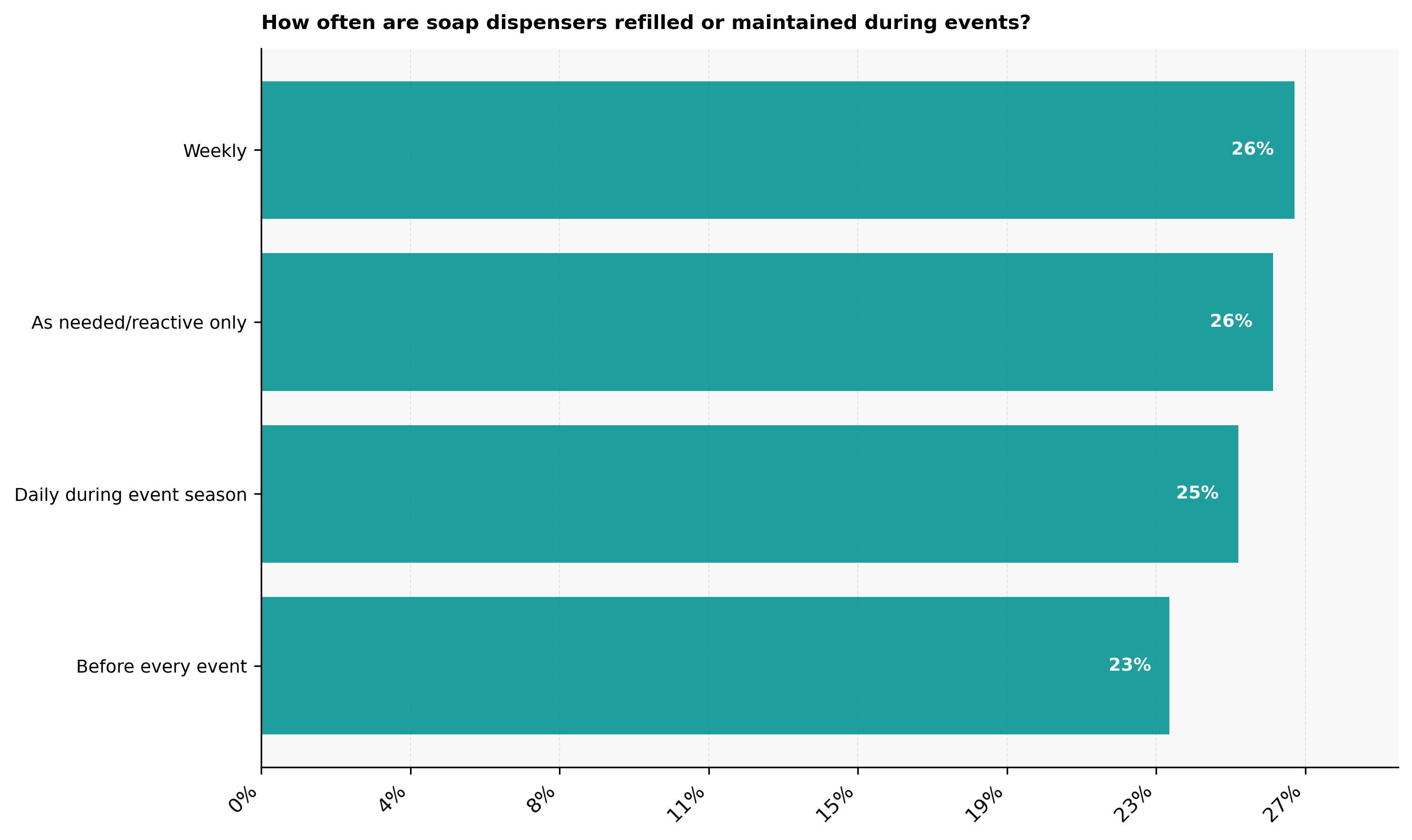
- 26% of stadium facilities managers refill or maintain soap dispensers weekly during events, 26% refill them as needed, or on a reactive basis, 25% do so every day during event season, and 23% refill or maintain dispensers before every event
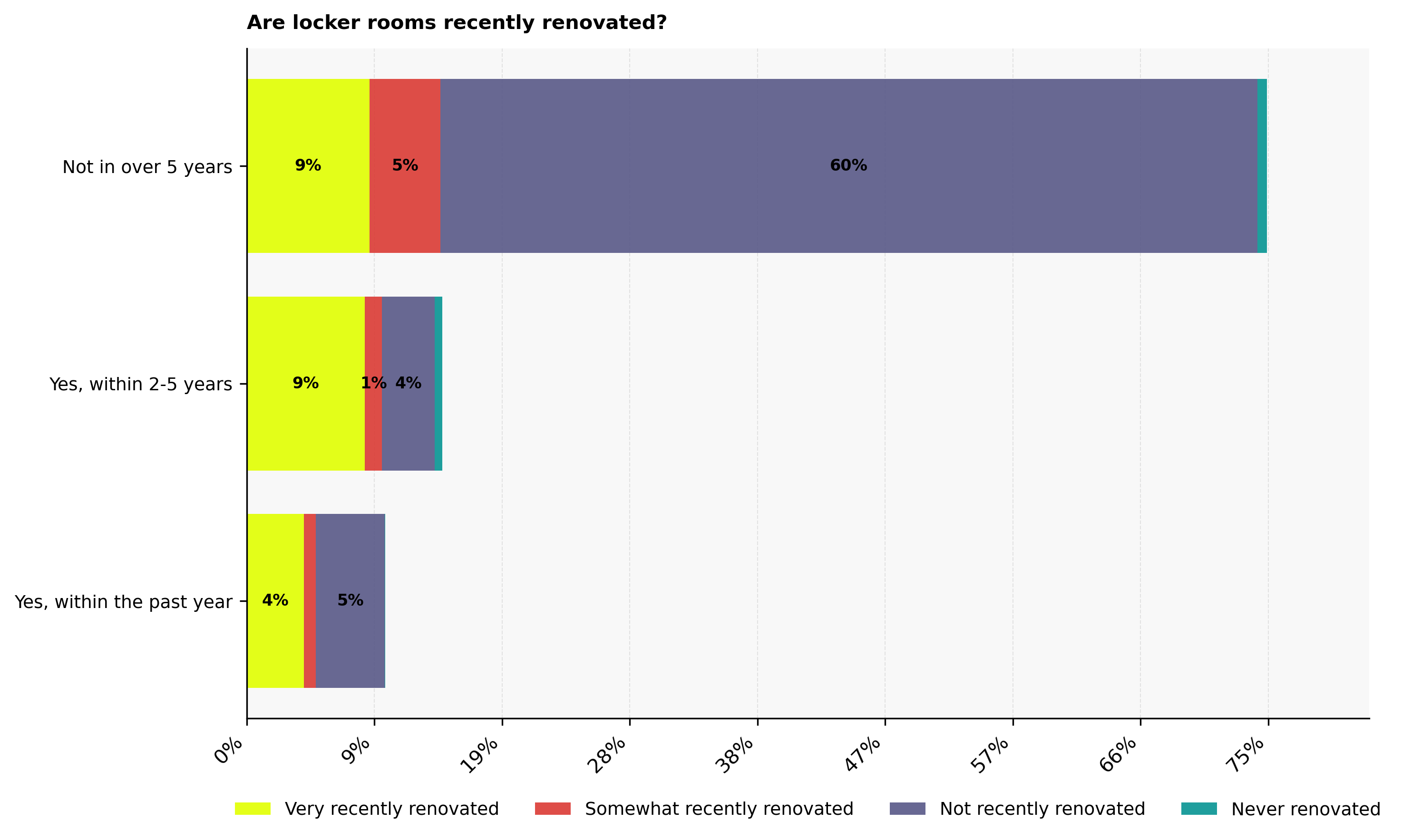
- 60% of stadium facilities managers’ locker rooms have not been renovated in the last 5 years; 5% were somewhat recently renovated during this period; 9% were renovated within the last 2 to 5 years; and 9% were renovated within the last 5 years. 1% somewhat recently in this period, and 4% not renovated at all during this time, while 4% were renovated in the last year, but 5% were not
- 76% of stadium facilities managers don’t prioritize touchless or sensor activation in soap dispensers; however, compatibility with foam, liquid, gel, or soap is an important factor for 14%, and 10%’s top priority is a large capacity refill reservoir
- 64% of stadium facilities managers rate the condition of their locker room shower systems as functional but aging, 34% as recently renovated and with a high efficiency, and 2% are in need of a full replacement
- 55% of stadium facilities managers' shower systems have been partially upgraded to use water-efficient or low-flow technology, and 45% are already fully low-flow
- 9% of stadium facilities managers’ kitchen or concession plumbing fittings are mostly outdated but still generally good, yet 28% are mostly outdated and have some problems, and 14% are outdated and very poor, in contrast, 2% are in excellent condition as they were recently upgraded to commercial-grade, 5% are generally good, although recently upgraded, 24% have some problems, and 17% although new are still very poor
- 61% of stadium facilities managers field irrigation is somewhat automated, and 4% is partially on the way to being completely automated, while 27% is mostly manual, 6% is fully automated, and 2% is not automated at all
- 23% of stadium facilities managers completely manage stormwater runoff onsite, and 12% mostly manage it onsite; however, 44% don't really manage it onsite, and it’s not managed onsite at all for 16%, the remaining 3% partially manage their stormwater runoff
- 50% of stadium facilities managers are currently under water restrictions, 12% are rarely affected but are currently impacted, and 38% have no restrictions at all and are rarely affected
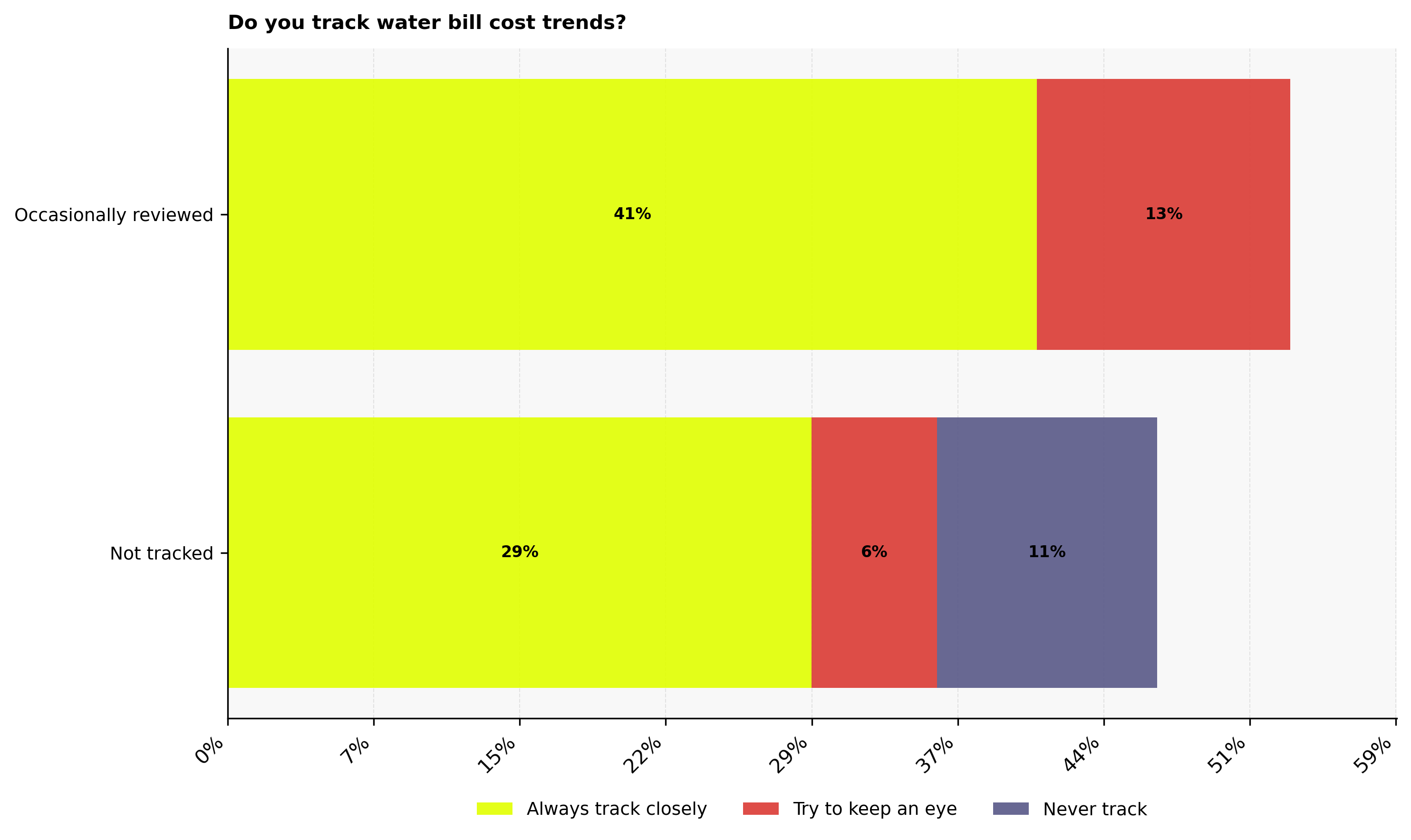
- 41% of stadium facilities managers always track water bill cost trends on an occasional basis, 13% try to keep an eye occasionally, and 29% always track these trends closely, but without formal processes, 6% don't track them, but try to keep tabs, and 11% never track trends whatsoever
- About the Data
How confident are stadium facilities managers in fittings handling peak crowds?
49% of stadium facilities managers are somewhat confident in their fittings being able to handle peak crowds, but 50% are not very confident they are up for the task
Confidence levels in fittings are not overly high:
Of the 435 stadiums across the United States, 395 can accommodate more than 10,000 spectators, and 172 can accommodate 30,000 or more. A further 97 stadiums have been built to accommodate at least 50,000 people.
Stadiums with capacities to host tens or hundreds of thousands of guests need water fittings strategically chosen to handle this demand. But just how confident are stadium facilities managers in the ability of their fittings to stand up to the needs of peak crowds?
Among our audience members, 50% did not feel very confident in their current infrastructure, and a further 49% were only somewhat confident that their fittings could handle peak pressure. None of our audience members noted that their infrastructure needed specific upgrades, nor did any give a full vote of confidence in their fittings’ capabilities.
High-attendance events place tremendous demands on restroom fittings. Commercial-grade touchless faucets designed for continuous use help improve reliability while reducing maintenance demands during peak traffic. For existing venues, retrofit faucet and shower options allow facilities to modernize performance without extensive plumbing renovations, making upgrades practical during short off-season construction windows.
What are stadium facilities managers' biggest concern when retrofitting water fittings?
Construction downtime during the off-season is a real concern for 36% of facilities managers when retrofitting water fittings, 28% feel the same about disruption to game-day operations, but 36% don’t see this as a major issue
Retrofitting concerns are not too major:
Stadium facilities managers are tasked with balancing a number of risks and concerns when retrofitting and upgrading their water infrastructure. They need to consider everything from disruptions to event calendars to regulatory compliance, and the integration of new fittings into their stadiums’ existing building management systems.
Our audience provided clear insights into which of these concerns are the most pressing for facilities managers in the US. A total of 64% cited disruptions to game-day operations as their leading concern, with 36% noting that this isn’t a serious issue for them, and 28% viewing it as a very real concern. This is definitely understandable, given the impact that stadium upgrades can have on spectators’ experiences.
Second on the list was construction downtime during off-season windows. 36% of our audience identified this downtime as their primary concern, with all responses considering it a noteworthy concern during retrofitting activities.
With limited off-season construction schedules, renovation speed is just as important as product performance. Retrofit plumbing solutions designed to work with existing rough-ins can significantly reduce installation time while minimizing disruption to facility operations. Selecting products that simplify replacement without sacrificing durability allows stadiums to modernize aging restrooms and locker rooms within tight project schedules.
Are low-flow fittings widely used at stadium facilities managers' venues?
37% of stadium facilities managers commonly have low-flow fittings in select areas only, but for 10%, these fittings aren't very common, 27% somewhat commonly have few low-flow fittings installed, and 27% have low-flow fittings throughout the stadium, but they’re rarely used
Low-flow fittings are used to varying degrees:
According to Pitches in Peril, eight of the eleven US FIFA World Cup host venues are facing water stress severe enough to pose risks of disruption to sporting events. Additionally, by 2050, nearly a third of the stadiums slated to host 2026 Men’s World Cup events will face demand for water that equals or surpasses the available supply.
Low-flow water fittings are among the most effective tools for drastically reducing stadium water waste. However, based on our audience’s opinions, they have not been widely adopted just yet. 47% of stadium facilities managers’ stadiums have low-flow fittings installed, but only in select areas. Of this group, 37% say that this type of fitting is somewhat commonplace at their venues, and 10% note that they aren’t very common yet.
A further 27% have only a few low-flow fittings installed at their stadiums, and all responses indicate that these fittings are somewhat common to see. Only 27% have low-flow fittings fitted throughout their stadiums, with all of these managers saying that their current fittings are seldom used at present.
Water conservation has become a strategic priority for stadium operators. Today's low-flow commercial faucets deliver significant water savings while maintaining the performance expected during high-traffic events. Chicago Faucets offers a complete portfolio of low-flow touchless, metering, and manual faucets engineered to help facilities reduce water consumption, support sustainability initiatives, and meet evolving green building requirements without compromising user experience.
Overall, there is a positive trend towards low-flow technology adoption, but there’s definitely room to improve the implementation of water-saving systems to combat the growing risk of water stress.
Do stadium facility managers offer water refill stations?
36% of stadium facilities managers don’t currently offer water refill stations at all, 10% absolutely do, and 24% have some available, while 2% have them in future plans or limited availability, 8% definitely provide these stations, and 9% have plans that are still in the works, and a further 19% have stations only somewhat available to fans
Water refill stations are not standardized:
While many stadiums are equipped with free water refill stations to ensure fans stay hydrated, the infrastructure is only useful when specific events’ security rules allow it. FIFA’s recent decision to ban fans from bringing their own refillable water bottles into venues due to safety concerns has highlighted a major variable for stadium facilities managers across the US.
This rule aside, 36% of stadium facilities managers state that their venues do not currently offer water refill stations at all; 10% noted that they were absolutely provided, 24% said they were only somewhat available, and 2% cited future plans or limited availability.
Of those who do have refill stations in limited locations, 8% were definitely provided, and 9% had plans that were still in the works. 19% reported that these stations were only somewhat available to fans, and fewer than 1% reported a total lack of availability.
Fewer water stations are still present or in the works
However, some facilities managers' stadiums do have water refill stations located throughout, with 14% describing widespread availability, 1% saying that their stations were still in the planning phase, and 2% noting that their stations were not currently available.
Less than 1% shared that while stations were installed throughout the stadiums, their availability to attendees is limited. Other managers and their facilities plan to install refill stations in time for the next season; 6% said these stations would be absolutely available, 3% that they would not be available, and less than 1% admitted to limited or low future availability.
Hydration stations have become an important amenity in modern stadiums, helping reduce single-use plastic waste while encouraging fans to refill reusable bottles. Bottle filling stations combined with touchless drinking fountains provide a hygienic, convenient solution that supports sustainability initiatives while enhancing the overall guest experience throughout the venue.
Do stadium facilities managers have emergency shutoff valves?
34% of stadium facilities managers have emergency shutoff valves that are not regularly tested, 26% have these valves in some areas only, or not really at all, and 14% are unsure of valve locations, while only 12% have valves that are fully mapped and tested, and 5% are not really ready for these emergencies
Emergency shutoff valves are not available across the board:
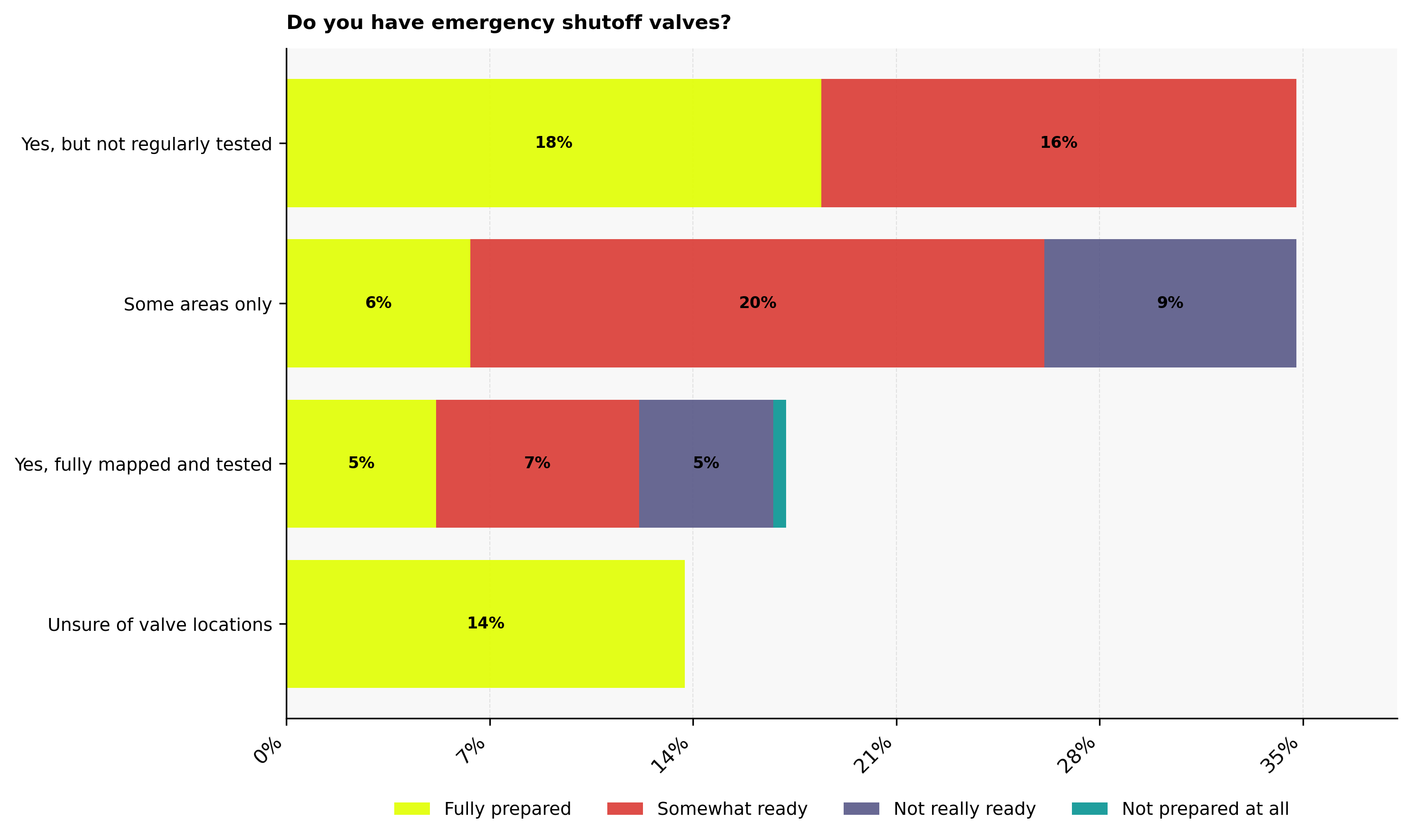
While emergency shutoff valves are essential to proper water system management, our audience’s opinions revealed diversity in their availability and condition. Just over 17% of stadium managers can confidently say that their stadiums’ emergency shutoff valves are fully mapped and thoroughly tested.
However, only 5% of valves are properly prepared, while 7% are only somewhat ready for water emergencies, 5% do not feel fully prepared, and under 1% are not prepared at all to stop leaks and other issues in their tracks.
Inconsistent emergency readiness despite installed safety systems
34% of our audience noted that although their facilities do have valves installed, they are not regularly tested, which could potentially cause issues at critical moments. 18% of this group feel fully prepared to handle emergencies despite a lack of testing, and 16% believe that they are somewhat ready to do the same.
A similar 35% admit they have emergency shutoff valves only in some areas of their facilities, with 20% feeling only somewhat prepared to weather emergencies, 9% only marginally ready, and just 6% feeling confident in their preparedness.
The remainder of the stadium facilities managers in our audience (14%) are still unsure of the locations of their shutoff valves. Despite this, all of them described themselves as being fully prepared to handle compromised systems and get them back on track.
Do stadium facilities managers use AI for leak detection?
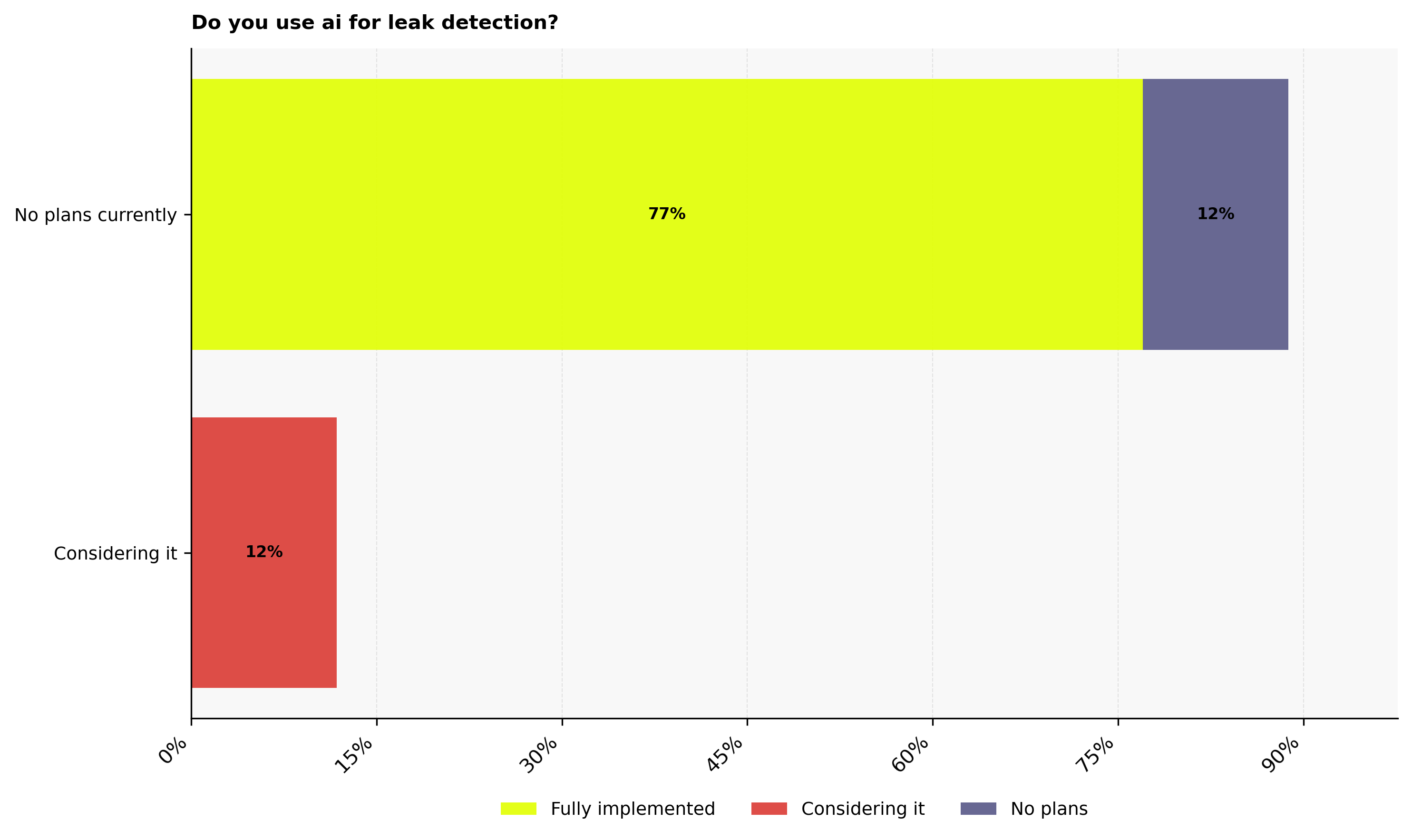
12% of stadium facilities managers are considering using AI for leak detection, 12% have no plans for doing so, and 77% have fully implemented this technology
AI leak detection on the rise:
AI is fast becoming a critical tool across industries and sectors worldwide, and the stadium management industry is no exception. In terms of water management specifically, AI-based acoustic leak detection tools have consistently shown promise in studies in pinpointing leaks and areas of damage.
A 2022 study published in the journal Results in Engineering finds that while the traditional acoustic listening method is highly effective at reducing system water losses, it is usually time-consuming and labor-intensive and can be imprecise, especially without proper staff training. The study found that AI-based water leak detection systems were more than 90% effective in this regard, producing results similar to those of experts in water system management.
It makes sense, then, that among our audience, many stadium facilities managers are already using AI to streamline their water management processes. 77% have already fully implemented AI for leak detection at their venues, and a further 12% are considering doing so in the near future.
The minority (12%) has no plans to implement artificial intelligence just yet.
Overall, stadium managers seem to be leaning into the power of AI to keep their water systems well-maintained while reducing strain on their human workforces.
Is restroom usage tracked digitally at stadium facilities managers' venues?
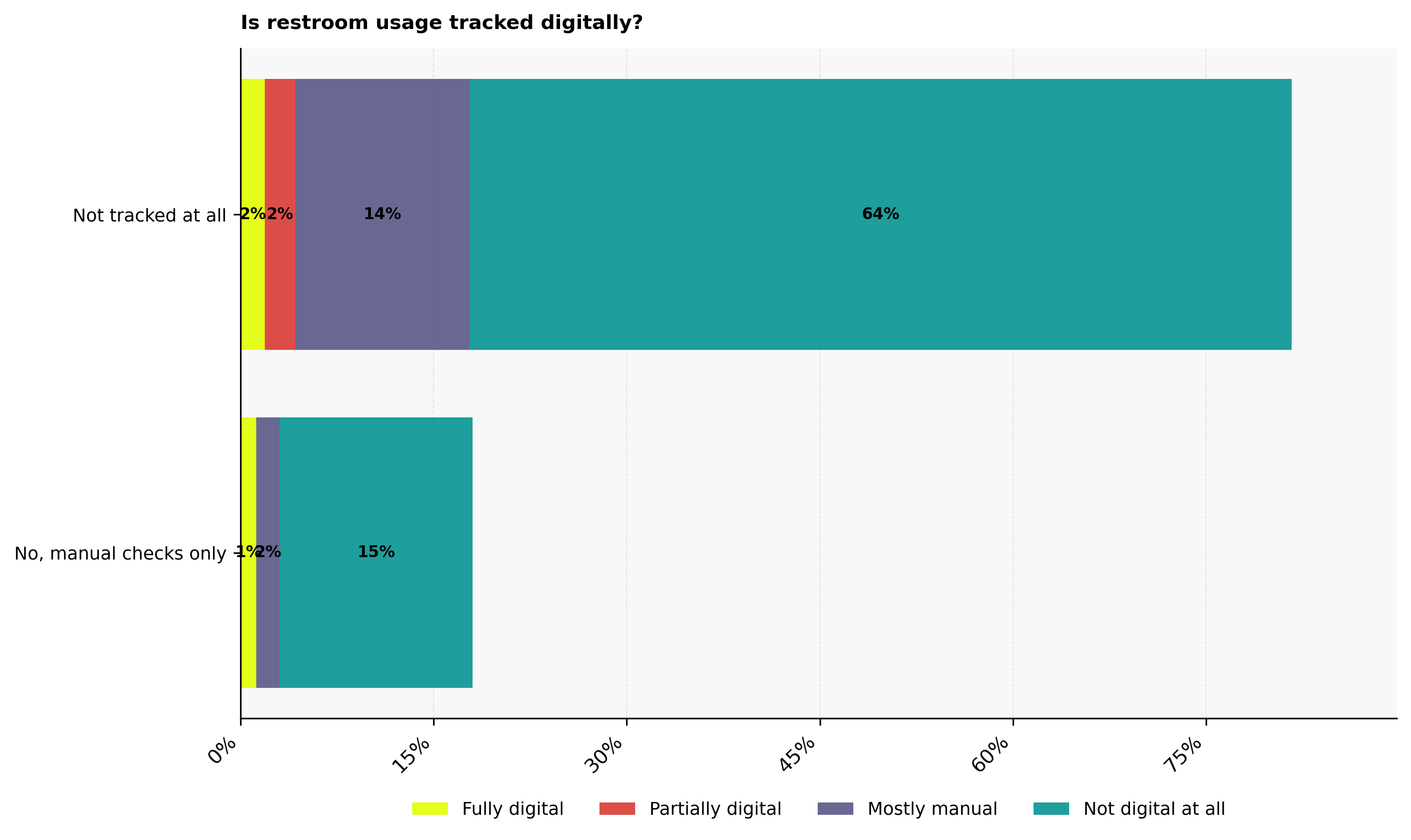
64% of stadium facilities managers don’t track restroom use digitally at all, 14% do so mostly manually, 2% have partially digitized this process, and 2% are fully digital, while 15% only do manual checks, 2% use mostly manual processes, and 1% rely fully on digitized methods with no manual input whatsoever
Restroom usage tracking methods vary:
Digital tracking and AI-powered algorithms are already being used to enhance spectators’ stadium experiences at US venues. The Ohio State University provides a notable example. In 2023, the university’s athletics department began developing a technological tracking system to manage crowds during events, while also allowing visitors to use an app to find the shortest queues and avoid lengthy waits.
Aside from benefitting fans, systems like these also offer managerial advantages. For instance, they allow managers to schedule cleaning staff to resupply and clean the busiest restrooms more regularly, helping to create a consistently positive experience for spectators.
The Ohio State University athletics department’s app and similar examples have shown great potential to improve the in-stadium experience, but adoption of digital tracking systems remains slow. This is particularly true for restroom usage. Our audience almost unanimously agreed that they are not using any digital tracking methods. Just 2% noted that tracking was fully digital, and another 2% cited partly digital tracking methods, while 14% tracking efforts were predominantly manual. 64% shared that their tracking efforts were not digital at all, and that their restrooms were not tracked at venues.
Of the 18% who only perform manual checks, just 1% involved digital technologies in this process, and 2% carried out mostly manual processes. The majority - 15% - did not include any tech in their restroom checking efforts.
As more building systems become connected, water management is emerging as the next frontier in intelligent facility operations. CF Connect PLUS extends building intelligence to point-of-use plumbing by networking touchless faucets and temperature sensors through a centralized Gateway. Facility managers can automate hygiene flushing, monitor water temperatures, generate audit-ready documentation, and integrate water management data into their existing Building Automation System through BACnet/IP. The result is greater visibility, less manual maintenance, and a more proactive approach to managing stadium water systems.
What percentage of restroom fittings are touchless/sensor-activated at stadium facilities managers' venues?
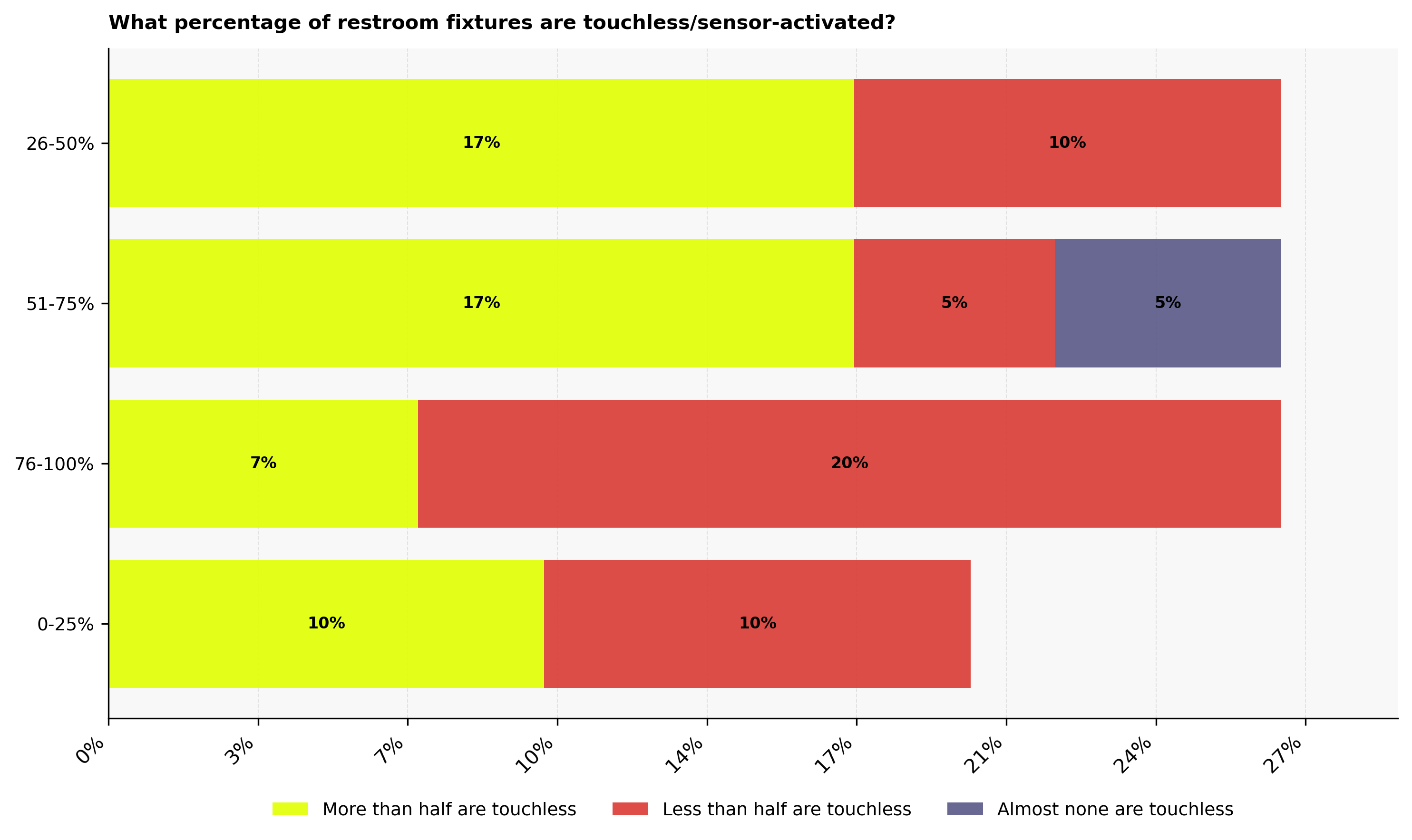
For 17% of stadium facilities managers, between 26 and 50% of their restroom fittings are touchless or sensor-activated, and for 10%, less than half this number are, 17% have more than half of 51-75% fittings with this technology, but 5% have less than half this, and 5% have almost none that are touchless, while those with between 76-100% have 7% more than half touchless and 20% with fewer than half, and those with between 0 and 25% have more than half touchless for 10%, and another 10% less than half
Touchless or sensor-activated restroom faucets are commonplace:
Data from the Bradley Company's 2026 Healthy Handwashing Survey shows that 68% of Americans say they would be more likely to return to businesses and venues whose restrooms are clean, fresh, and properly maintained. Additionally, almost 80% of Americans believe that touchless fittings are important features in public restrooms, and just as many respondents say these fittings actively improve their overall experience in a venue.
Understanding how restrooms are used is becoming increasingly valuable for stadium operations. Combining usage data with connected plumbing technologies allows facility managers to better plan maintenance, optimize staffing, and improve the fan experience. As digital building management continues to evolve, integrating water system data into facility operations provides another layer of actionable insight for smarter decision-making. Chicago Faucets CF Connect provides intelligent water management for faucets with Bluetooth® low energy technology, allowing them to be adjusted and controlled with a smartphone or tablet.
Facilities managers can select in the CF Connect app use-based, interval-based, or volume-based Hygiene flush mode to reduce water stagnation. Pipe flush mode is available for longer purges that support remediation efforts. Hygiene flush options include adjustable flushing duration, flushing volume, and the interval between flushes. In the app’s settings, operation and hygiene flush modes can be saved, named as a pre-set, and used to transfer settings to other faucets in a facility. Set the faucet's operating mode depending on location and usage: Normal Mode, Scrub Mode, Metering Mode, Water Saver Mode, Handwash Mode, Volume Mode, and Cleaning Mode.
The stadium managers in our audience may already be aware of these associations, as many of their venues are already fitted with touchless and sensor-activated water fittings, at least to some degree.
Touchless or sensor-activated statistics
27% of our audience reports that between 76% and 100% of their restroom fittings are currently touchless or sensor-activated, with 20% stating that fewer than half of their fittings fall into this category and 7% pegging this share at over half. Another 27% note that between 51% and 75% of their restroom fittings have touchless designs, 17% state that more than half of their stadiums’ fittings are touchless, less than half for 5%, and another 5% noted that very few of their fittings are sensor-operated or can be used without direct handling.
For a further 27% of our audience, between 26% and 50% of their restroom fittings are either sensor-activated or touchless, with this number constituting more than half of all fittings in 17% of managers’ stadiums and less than half in 10%.
Some had even lower figures to share. 10% said that while only 0% to 25% of their fittings are touchless, they constitute over half of their overall fittings, and another 10% in this category admitted that these modern fittings represented fewer than half of their facilities’ total.
Understanding how restrooms are used is becoming increasingly valuable for stadium operations. Combining usage data with connected plumbing technologies allows facility managers to better plan maintenance, optimize staffing, and improve the fan experience. As digital building management continues to evolve, integrating water system data into facility operations provides another layer of actionable insight for smarter decision-making.
What type of soap dispensers are installed restroom-wide at stadium facilities managers' venues?
Touchless or sensor-activated soap dispensers are the best choice for 49% of stadium facilities managers, and a good option for 10%, but not ideal for 30%, while a mix of touchless and manual dispensers is not ideal for the remaining 10% either
Soap dispenser preferences are clear:
Considering that the majority of Americans prefer touchless water fittings in stadium restrooms, it stands to reason that fans expect a hygienic, hands-free experience at every level. This preference for sensor-activated technologies has also directly affected how stadiums approach their hand hygiene systems.
Our data backs this trend up. According to our audience, the vast majority of stadium facilities managers have installed touchless, sensor-activated soap dispensers in all restrooms. 89% report having these systems in place, with 49% believing that touchless dispensers are the best choice for their water management workflows, and 10% considering them a solid option. Interestingly, 30% of this group notes that while they do have touchless dispensers installed at present, they don’t consider them an ideal solution for their water management efforts or their visitors’ needs.
A far smaller percentage (10%) of facilities managers' report having a mix of manual and touchless dispensers installed throughout their restrooms, with all of these audience members noting that these setups are less than ideal.
How often are soap dispensers refilled or maintained during events at stadium facilities managers' venues?
26% of stadium facilities managers refill or maintain soap dispensers weekly during events, 26% refill them as needed, or on a reactive basis, 25% do so every day during event season, and 23% refill or maintain dispensers before every event
Approaches to soap dispenser management fluctuate:
Bulk refillable soap dispensers may be convenient for venues, but studies have shown that they can be prone to bacterial contamination, especially extrinsic contamination during refilling. New research has found that around one in four soap dispensers in public restrooms are contaminated with bacteria, posing a public health hazard by spreading germs among users.
26% of stadium facilities managers report maintaining and refilling soap dispensers weekly, and 25% do so daily during busy event seasons. 23% report performing maintenance before every upcoming event, and 26% only refill and maintain their dispensers as needed; a practice which could increase the odds of bacterial contamination.
Frequent soap dispenser refills can consume significant maintenance time during large events. Centralized soap dispensing systems, like Chicago Faucets’ SoapBank™, a multi-feed soap dispensing system reduce refill frequency by supplying multiple dispensers from a single reservoir, helping maintenance teams spend less time servicing individual units while ensuring soap remains available during periods of peak demand.
Are locker rooms recently renovated at stadium facilities managers' venues?
60% of stadium facilities managers’ locker rooms have not been renovated in the last 5 years; 5% were somewhat recently renovated during this period; 9% were renovated within the last 2 to 5 years; and 9% were renovated within the last 5 years. 1% somewhat recently in this period, and 4% not renovated at all during this time, while 4% were renovated in the last year, but 5% were not
Locker room renovations are not all recent:
Locker rooms are an essential amenity at stadiums, especially for the players and athletes participating in their events. Looking at our audience’s responses, it seems that many facilities’ locker rooms may be due for an update.
More than 74% of locker rooms had not been renovated in over 5 years, with 60% of managers’ locker rooms having not been renovated recently, 5% renovated somewhat recently, and 9% reporting recent upgrades. Under 1% admitted that their locker rooms had never received renovations.
A little over 14% of lockers had received structural updates within the last 2 to 5 years. 9% had recent renovations; 1% had relatively recent renovations, and 4% reported that their locker rooms hadn’t been renovated recently. Again, just under 1% noted that their lockers had never been the subject of refurbishment plans.
The minority of stadium managers reported that their locker rooms have gotten a makeover within the past year. Of this group, renovations had been completed very recently for 4%, and fewer than 1% fell into the ‘somewhat recently renovated’ category. The remaining 5% renovations hadn’t occurred recently, pointing to a need for more regular renovations and updates to align with visitors’ expectations.
How do stadium facilities managers rate the condition of locker room shower systems?
64% of stadium facilities managers rate the condition of their locker room shower systems as functional but aging, 34% as recently renovated and with a high efficiency, and 2% are in need of a full replacement
Locker room showers could do with some attention:
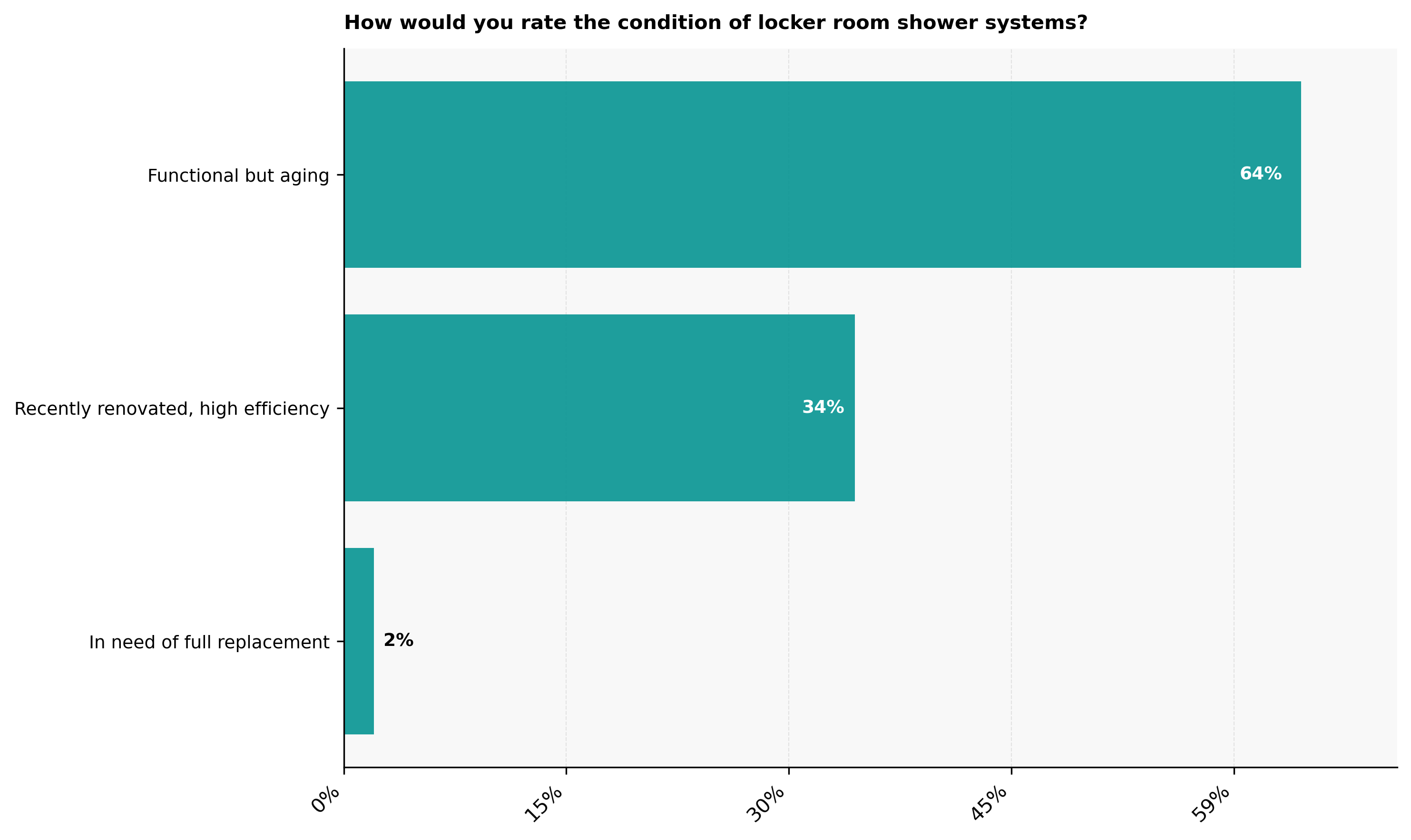
As noted above, many stadium locker rooms in the US have gone years without structural updates. In line with this, 64% of our audience members reported that their locker room shower systems are functional but aging and may soon need refurbishment. 2% felt that their locker room showers were in poor condition and needed to be completely replaced.
Just over a third (34%) of facilities’ locker room showers were highly efficient, thanks to recent renovations and replacements. It seems that shower fitting updates may need to be prioritized to optimize stadium water management efforts in the future.
Locker room shower systems often experience periods of intermittent use between events, creating unique water management challenges. Modern shower technologies, including automated draining (Auto-Drain® Shower System) and thermostatic temperature control, help improve water quality, reduce stagnation concerns, and enhance user safety while extending the life of plumbing systems. Retrofit solutions also allow facilities to upgrade existing showers without extensive renovations.
Do shower systems use water-efficient or low-flow technology at stadium facilities managers' venues?
5% of stadium facilities managers' shower systems have been partially upgraded to use water-efficient or low-flow technology, and 45% are already fully low-flow
Water efficiency is a priority in showers:
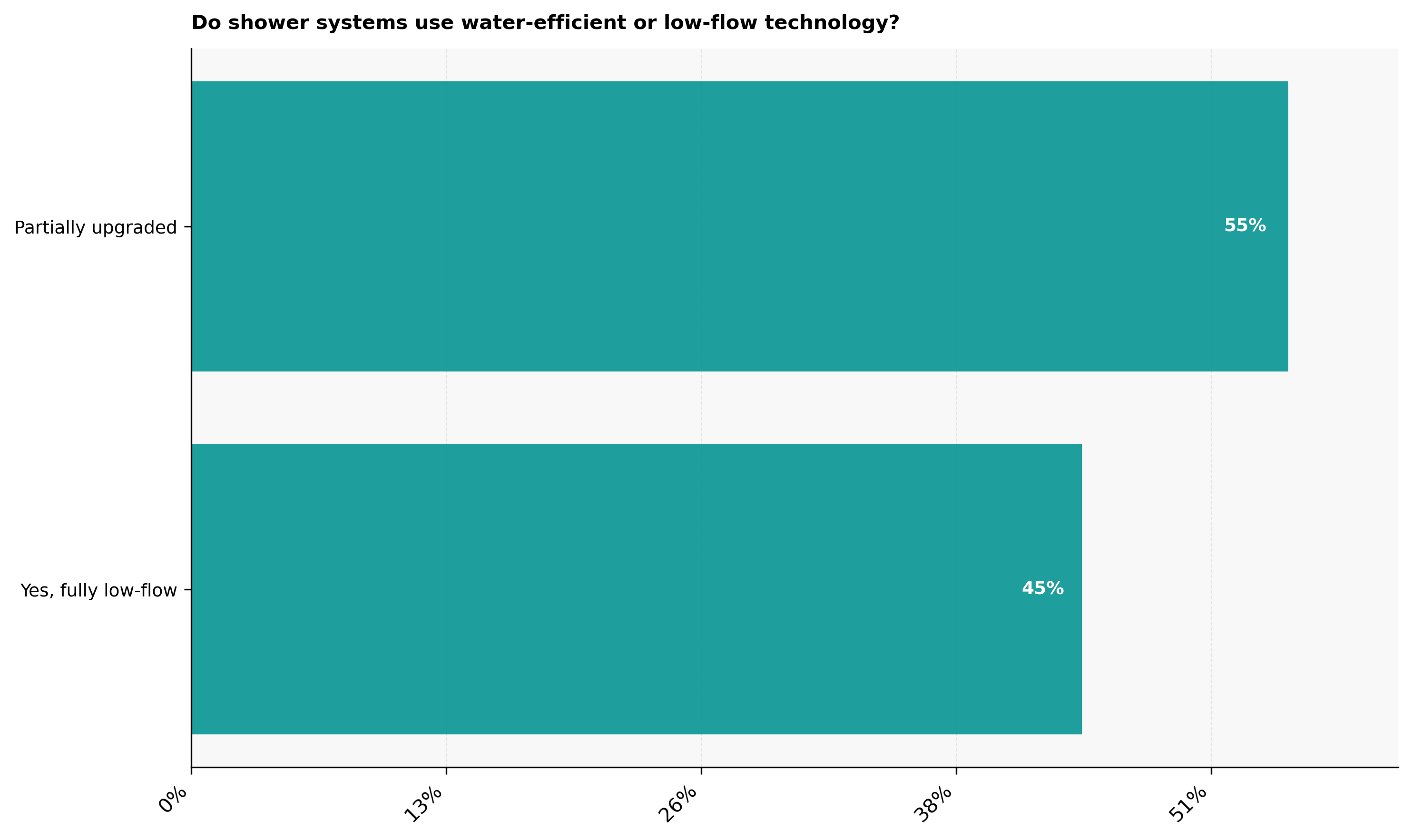
Shower use accounts for as much as 1.2 trillion gallons of water every year in the US alone, but simple solutions, such as installing low-flow showerheads, could allow the average family to save more than 2,000 gallons annually. Low-flow showerheads’ water-saving abilities extend to stadiums as well, and many stadium facilities managers have already made the switch to support their water management efforts.
45% of venues have already installed low-flow showerheads throughout all of their locker room showers. The remaining 55% of managers' showers have been partially upgraded to save water while still providing high-quality, efficient amenities.
What is the condition of kitchen/concession plumbing fittings at stadium facilities managers' venues?
9% of stadium facilities managers’ kitchen or concession plumbing fittings are mostly outdated but still generally good, yet 28% are mostly outdated and have some problems, and 14% are outdated and very poor, in contrast, 2% are in excellent condition as they were recently upgraded to commercial-grade, 5% are generally good, although recently upgraded, 24% have some problems, and 17% although new are still very poor
Even newly installed plumbing fittings need some work:
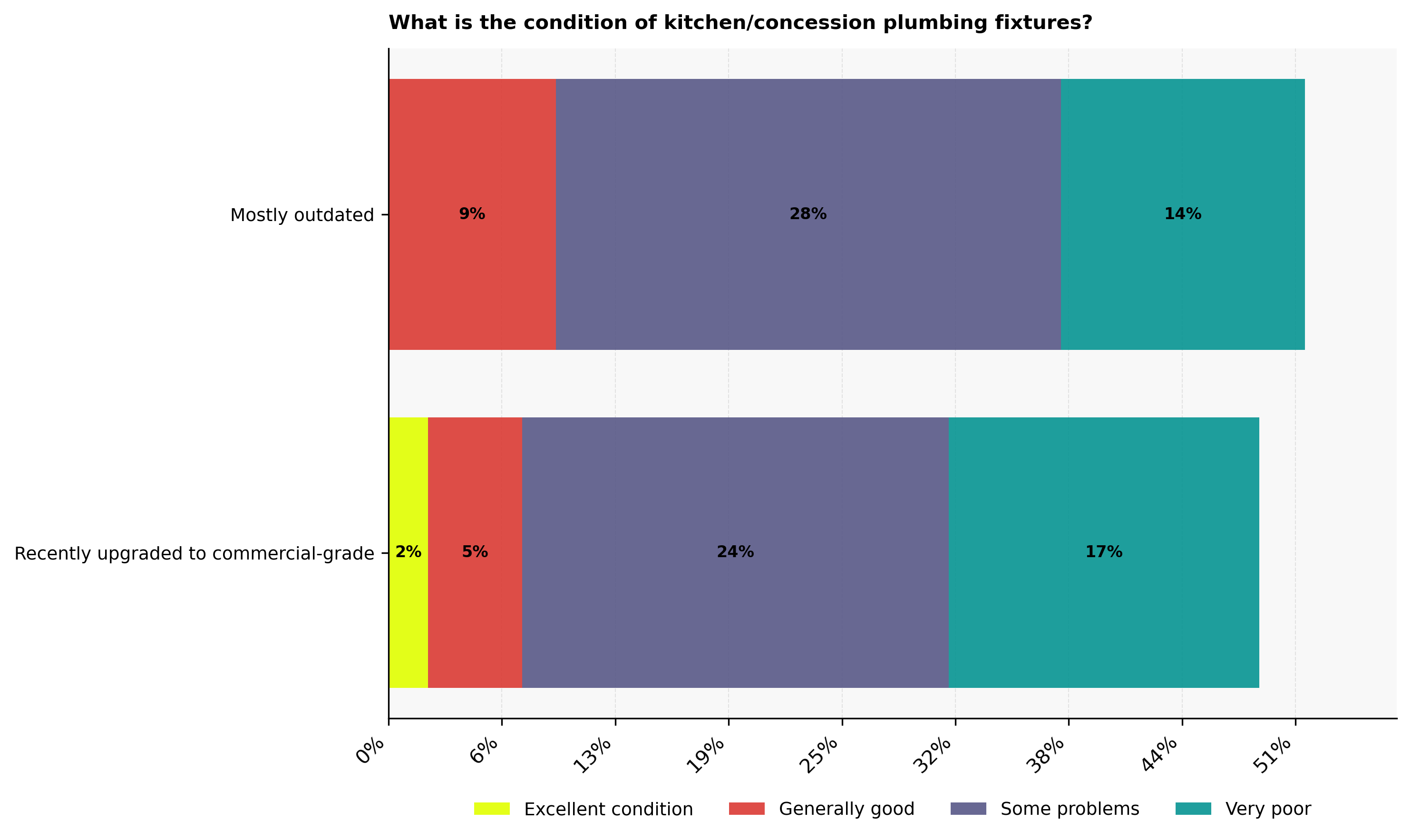
Water management at stadiums extends to kitchens and concession stands, which rely on extensive plumbing for sanitation and food preparation. The stadium facilities managers in our audience have mixed sentiments about the current state of their kitchen plumbing systems. 9% agree that while their systems are mostly outdated, they’re generally still in good condition, and 28% admit that their outdated plumbing is beginning to pose some challenges. A further 14% report that their plumbing is both mostly outdated and in very poor condition.
Of our audience members who recently upgraded their kitchen and concession plumbing to commercial-grade systems, just 2% report that their systems are in excellent condition, and 5% say they are generally functioning well. Despite the upgrades, 24% still state that their plumbing systems are giving them problems, and 17% confess to the condition of their fittings not being up to standard at all.
Is field irrigation automated at stadium facilities managers' venues?
61% of stadium facilities managers field irrigation is somewhat automated, and 4% is partially on the way to being completely automated, while 27% is mostly manual, 6% is fully automated, and 2% is not automated at all
Field irrigation automation is not the norm:
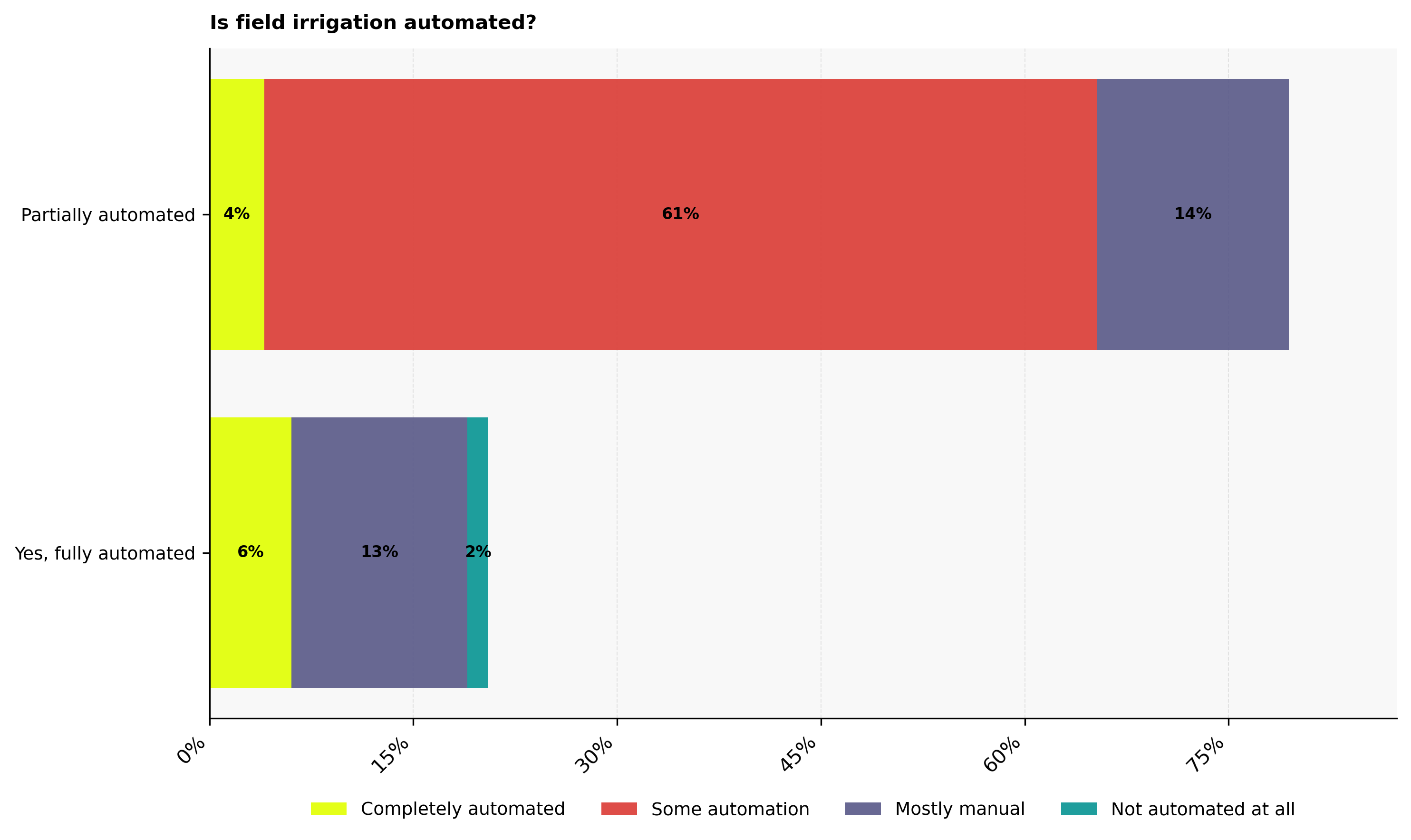
Smart irrigation controllers can drastically reduce water use by automating irrigation, ensuring it occurs only when absolutely necessary. Environmental agencies such as the EPA have found that automating field irrigation can reduce outdoor water consumption by up to 50%, improve irrigation efficiency, and provide significant savings on water bills.
Stadium facilities managers have already partially or fully automated their field irrigation to reduce waste and expenses. 79% have partially automated irrigation operations, with 4% noting that the automated portions of their irrigation efforts are completely automated, 61% have some automation in place, and 14% still rely mostly on manual irrigation for now.
The remainder have fully automated their irrigation practices. Within this group, 6% of managers’ efforts are entirely automated now, while 13% still use manual work to some degree. A mere 2% of discussions centered on not having any automation in place to keep their fields in prime condition.
Is stormwater runoff managed onsite at stadium facilities managers' venues?
23% of stadium facilities managers completely manage stormwater runoff onsite, and 12% mostly manage it onsite; however, 44% do not really manage it onsite, and it is not managed onsite at all for 16%, the remaining 3% partially manage their stormwater runoff
Stormwater runoff is managed onsite and off:
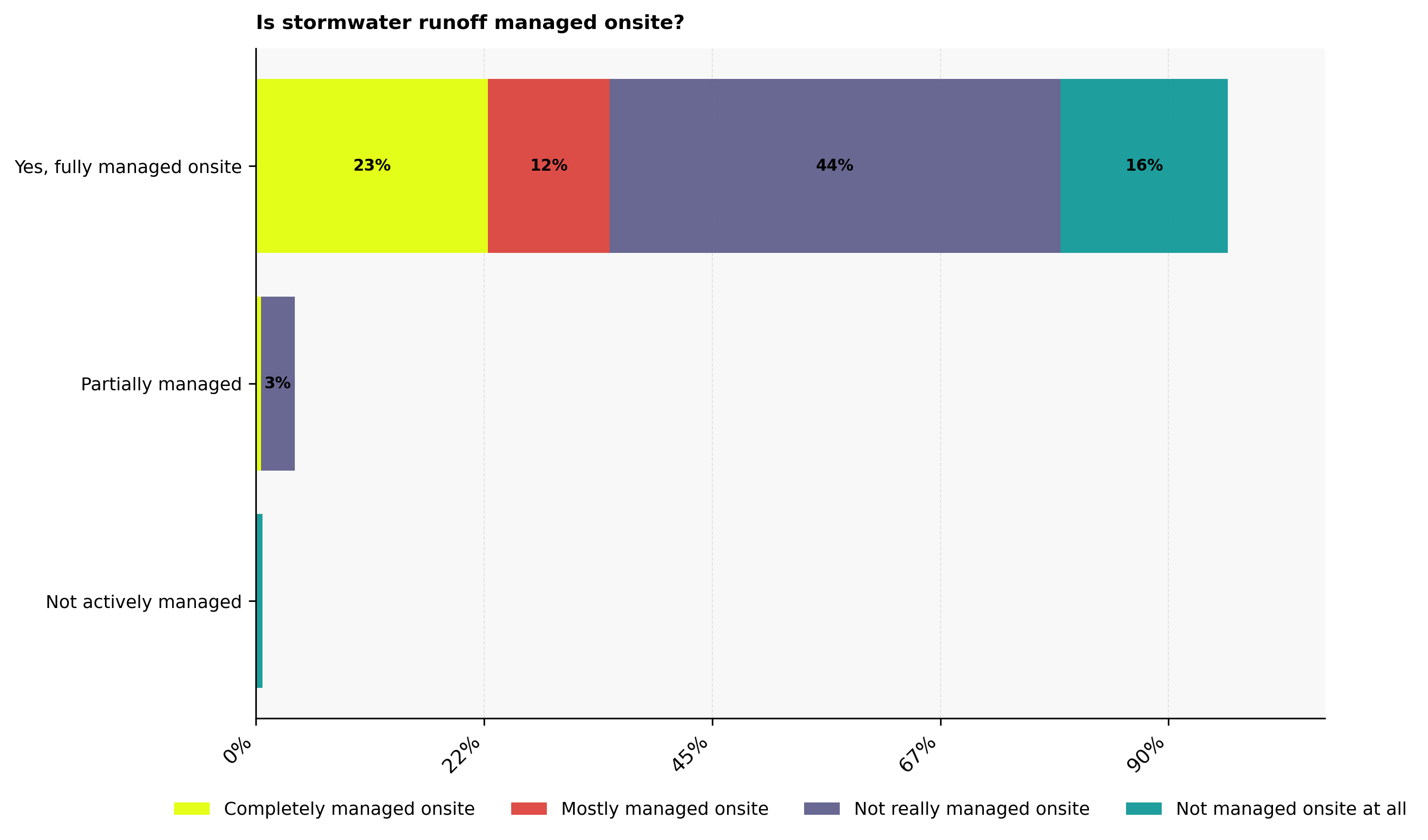
Stadiums like the Mercedes-Benz Stadium are leading the way in water management. In addition to achieving a 47% reduction in water usage, this stadium has been fitted with a 2.1 million-gallon stormwater management system that uses bioswales, cisterns, and a 1.1 million-gallon underground stormwater vault to collect runoff. The vault captures and releases water steadily, thereby preventing flooding not only at the stadium but also in its surrounding communities.
As for our audience’s venues, the majority are also actively managing onsite stormwater runoff. 23% manage runoff completely onsite, and 12% predominantly manage runoff at their locations. 44% of managers reported that their stormwater runoff is largely managed offsite, and 16% do not yet have any on-site management systems in place.
Some venues partially manage their stormwater runoff on site, with only a fraction stating that this management is completely conducted at the stadiums themselves. A further 3% say their runoff management is not really addressed onsite. As for those venues that do not actively manage their runoff, less than 1% state that their runoff is rarely managed onsite, or not at all.
Are stadium facilities managers under water restrictions?
50% of stadium facilities managers are currently under water restrictions, 12% are rarely affected but are currently impacted, and 38% have no restrictions at all and are rarely affected
Water restrictions are a common US problem:
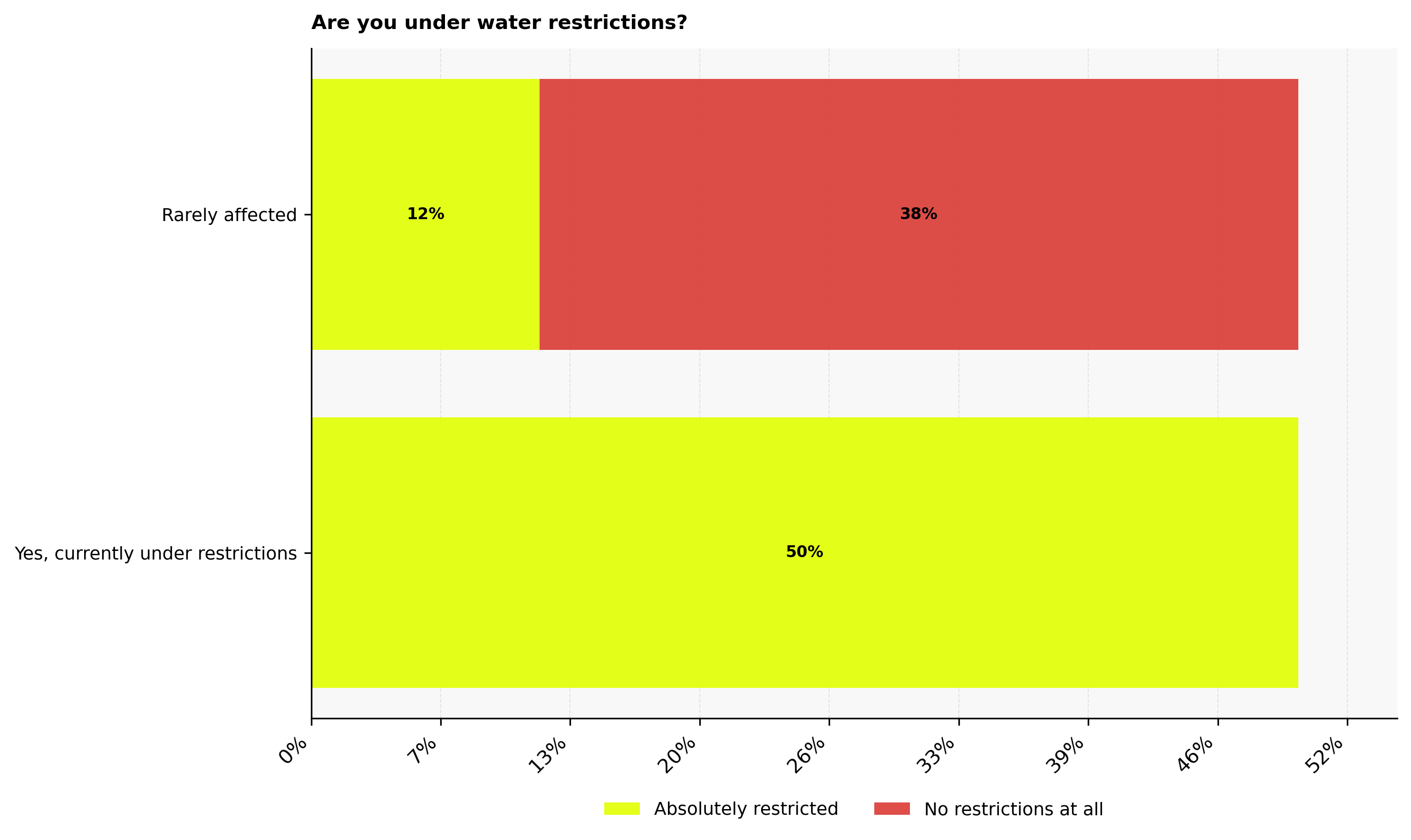
With 45 out of 50 US states experiencing drought in mid-2026, numerous cities and municipalities have enforced water restrictions to conserve this precious resource. As a result, many stadiums across the nation are currently under water restrictions. 50% of our audience reported that their stadiums are under active restrictions, reflecting that water usage is tightly restricted at present. Many faucet manufacturers have sustainable faucets. Chicago Faucets has one of the largest selections of EPA WaterSense faucets available and with many 0.35GPM and 0.50 GPM ultra-low flow metering and electronic faucets.
The remainder noted that they are rarely affected by restrictions; 12% 's water consumption is absolutely restricted when usage rules are in place, and 38%’s venues have not faced any restrictions in 2026.
Do stadium facilities managers track water bill cost trends?
41% of stadium facilities managers always track water bill cost trends on an occasional basis, 13% try to keep an eye occasionally, and 29% always track these trends closely, but without formal processes, 6% don't track them, but try to keep tabs, and 11% never track trends whatsoever
Water bill cost trend tracking is minimal:
Stadiums are in for persistent water scarcity for the rest of the year, with more than 132.1 million Americans currently affected by drought, which is expected to persist for months in many areas of the country. Drought and water scarcity have knock-on effects not only on water quality and demand but also on costs, as water bills rise to cover increased water treatment needs and other supply-related costs.
In the face of rising water bills, it’s becoming essential for stadium facilities managers to track expenses and implement water-saving fittings and technologies wherever feasible. However, 11% of stadium facilities managers confess to never tracking these expenses, 6% try to stay ahead of them, and 29% track their bills more diligently, although they still classify their cost trends as largely untracked.
A further 42% of managers occasionally review their water bill cost trends, but track them closely to sustain the profitability of their venues. The remaining 13% keep an eye on these trends where possible, but only review them every once in a while. To see how you can reduce water consumption and savings on utility bills, run Chicago Faucets water savings calulator.
By adopting a more consistent approach to water bill cost tracking, stadium facilities managers may be able to identify areas of excess expenditure and wastage more effectively. With this knowledge, they can then implement proactive water management practices to conserve water, reduce costs, and provide world-class amenities that are truly aligned with the needs of our changing world.
Overall, these results reveal a broader shift toward smarter fittings, stronger oversight, and greater adoption of water-saving and digital technologies across stadium environments.
The findings in this report demonstrate that stadium water management is evolving from routine maintenance to a strategic component of facility operations. As venues prepare for larger crowds, increasing sustainability goals, and greater operational demands, connected technologies, water-efficient fittings, and intelligent plumbing systems will play an increasingly important role in improving reliability, reducing maintenance, and supporting long-term building performance.
Chicago Faucets continues to develop commercial plumbing solutions that help stadiums modernize their water systems, from touchless faucets and bottle filling stations to connected water management with CF Connect PLUS, centralized soap dispensing, and advanced shower technologies. Together, these innovations help facilities improve operational efficiency while creating safer, more sustainable environments for athletes, staff, and fans.
About the data
Sourced using Artios from an independent sample of 214,584 opinions of stadium facilities managers in the USA across X, Quora, Reddit, Bluesky, TikTok, and Threads. Responses are collected within a 95% confidence interval and 5% margin of error. Results are derived from what people describe online, from opinions expressed online, and not actual questions answered by people in the sample.
To see actual Chicago Faucets stadium, athletic fields and gymnasium water management case studies, click here. To meet with a water management specialist, click here.