

Airports Water Management Statistics: USA 2026
Airports Water Management Statistics: USA 2026
In 2008, America’s busiest airport, Georgia’s Hartsfield–Jackson Atlanta International Airport, embarked on a major water conservation initiative in response to a drought-related state of emergency. In 2017, the 104 million passengers who moved through its terminals used an incredible 436 million gallons of water. Drought conditions may have eased, but with climate change and a growing population, airports across the country need to do more to manage water. This means not only reducing consumption, but also using water more intelligently and gaining greater visibility into where and how it’s used across operations.
To understand the views of 28,370 facility managers and building specifiers on airport water management, we used AI-driven audience profiling to analyze insights from online discussions over 12 full months ending March 28, 2026. These insights reveal the current state of water usage, conservation initiatives, and challenges.
Index
Index
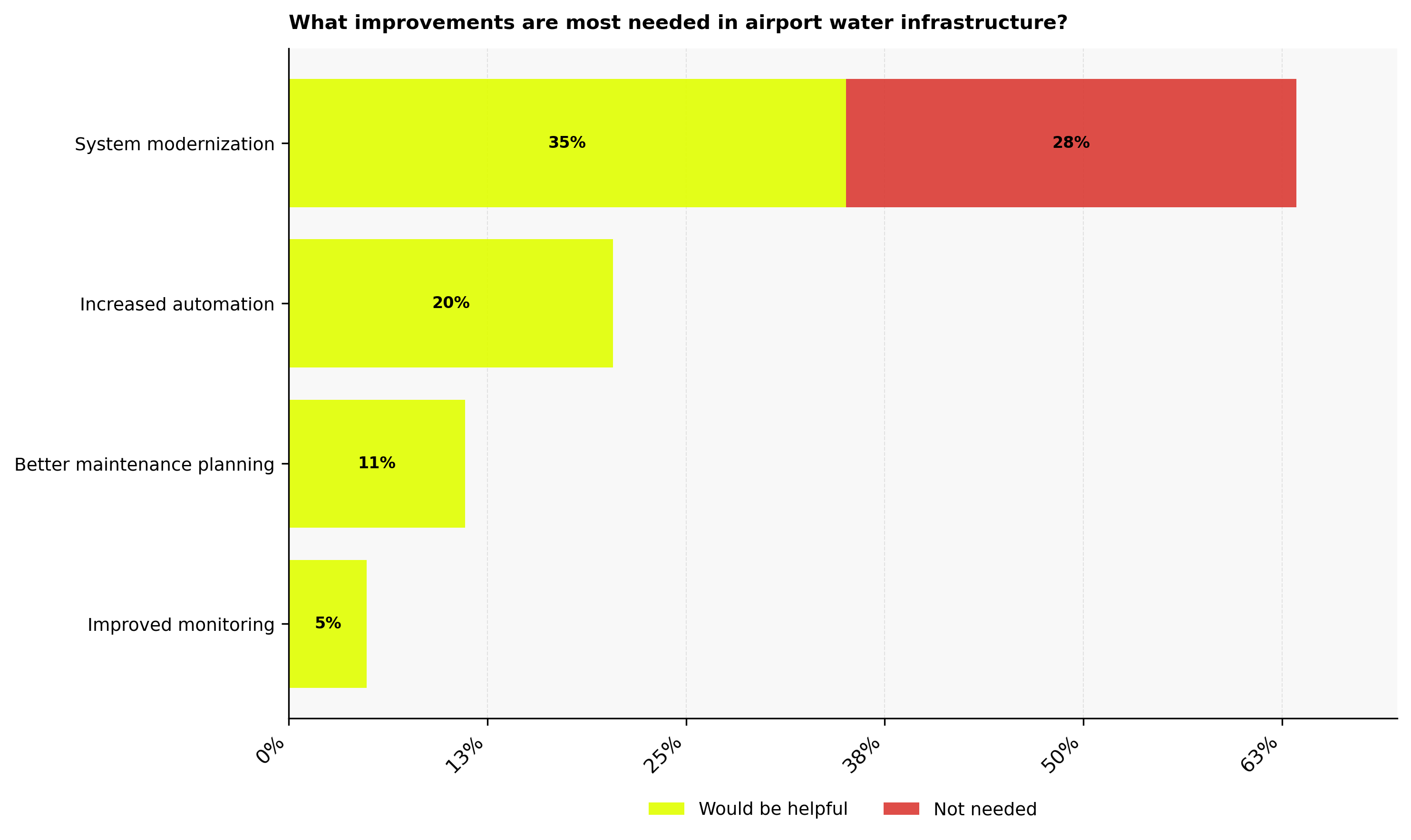
- 35% say system modernization is the most needed improvement
- 52% say complex layouts are the most common challenge
- 59% say system imbalances are the biggest pressure challenge
- 55% say cost is somewhat challenging for reuse systems
- 89% say cost pressures impact sustainability alignment
- 28% say resource allocation is challenging across terminals
- 100% say weather impacts water usage predictability
- 60% say peak travel doesn’t impact performance
- 95% say retail/food impacts water usage most
- 100% say outdoor areas need the most monitoring
- 74% say cooling systems are essential
- 100% say restroom usage drives water usage
- 100% say irrigation reuse is most common
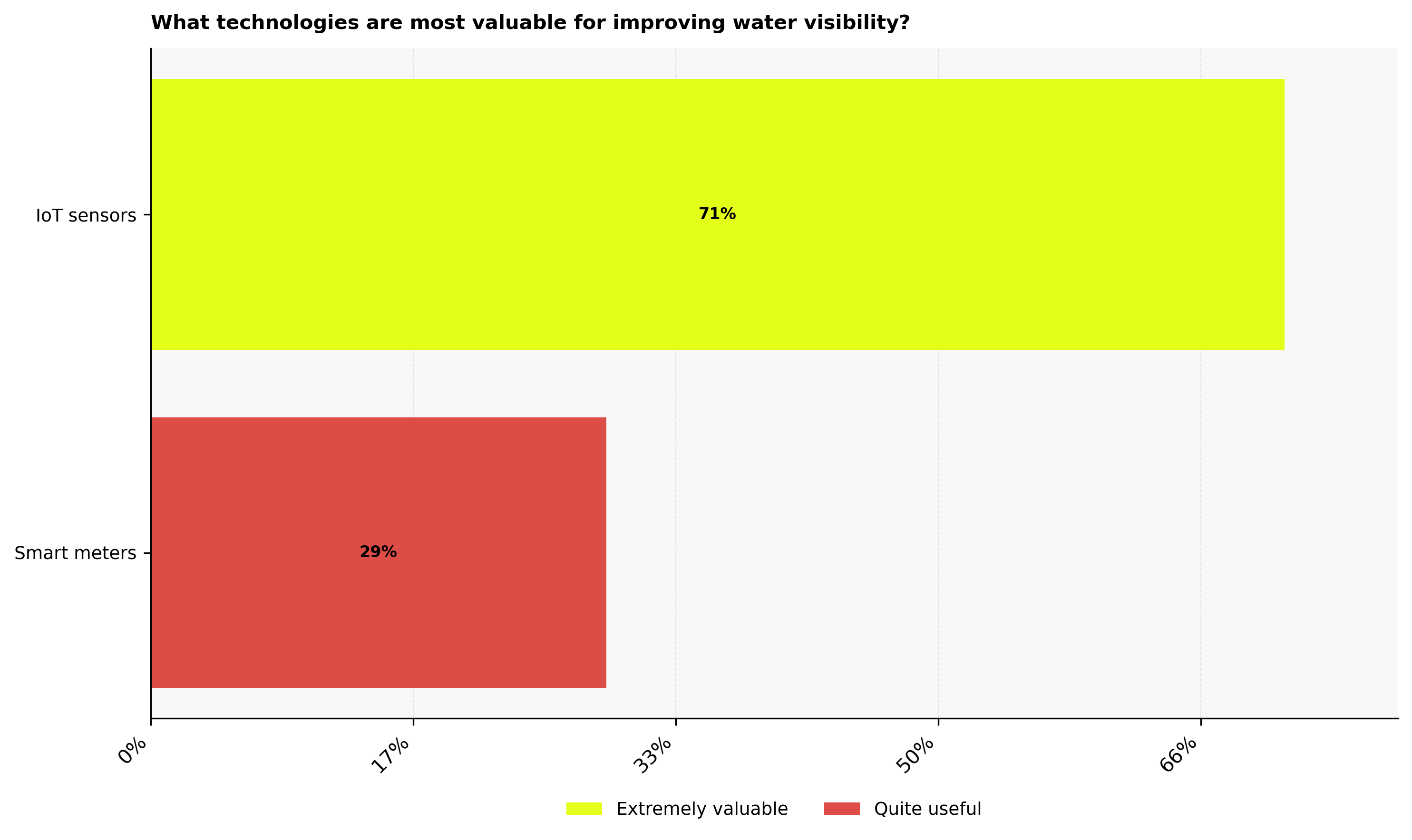
- 71% say IoT sensors improve visibility
- 100% say tech optimizes systems
- 47% say efficiency per passenger is key
- 86% say cost impacts efficiency balance
- 45% say contamination prevention isn’t most effective
- 39% say contamination is a major risk
- 90% of audience is based in Los Angeles
- A Shift Toward Smarter Water Management
- About the Data
What Improvements Do Facilities Managers Say are Most Needed in Airport Water Infrastructure?
35% of facilities managers or building specifiers say system modernization is the most needed improvement in airport water infrastructure
Several aspects of airport water infrastructure are in need of upgrading:
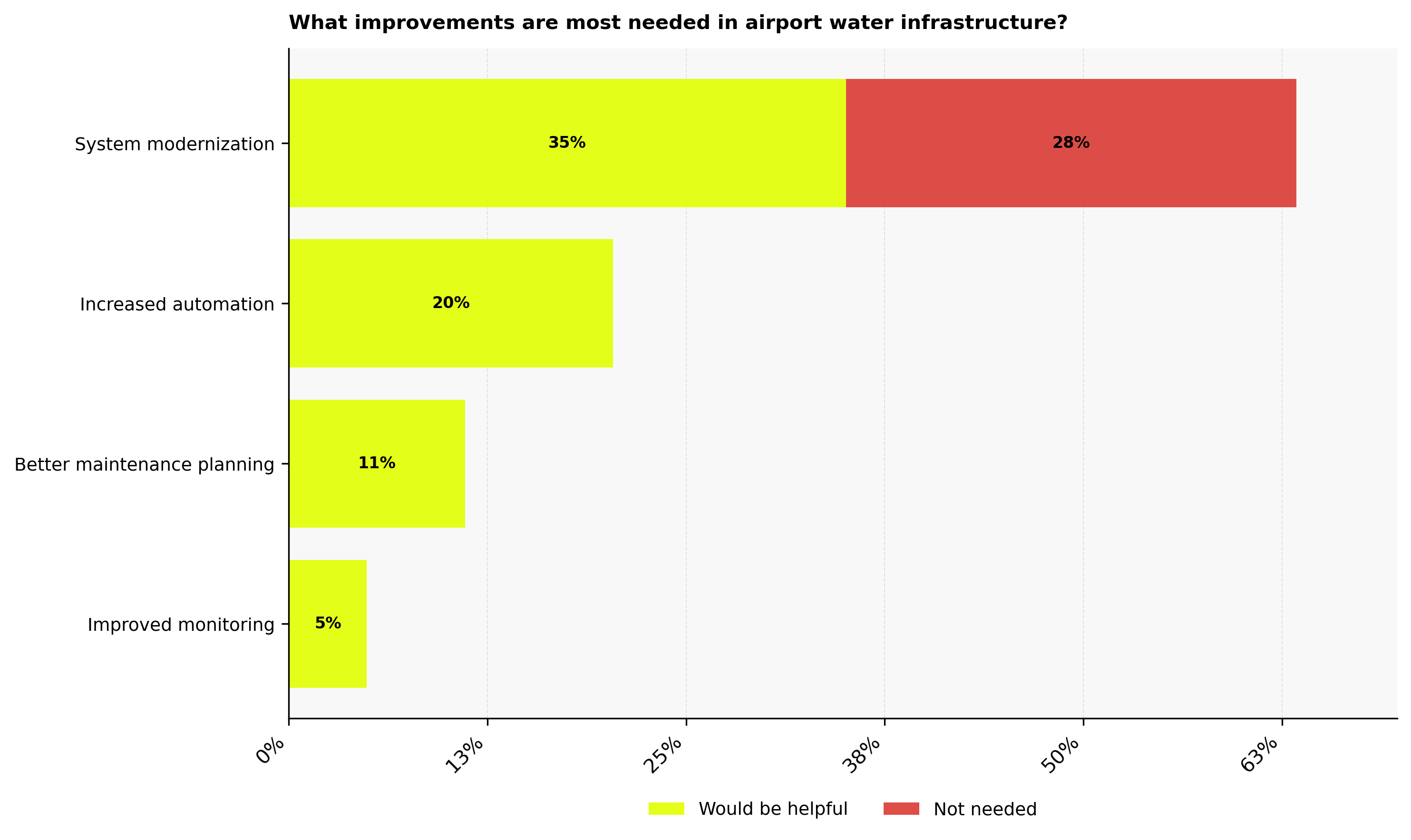
One of the first steps to effective water conservation in airports is improving their water infrastructure, although exactly which improvements need to be made varies from location to location. 35% of facility managers and building specifiers say system modernization would be helpful, while 28% report it is not needed, likely due to their systems already having been upgraded. This aligns with broader concerns, as aging water infrastructure remains a major issue across the U.S.
According to one report, most buried water pipelines in America are almost due for retirement or are already too old for use. A significant number of these pipelines will need to be decommissioned and replaced within the next 25 years at a cost of approximately $1 trillion.
20% of facilities managers or building specifiers say increased automation would be a helpful improvement, indicating that human error or carelessness may be a noticeable source of water wastage. 11% say better maintenance planning would be helpful, which implies their airports don’t pay sufficient attention to maintenance, or they’re aware of aging infrastructure’s growing maintenance requirements.
Only 5% say improved monitoring would be helpful, suggesting that airport staff do not comply with water management policies.
Which Infrastructure Challenges Do Facilities Managers Most Commonly Encounter in Airport Water Systems?
52% of our facilities managers or building specifiers say complex layouts are the most common infrastructure challenge in airport water systems
There’s an almost even split in opinions of airport water systems’ most common infrastructure challenges:
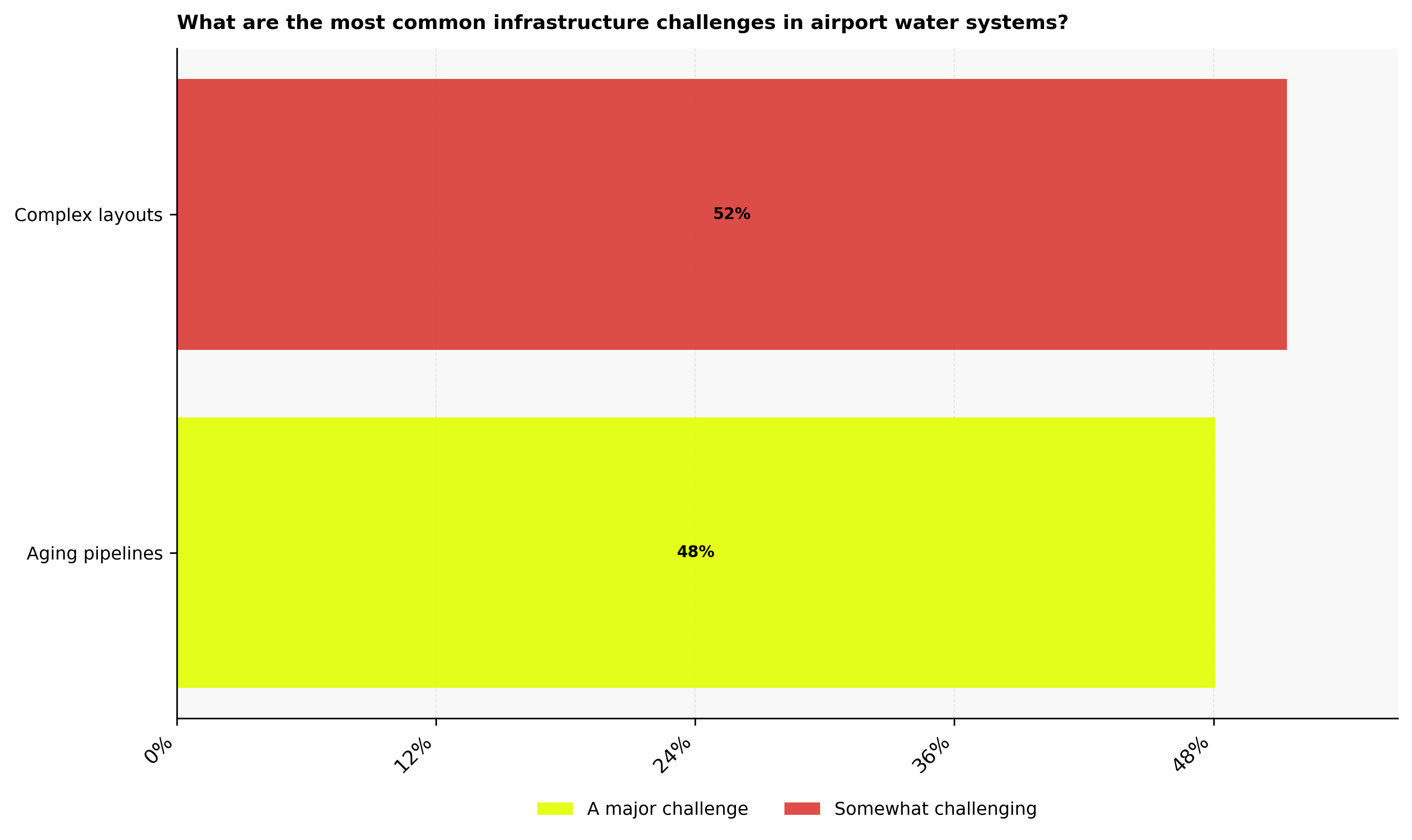
Our audience identifies two airport water system infrastructure challenges, although opinions differ regarding their severity. While 52% say the complex layouts of infrastructure are somewhat challenging, indicating these challenges are relatively manageable, 48% say aging pipelines are a major concern. This ties in with the report about aging underground pipes mentioned above. Issues associated with aging pipelines include higher repair costs,frequent leaks and higher rates of water loss, reduced pressure due to corrosion buildup and potential contamination.
What Are the Biggest Challenges for Facilities Managers in Maintaining Consistent Airport Water Pressure?
59% of facilities managers and building specifiers agree that system imbalances are the biggest challenge in maintaining consistent water pressure
There are a variety of challenges in ensuring consistent water pressure in US airports:
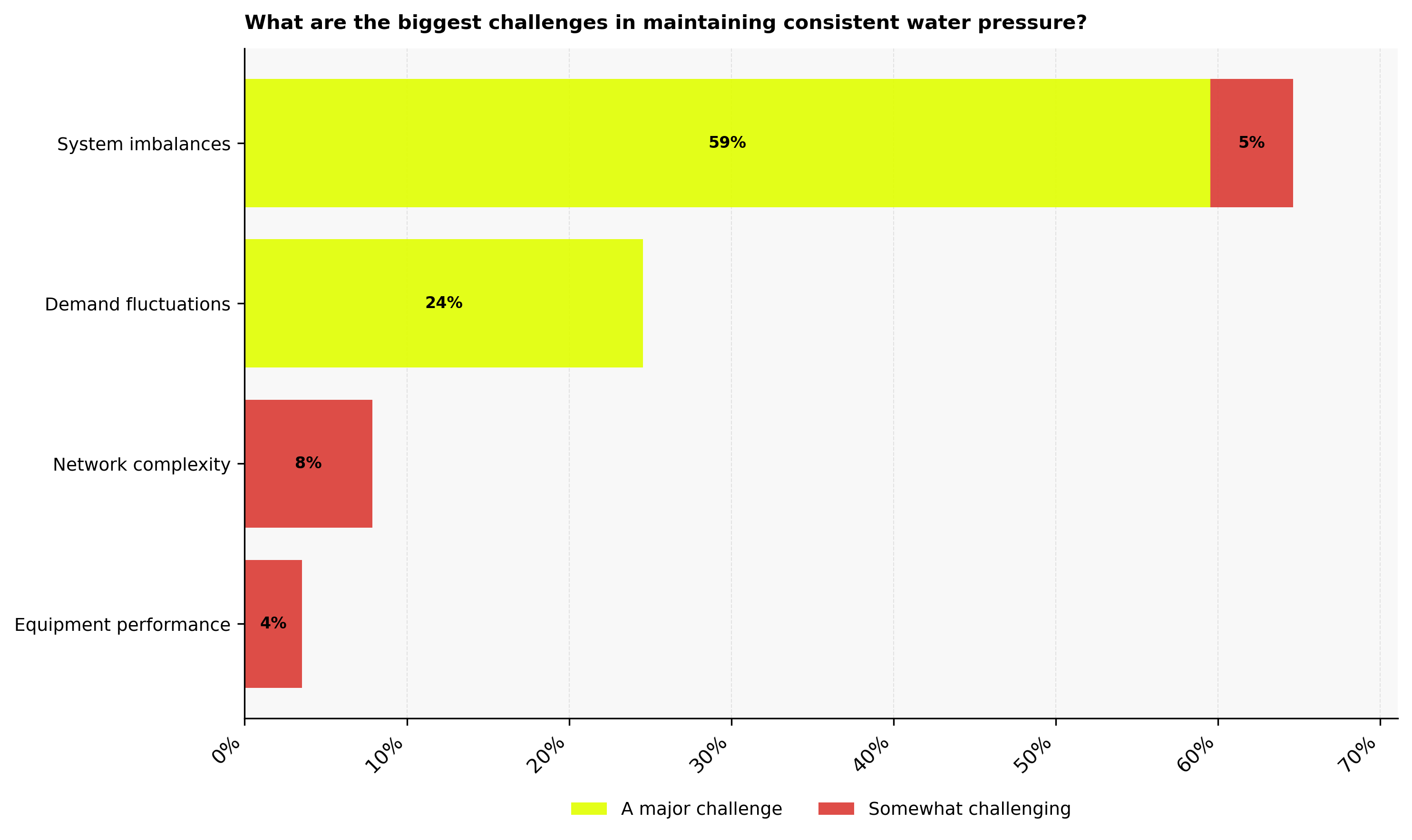
Facilities managers and building specifiers face a variety of challenges in maintaining consistent water pressure in airports. For 59%, system imbalances are a major challenge. This shows that, in addition to occurring frequently, these imbalances are difficult to rectify or prevent. That said, 5% say system imbalances are only somewhat challenging. This may be because they’re seldom affected by this issue, or they’ve had success in preventing or rectifying it.
24% say demand fluctuations are a major challenge, implying these fluctuations are difficult to predict and to respond to efficiently. The relatively small remainder of our audience raises other points, with 8% saying network complexity and 4% saying equipment performance are moderately challenging.
Water pressure issues are not unique to the airports where facilities managers and building specifiers work or have worked, given the many news reports of airports experiencing similar issues over the last few years. For example, Virginia’s Richmond International Airport made headlines in 2025 when passengers found that restroom facilities were closed and the building had no water due to water pressure issues. In 2021, low water pressure led to the temporary closure of some restaurants and restrooms at Memphis International Airport.
What Challenges Exist for Facilities Managers in Implementing Airport Water Reuse Systems?
Cost considerations are somewhat challenging when implementing water reuse systems, according to 55% of facilities managers or building specifiers
Not everyone feels the same way about water reuse system implementation challenges:
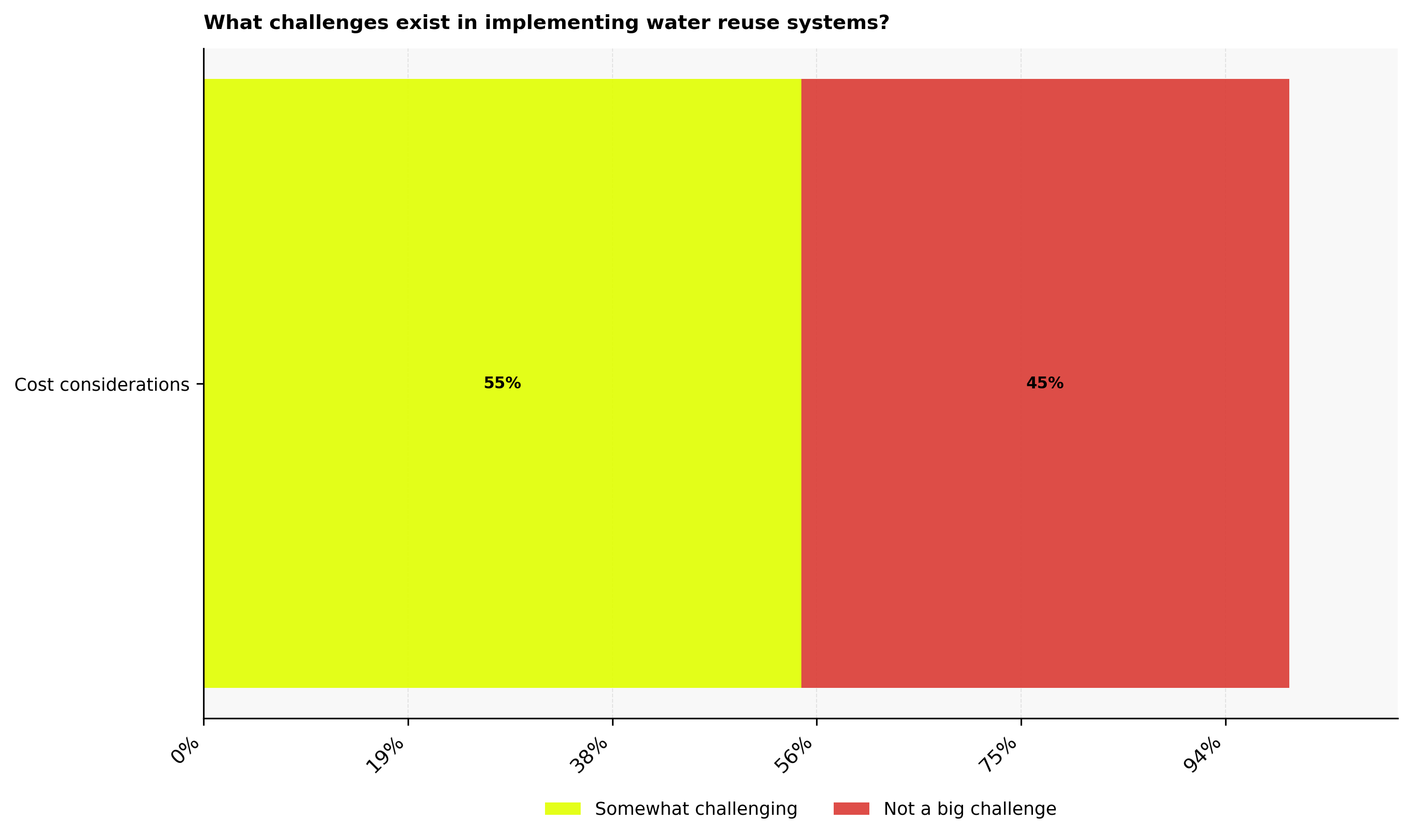
Water reuse systems can be powerful tools for water management and conservation, but implementing them isn’t always easy. The facilities managers and building specifiers in our audience identified cost considerations as a single challenge in implementing water reuse systems. However, they were almost evenly split on how much of a challenge this is.
55% report that cost considerations are somewhat challenging, suggesting that finance and management teams may need to find savings elsewhere to support system implementation. On the other hand, 45% say cost considerations are not a big challenge, implying the systems they implemented or looked at implementing are within budget.
2025 estimates put a large international airport’s daily water consumption at 400,000 to 3 million gallons (1.4 to 11 million liters) and its annual water consumption at 132 million gallons to more than 1 billion gallons (enough to fill 1,500 Olympic-sized swimming pools). With more than 150 international airports in the US, it’s clear that water reuse is an essential strategy for conservation and cost savings.
What Challenges Do Facilities Managers Face in Aligning Airport Water Systems with Sustainability Goals?
89% of facilities managers and building specifiers say cost pressures are a major challenge in aligning water systems with sustainability goals
Not everyone feels the same way about the challenges faced when ensuring water systems support airports’ sustainability targets:
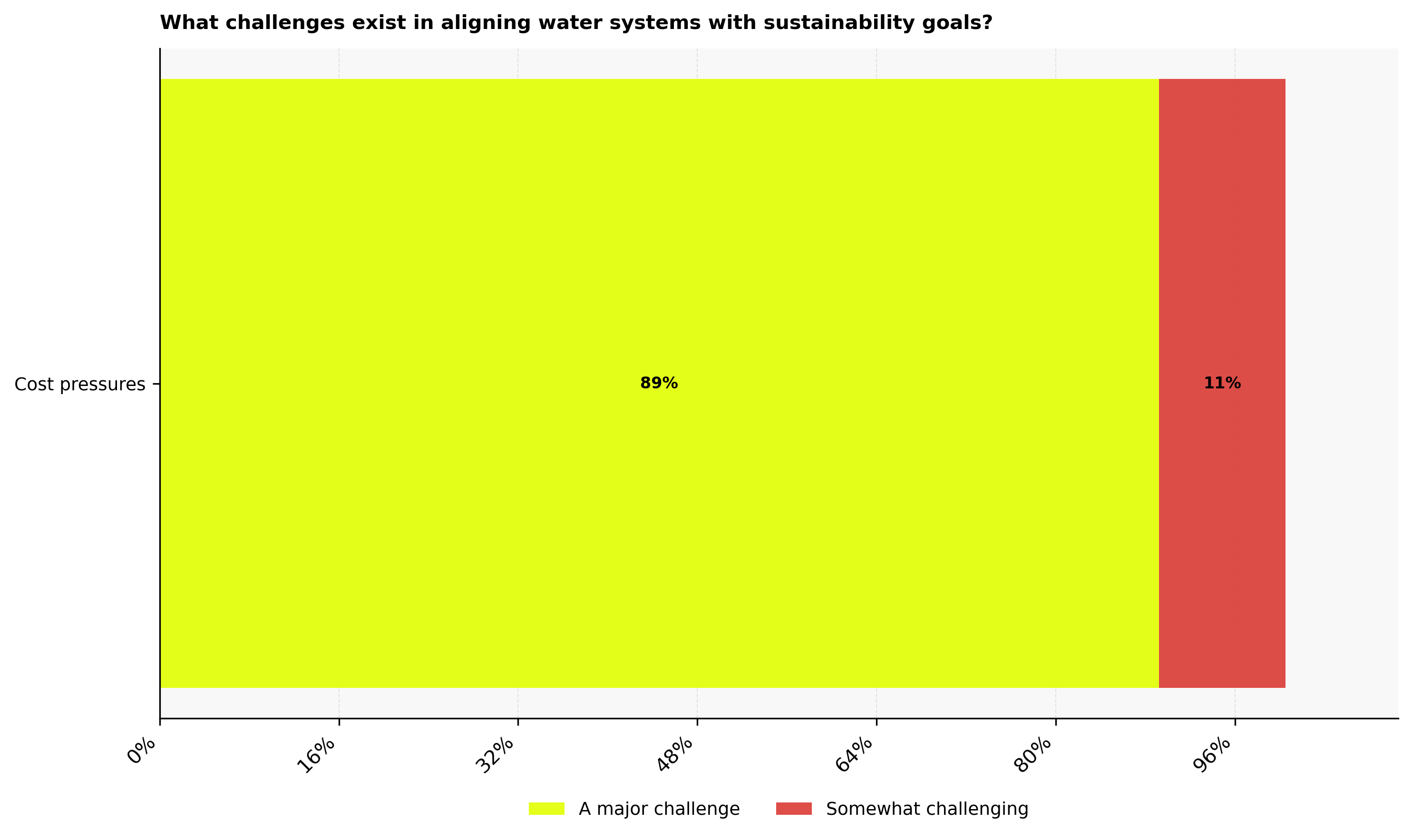
Ensuring airports’ existing water systems harmonize with their sustainability goals can be challenging. Facilities managers or building specifiers mention cost pressures as the single challenge when trying to align these systems and goals, although how challenging these can be depends on who you ask.
According to 89% of our audience, cost pressures are a major challenge, pointing to the fact that decision-makers may not have taken the cost of solutions into account when setting their sustainability goals or did not increase the relevant budgets sufficiently. For 11%, cost pressures are only somewhat challenging, revealing that those they’ve encountered were relatively easy to overcome.
The challenge of cost may be linked to airports’ choice of water conservation strategies, as some are undoubtedly more affordable to implement than others, especially when they involve aligning existing water systems with sustainability goals. Popular strategies include:
- Reclaimed water use
- Advanced water purification
- Geothermal cooling
- Using air conditioning condensate
- Water-saving fixtures such as low-flush systems
- Infrastructure upgrades
- Irrigation
- Use of drought-tolerant plants
- Wetland preservation
- Stormwater management
Tampa International Airport has had tremendous success with the reclaimed water project it launched in 2009. Since then, the project has saved over 450 million gallons of potable water used for landscape irrigation and other purposes.
What are the Challenges for Facilities Managers of Managing Water Across Multiple Airport Terminals?
28% of facilities managers or building specifiers say resource allocation issues are somewhat challenging when managing water across multiple terminals
There’s a wide variety of challenges involved in multiple terminal water management:
Managing water effectively across multiple terminals presents facilities managers and building specifiers with a host of challenges, some of which are greater than others. For 28% of our audience, resource allocation issues are somewhat challenging, meaning they’ve successfully managed or overcome this in the past. However, resource allocation issues are a major challenge for 21%, possibly due to a lack of visibility across terminals.
23% say data fragmentation is a major challenge, which again indicates a lack of visibility across terminals, although 13% say this is somewhat challenging. This implies they have found ways to overcome this fragmentation. For 6%, inconsistent usage patterns are somewhat challenging, suggesting they need to make quick decisions rather than decisions based on predictability.
On the other hand, 5% say this is a major challenge. The remaining 3% of our audience says separate system controls are a major challenge. This possibly requires them to treat each terminal as an entirely separate unit, which can be a time-consuming and laborious process.
What Factors Make Water Usage in Airports Difficult for Facilities Managers to Predict?
100% of facilities managers or building specifiers agree that weather conditions make water usage difficult to predict
Opinions are unanimous regarding which factors make it difficult to predict water usage in airports:
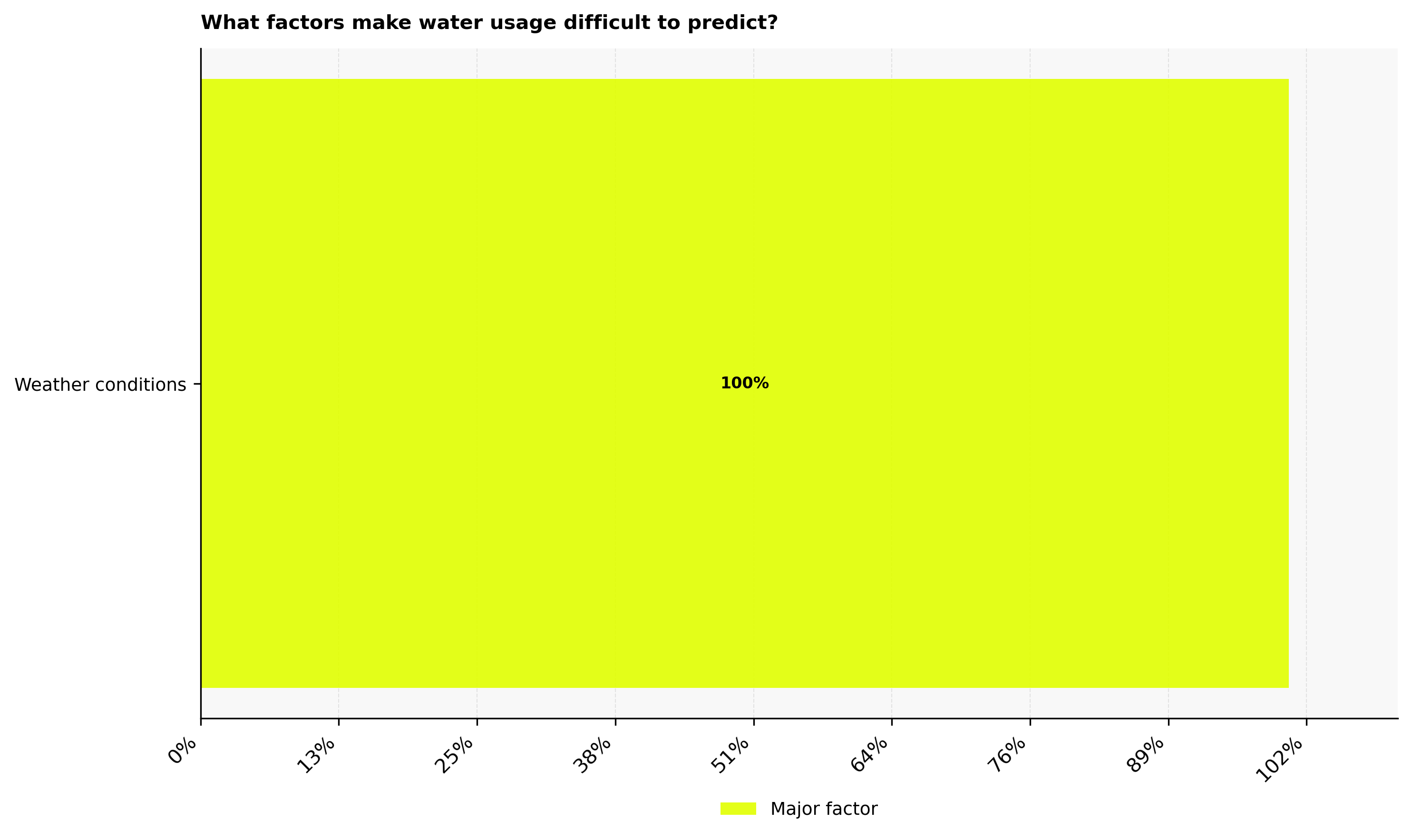
Every facilities manager and building specifier in our audience mentioned the same single factor that makes it difficult to predict water usage at airports. For 100% of our audience, weather conditions are a major factor, indicating they’ve all had negative experiences with the effects of adverse weather on supply and usage.
Taking a closer look, we find that growing demand, urbanization, and climate change are increasingly placing pressure on water resources. This is particularly noticeable during extreme weather events, as facilities and communities’ water needs change, while water availability may be limited due to pipes being damaged by hurricanes, tornadoes, storms, snow, or other adverse conditions.
What Do Facilities Managers Say About Whether Peak Travel Periods Affect Airport Water System Performance?
60% of facilities managers and building specifiers say there’s no major change to water system performance in peak travel periods
While the majority says peak travel periods don’t change water systems’ performance much, some have a different opinion:
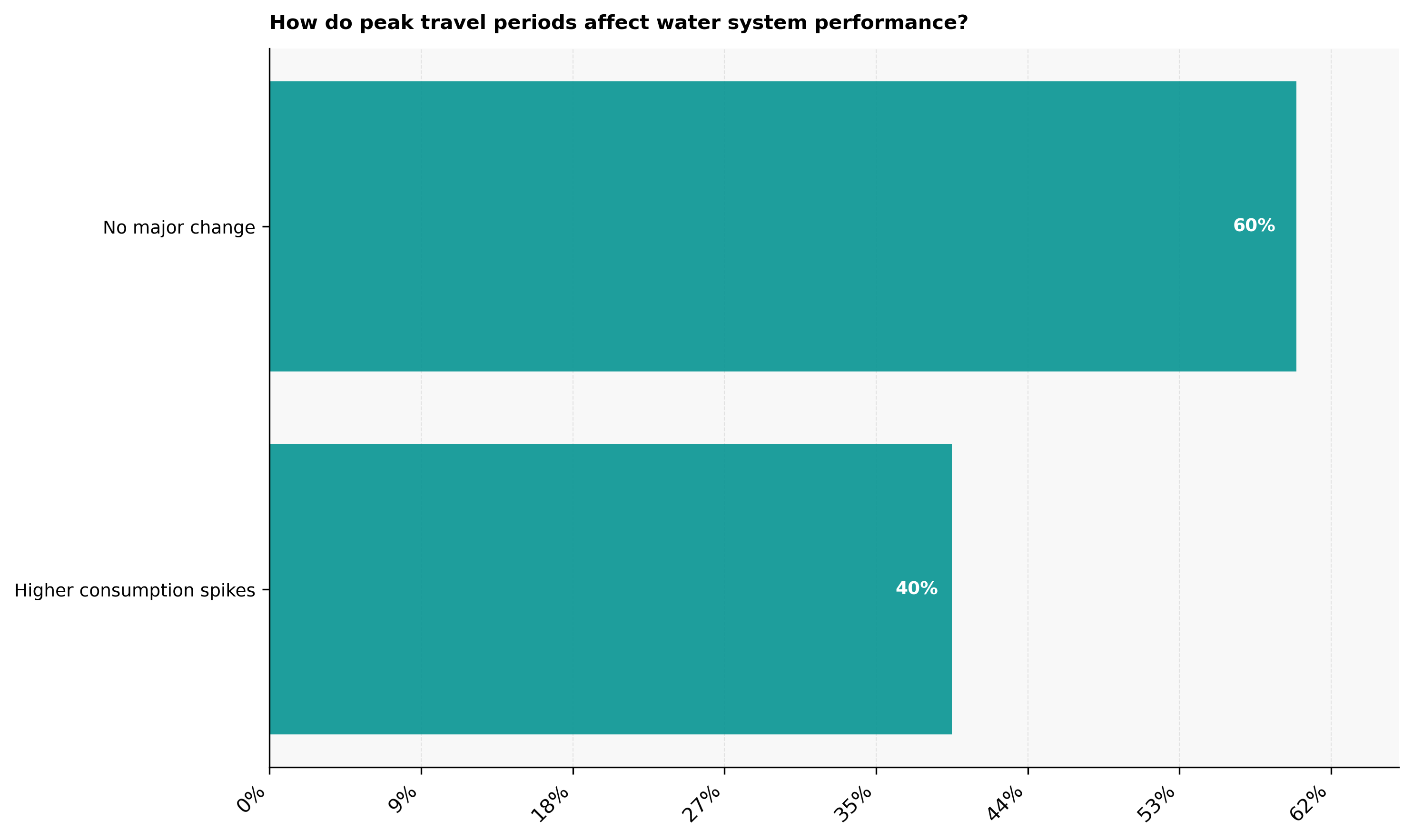
It’s natural to assume that peak travel periods have a serious impact on the performance of water systems in US airports, but this may not always be the case. In fact, 60% of facilities managers or building specifiers say there’s no major change to their water systems’ performance during these periods, which may be due to their systems having been upgraded to cope with increased demand or to passengers continuing with their journeys rather than lingering at restaurants or using restrooms.
Conversely, the remaining 40% say higher consumption spikes occur during peak travel periods, possibly due to the increased number of flights and passengers passing through their airports.
In the US, the strongest peak season is over the summer, beginning in June and winding down in September, with smaller peaks in October and December. Compared to regions such as Europe, which have much more developed seasonal peaks, air travel in the US (especially foreign travel) is spread more evenly across the calendar.
What Do Facilities Managers Say About How Different Terminal Functions Affect Water Usage at Airports?
95% of facilities managers or building specifiers say retail and food terminal functions have the greatest impact on water usage
Opinions on the impact of terminal functions on the use of water differ:
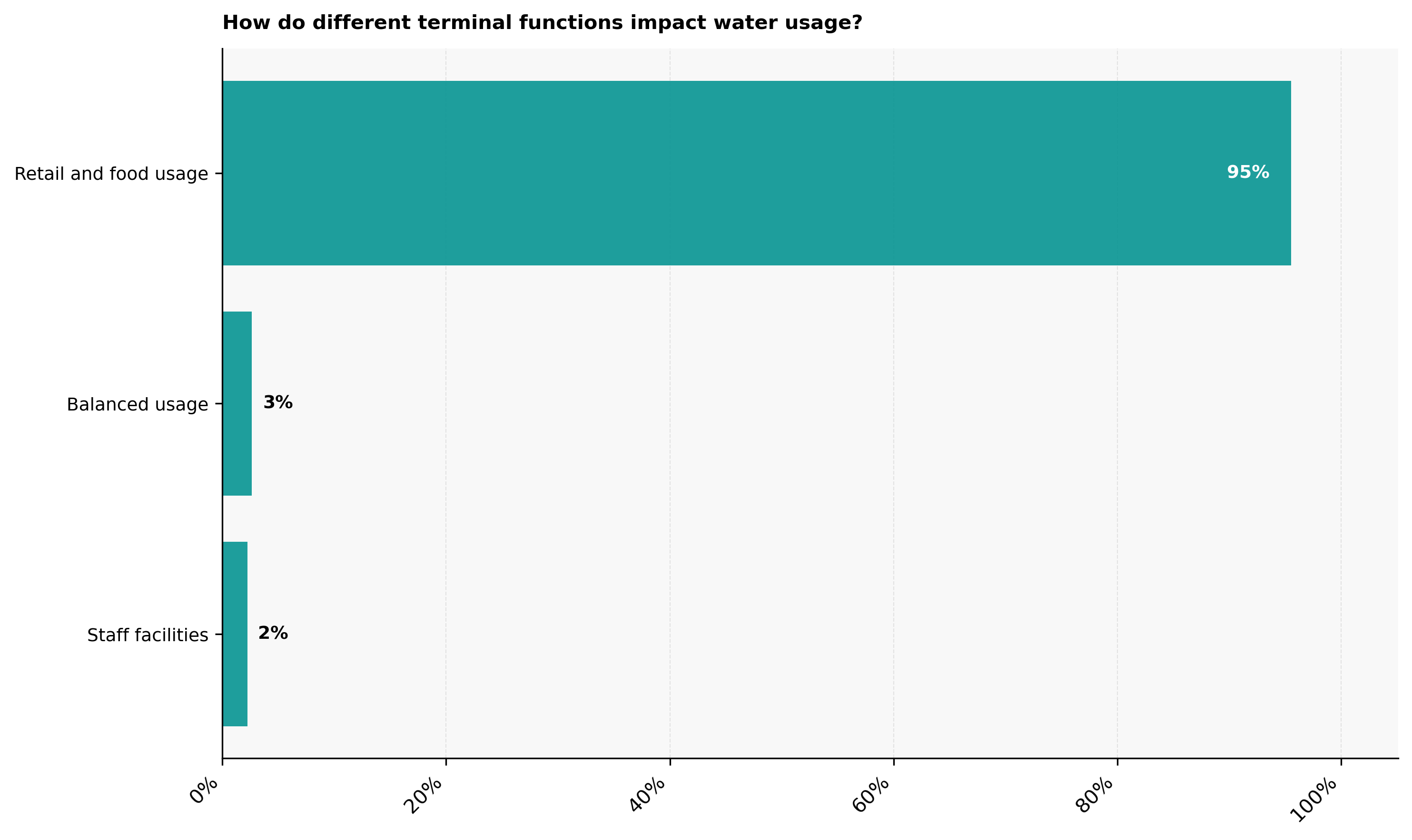
Some airport terminal functions have a greater impact on water usage than others. According to the overwhelming majority (95%) of facilities managers and building specifiers, retail and food usage has the greatest impact on water usage at airports. This is expected, as retail staff require water for drinking and cleaning, while restaurants use it for food and beverage preparation, as well as cleaning crockery and cutlery.
That said, 3% say they’ve noticed balanced usage across the different terminal functions. This may be due to good adherence to water conservation principles and policies. 2% say airport staff facilities have the greatest impact on water usage, which might be a result of carelessness or misuse by staff.
What Operational Areas Do Facilities Managers Say Require the Most Water Monitoring in Airports?
100% of facilities managers or building specifiers say outdoor areas require the most water monitoring
The operational area in most need of water monitoring is unanimously agreed on:
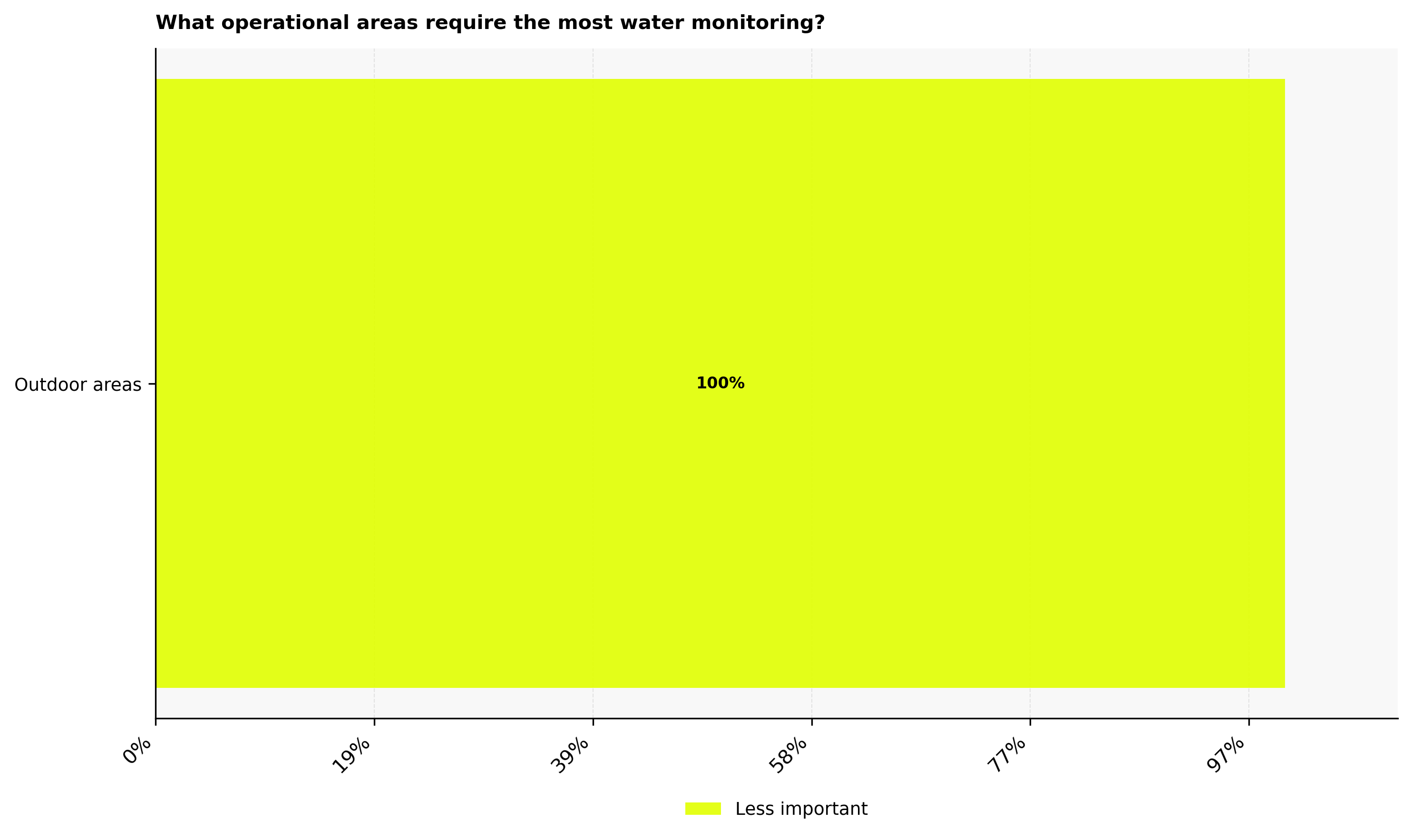
The facilities managers and building specifiers comprising our sample all (100%) identify the same operational area in need of the most water monitoring: outdoor areas. This makes sense, as according to a 2024 study published in the Sustainability journal, chemicals discharged from airports (particularly in airport runoff or stormwater) can contaminate water supplies and diminish water quality in surrounding areas.
The study found that airport runoff can contain hazardous substances such as polycyclic aromatic hydrocarbons (PAHs), glycols, benzotriazoles (BTs or BTR), polychlorinated biphenyls (PCBs), biocides, detergents, pesticides, phenols, formaldehyde, cyanides, and heavy metal ions. Many of these substances come from airport and installation cleaning, fuel spills, and anti-icing or de-icing operations.
According to Facilities Managers, What Role Do Cooling Systems Play in Airport Water Usage?
74% of facilities managers and building specifiers say cooling systems play an absolutely essential efficiency dependency role in airport water usage
Two major roles are played by cooling systems in water use at US airports:
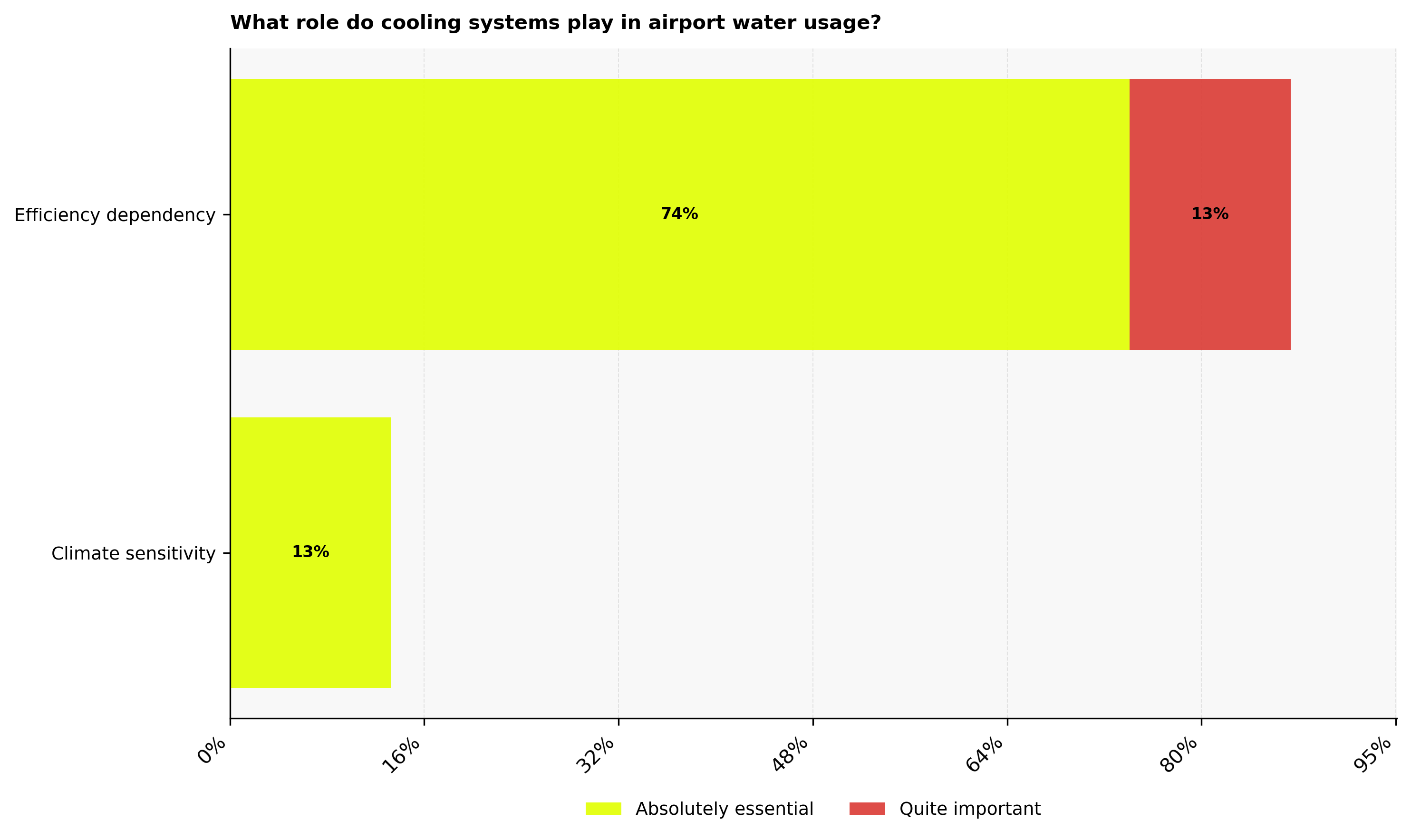
When commenting on the role cooling systems play in airport water usage, most of our audience mentions the efficiency dependency: the amount of water consumed depends on the efficiency of the cooling systems. 74% say the role is absolutely essential, while 13% say it’s quite important. The difference in opinion highlights that other factors may play a more influential role in water use at some airports than others.
The remaining 13% say cooling systems play an absolutely essential role in water usage at airports due to climate sensitivity. This shows that the amount of water consumed is directly linked to humidity, rising ambient temperatures, and other environmental conditions.
What Type of Passenger Behavior Do Facilities Managers Say Influences Water Usage The Most in Airports?
100% of facilities managers and building specifiers say high restroom usage is the passenger behavior with the greatest influence on airport water usage
Everyone agrees that passenger behavior has the biggest impact on the use of water:
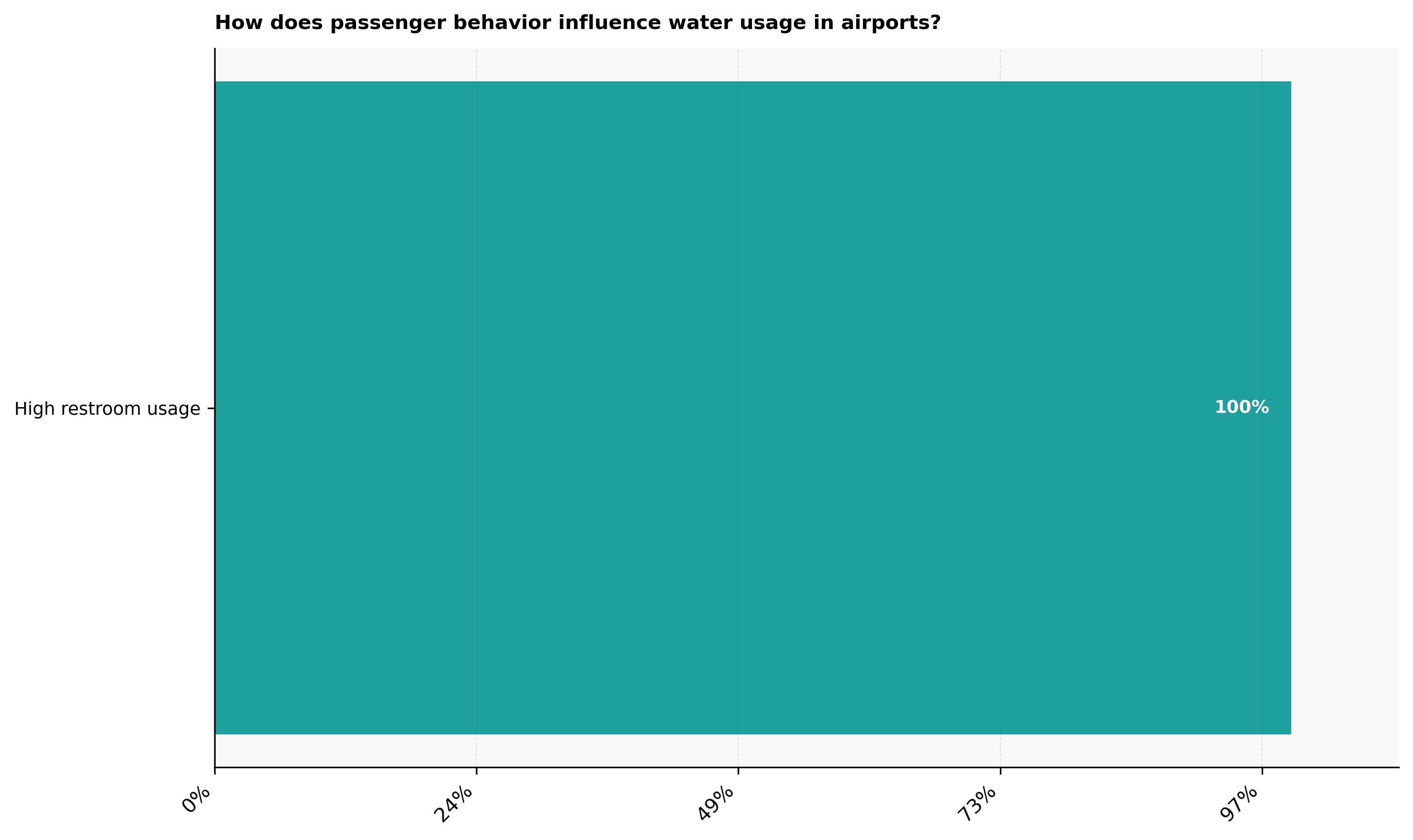
100% of facilities managers and building specifiers say that high restroom usage is the passenger behavior that most influences water usage in airports. This is because, in airport restrooms, passengers may use water to wash their hands and faces, shower, and flush toilets and urinals.
It makes sense, then, that if airports want to implement initiatives aimed at reducing water consumption in meaningful ways, they must take passenger behavior into consideration. The good news is that airports that do establish protocols for water conservation tend to see significant reductions in water use per passenger.
For example, Dallas Fort Worth International Airport reduced water use by 24.3% between 2011 and 2016. Similarly, Los Angeles Airport reduced water use by 6.3% in one year. Additionally, Orlando International Airport reduced water consumption by 11.5% between 2010 and 2016.
What Types of Water Reuse Strategies Do Facilities Managers See Most Commonly Used at Airports?
100% of airport facilities managers and building managers say irrigation reuse systems are the most commonly used water reuse strategy
The most commonly used water reuse strategy is:
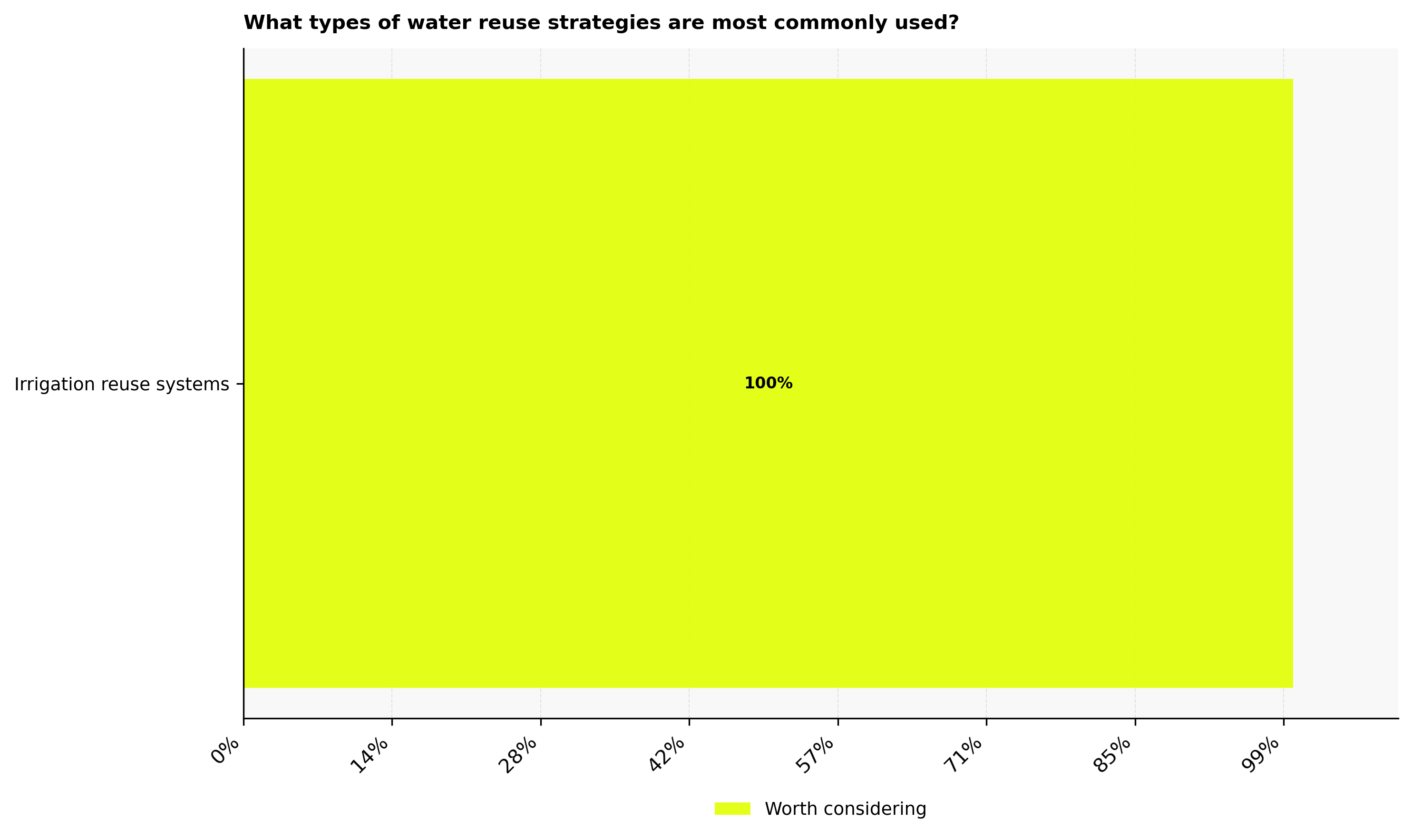
Irrigation reuse systems are the most commonly used water reuse strategy at airports, according to 100% of facilities managers and building specifiers, suggesting they are both cost-effective and relatively easy to implement. However, airports do not rely on these systems exclusively.
These and other reuse systems are being adopted by numerous airports across the country. Bluefield Research identified 22 projects that either had been or were planned to be implemented at airports (especially those in water-stressed states like Arizona, California, Florida, and Hawaii), such as Fresno-Yosemite International, Long Beach, San Diego International, and San Francisco International between 2002 and 2023. The total value of these projects was $1.78 billion.
Which Technologies Do Facilities Managers Identify as the Most Valuable for Improving Water Visibility in Airports?
IoT sensors are the most valuable technology for improving water visibility, say 71% of facilities managers and building specifiers
Two technologies dominate in water visibility:
We mentioned that some facilities managers and building specifiers may struggle with a lack of water usage visibility across terminals, which can make it difficult to manage and conserve water efficiently and effectively. Luckily, various technologies can improve this situation.
According to 71% of our audience, IoT (Internet of Things) sensors are extremely valuable for improving water visibility, likely because they have experience with using this technology. These sensors make it possible to monitor hydraulic data automatically in real time. If they detect events such as a water leak or a sudden increase in usage, the sensors’ cloud platform triggers alerts to notify Facilities Managers or Building Specifiers.
29% say smart meters are quite useful for improving water visibility. This implies that, while this technology might not be as effective as IoT sensors, it can make a noticeable difference.
How Do Facilities Managers Describe the Role of Technology in Airport Water Management?
100% of facilities managers and building specifiers say technology plays a system optimization role in airport water management
Technology’s role in managing water at airports in the US is wholly agreed on:
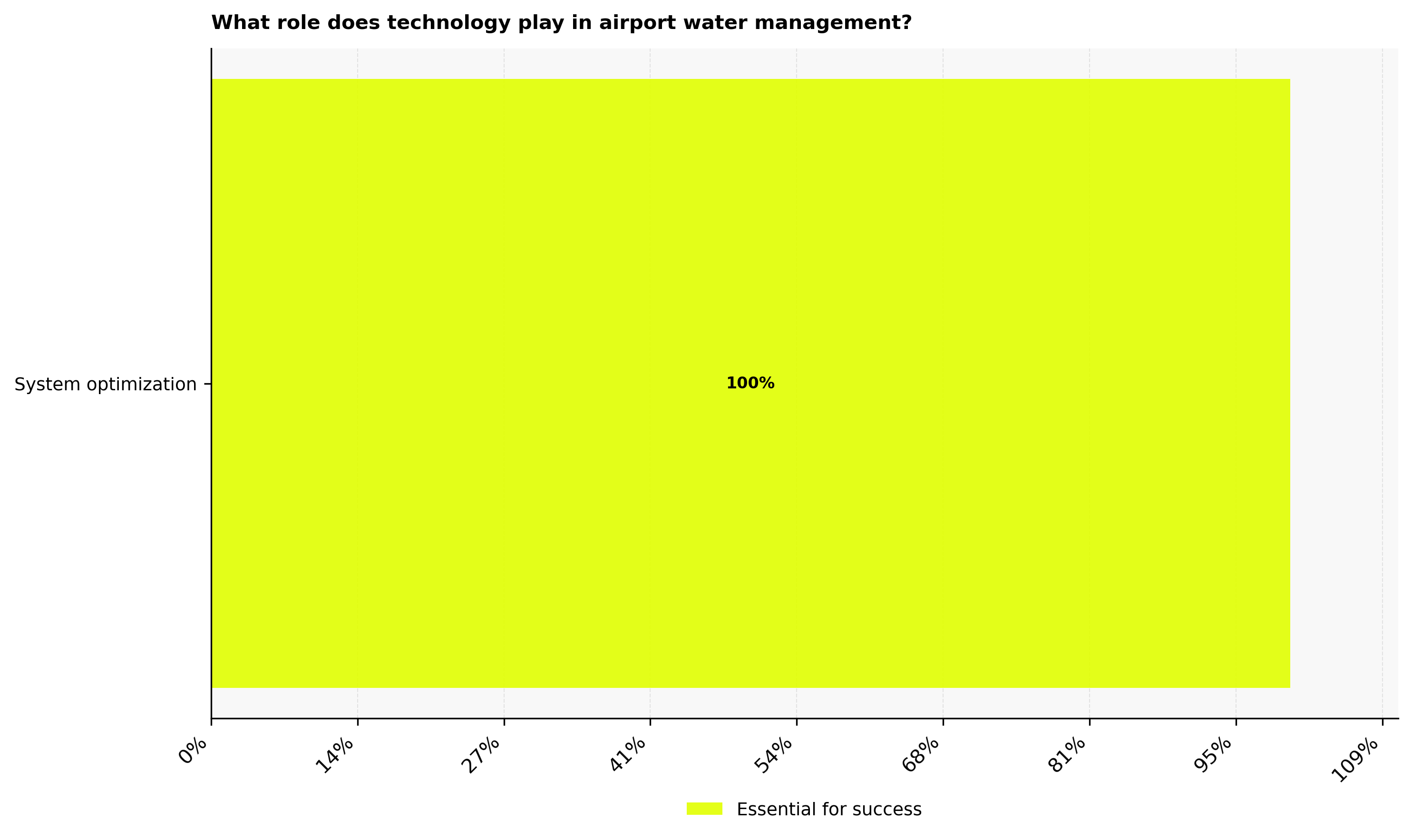
100% of facilities managers and building specifiers say the system optimization role that technology plays in airport water management is essential for success. Optimizing water systems is essential for effective water management. However, the complexity, effort, visibility, and time required, especially in response to unpredictable events, make manual optimization largely ineffective. Technology makes this considerably easier and more effective.
Our audience isn’t the only ones who think so. According to research by Amadeus, 79% of senior airport leaders say sustainability objectives are an important driver of technology investment.
What Water Savings Targets Do Facilities Managers Say Are Most Common in Airport Operations?
47% of facilities managers and building specifiers say improving efficiency per passenger is a common water savings target in airport operations
There are four common water savings targets:
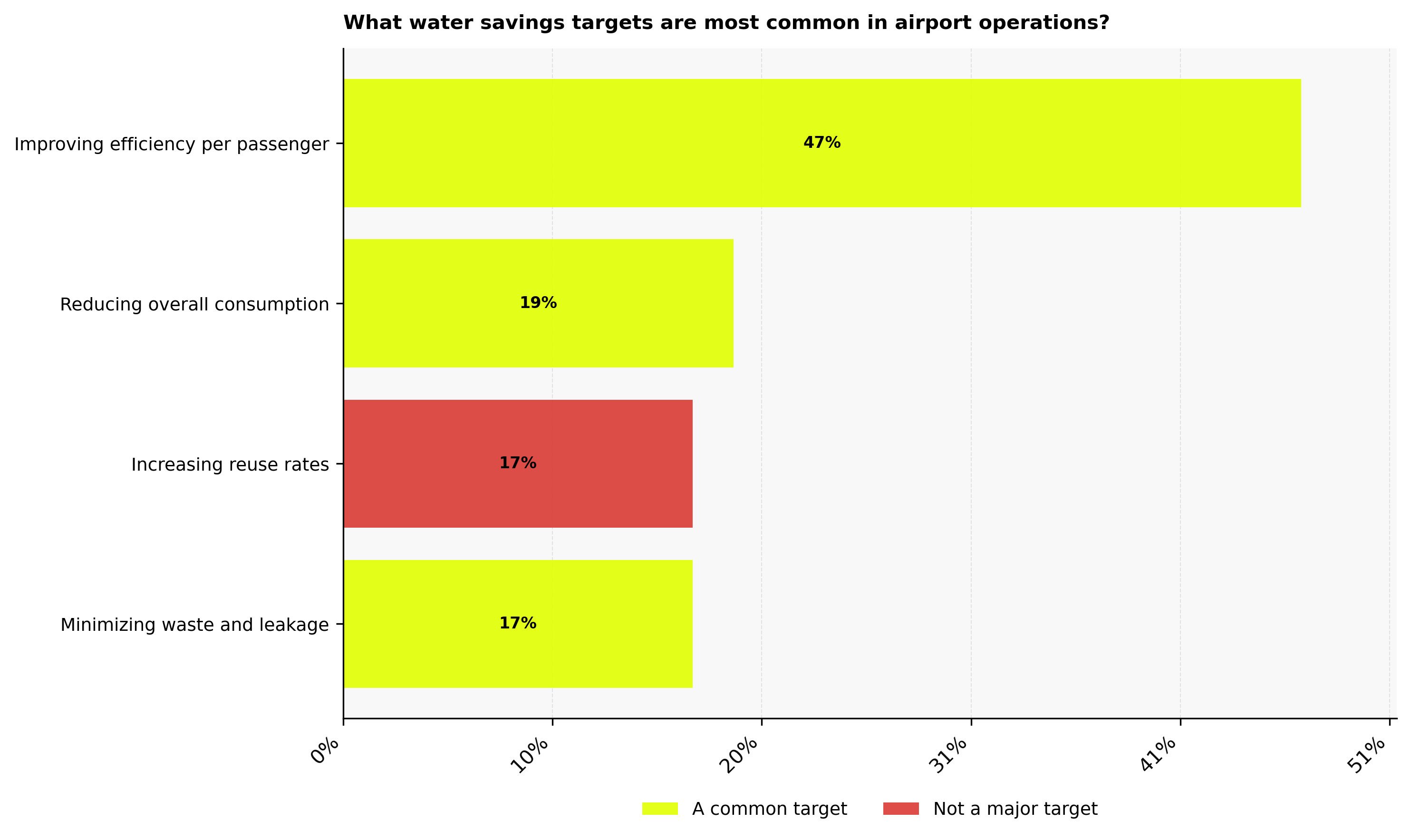
Our audience mentions several common water-saving targets in airport operations. Almost half (47%) say improving efficiency per passenger is a common target, so they’re aware that even small numbers of passengers can result in higher water consumption rates. 19% say reducing overall consumption is a common target, which isn’t surprising, given what we mentioned about daily and annual consumption at international airports.
17% mention increasing water reuse rates, although they say this is not a major target. This confirms that an increase in these rates would support the respective airports’ goals, even if they’re not the main route to achieving them. Another 17% say reducing waste and leakage is a common target, which ties in with what we’ve said about aging infrastructure and carelessness on the part of airport staff.
What Makes Balancing Efficiency and Operations Difficult for Airport Facilities Managers?
86% of facilities managers and building specifiers say cost considerations make balancing efficiency and operations somewhat difficult
Cost poses a challenge across the board:
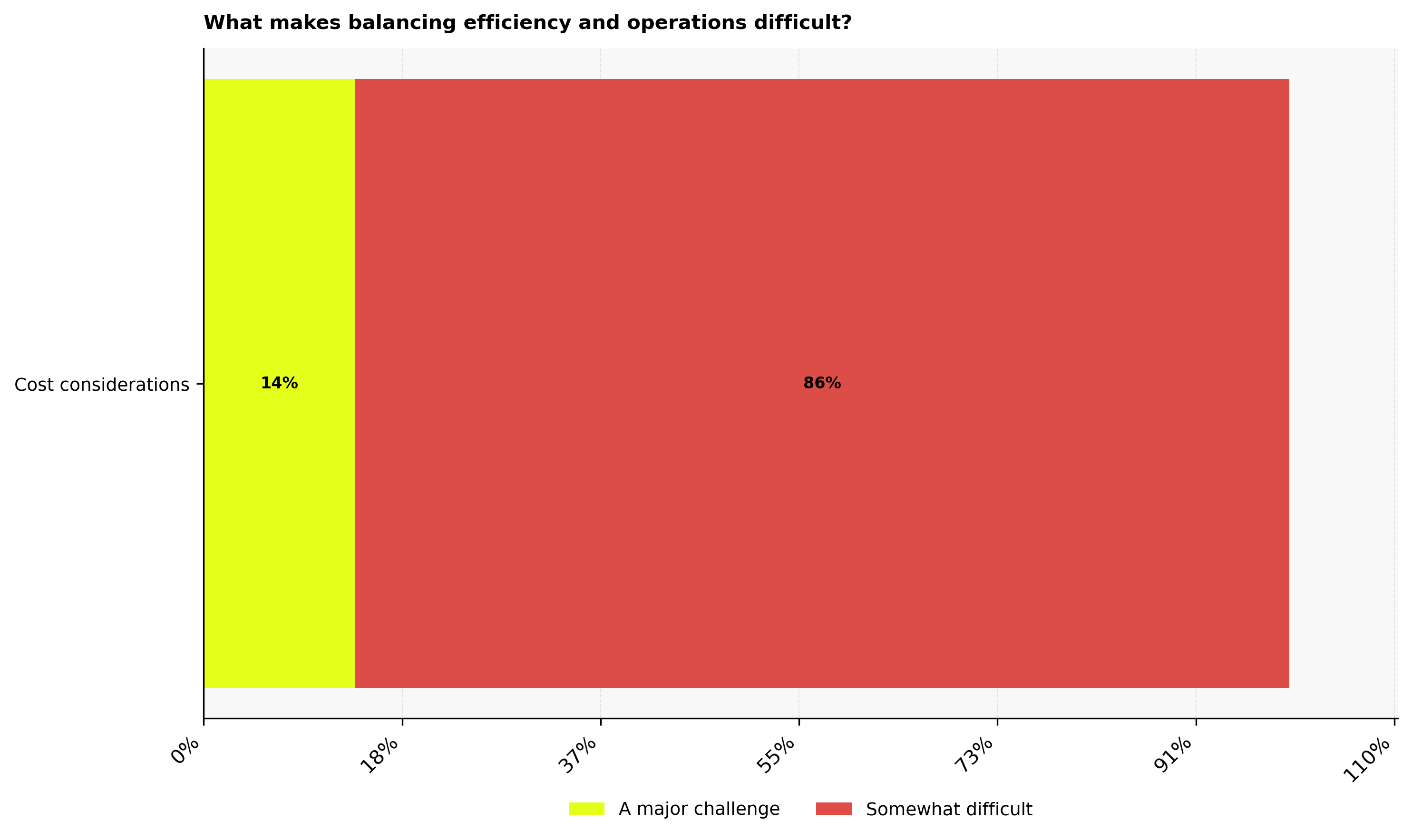
When it comes to efficiency and operations, facilities managers and building specifiers face a balancing act. While everyone says cost considerations make this difficult, opinions differ on the level of difficulty.
86% say cost considerations make balancing efficiency and operations somewhat difficult. This is possibly because they’ve been faced with these in the past, and they weren’t insurmountable. However, 14% say these considerations are a major challenge, implying they simply don’t have the budget to make their operations more efficient.
What Are Airport Facilities Managers' Most Effective Strategies for Environmental Protection?
45% of facilities managers and building specifiers agree that contamination prevention is not the most effective strategy for environmental protection
Strong opinions emerged regarding the effectiveness of different environmental protection strategies:
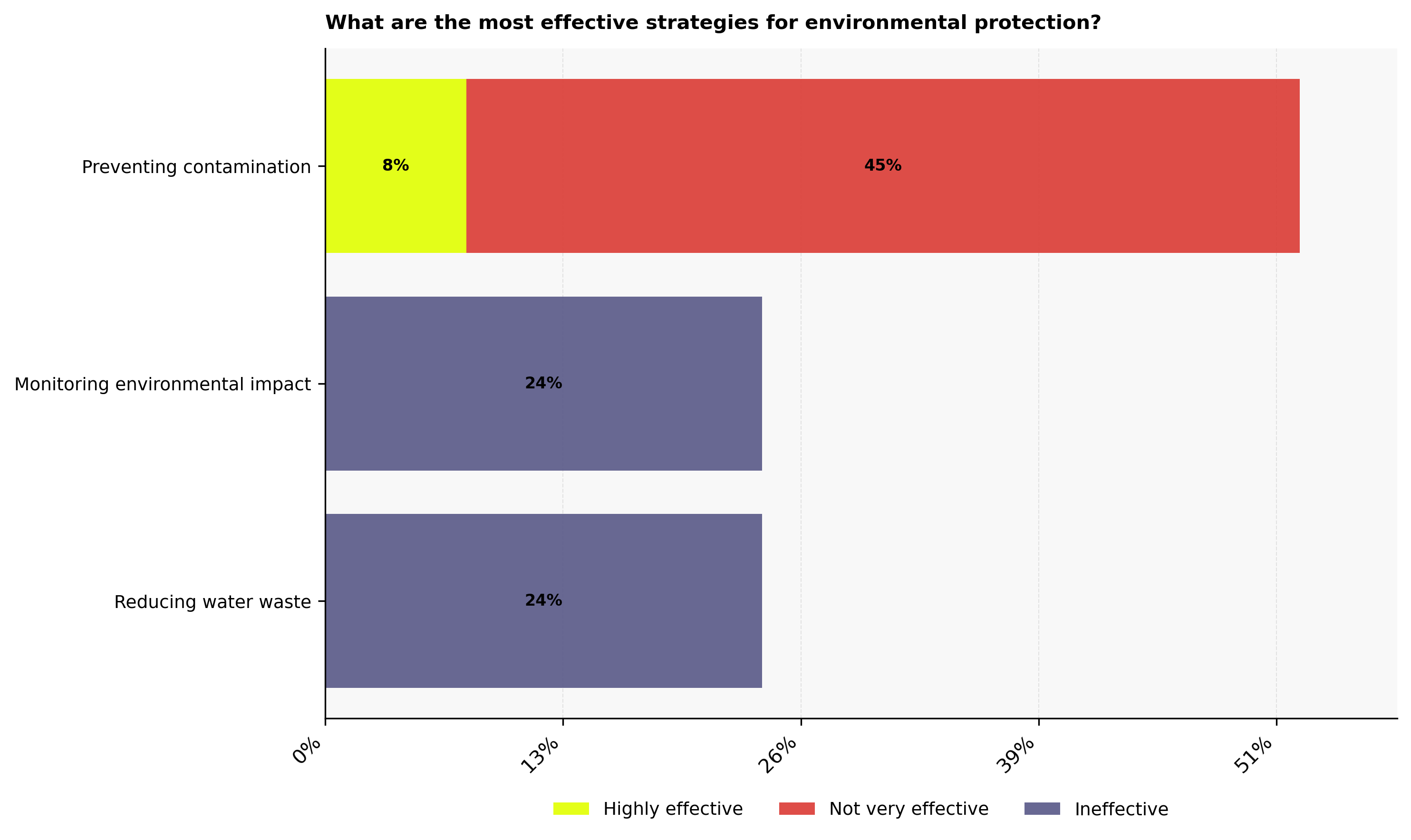
Due to the need for increased monitoring of outdoor areas and the risk of environmental contamination from runoff water containing toxic compounds, U.S. airports have implemented a range of environmental protection strategies, with varying levels of success. 45% of our audience say their current strategies for preventing water contamination are not very effective, while 8% say their strategies are highly effective. This confirms that both camps have monitored contamination levels.
24% say monitoring environmental impact is ineffective, showing that their strategies are responsive rather than proactive and preventative. The remaining 24% say their strategies aimed at reducing water waste are also ineffective.
There is no one-size-fits-all approach to environmental protection where water is concerned. Instead, it requires a multifaceted approach that includes:
- Best management practices
- Cost share programs
- Financial incentives
- Hazard mitigation
- Land conservation and natural infrastructure solutions
- Land use controls
- Public education and outreach
- Regulations, inspections, and permits
What Environmental Risks Do Airport Facilities Managers Associate with Poor Water Management?
39% of facilities managers and building specifiers say water contamination is a major environmental risk associated with poor water management
There are three environmental risks associated with not managing airport water properly:
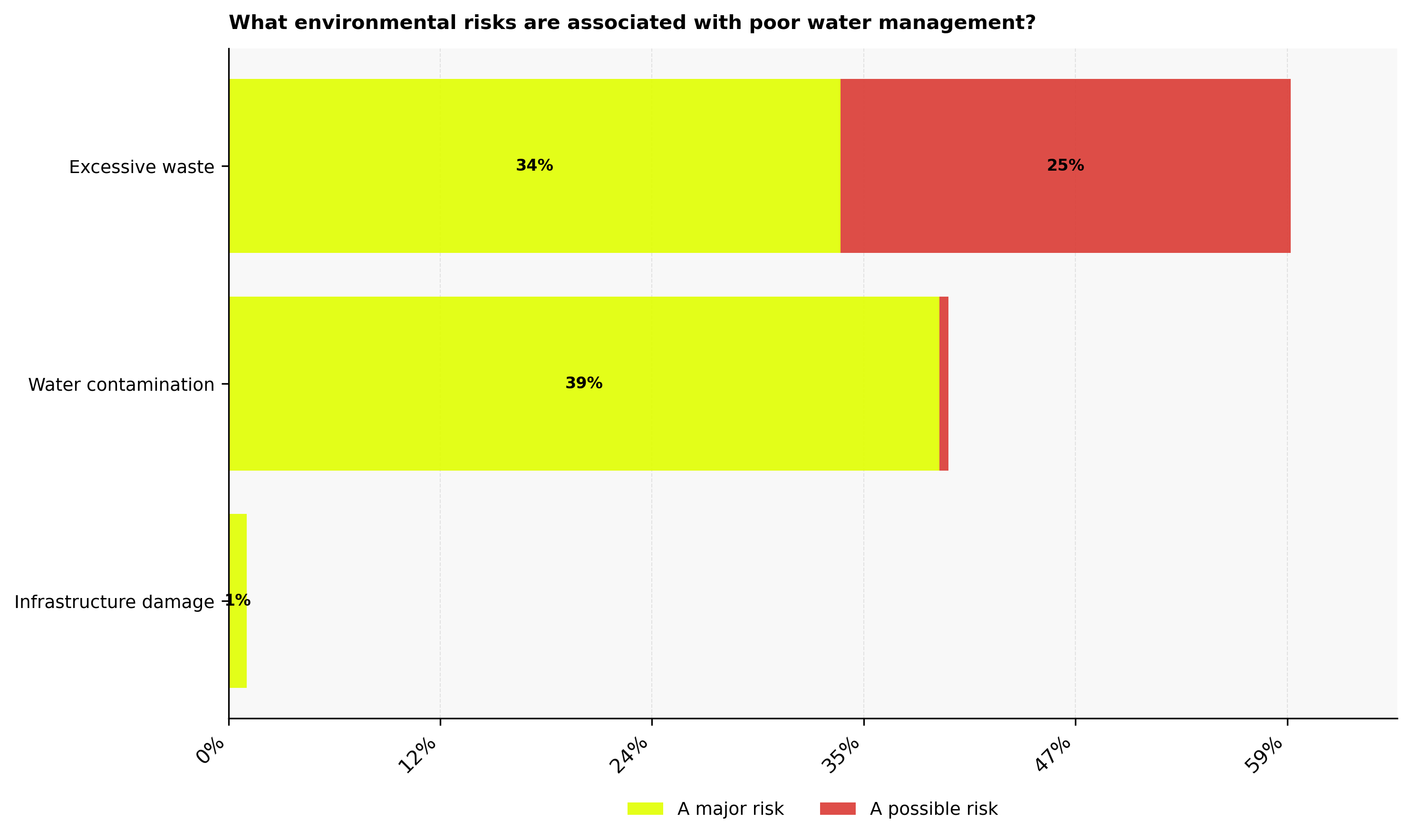
Poor water management carries a range of environmental risks. According to 39% of facilities managers and building specifiers, water contamination is a major risk, indicating they’ve noticed this at their own airports. That said, 1% say this is only a possible risk.
34% say excessive waste is a major risk of poor management, which may help explain why staff facilities and a lack of visibility contribute to high water consumption, as mentioned above. However, 25% disagree, saying this is a possible risk. The remaining 1% say infrastructure is a major risk, possibly speaking from experience.
This ties in with the study published in Sustainability, which found that poor water management creates significant environmental risks primarily through contaminated stormwater runoff containing de-icing fluids, fuel from spills, firefighting foams, and heavy metals. If untreated, these pollutants threaten local aquatic ecosystems, soil quality, and groundwater, potentially impacting nearby communities.
Which City Are Our Audience of Airport Facilities Managers Based In?
90% of the facilities managers and building specifiers are based in Los Angeles
Our audience represents three major US cities:
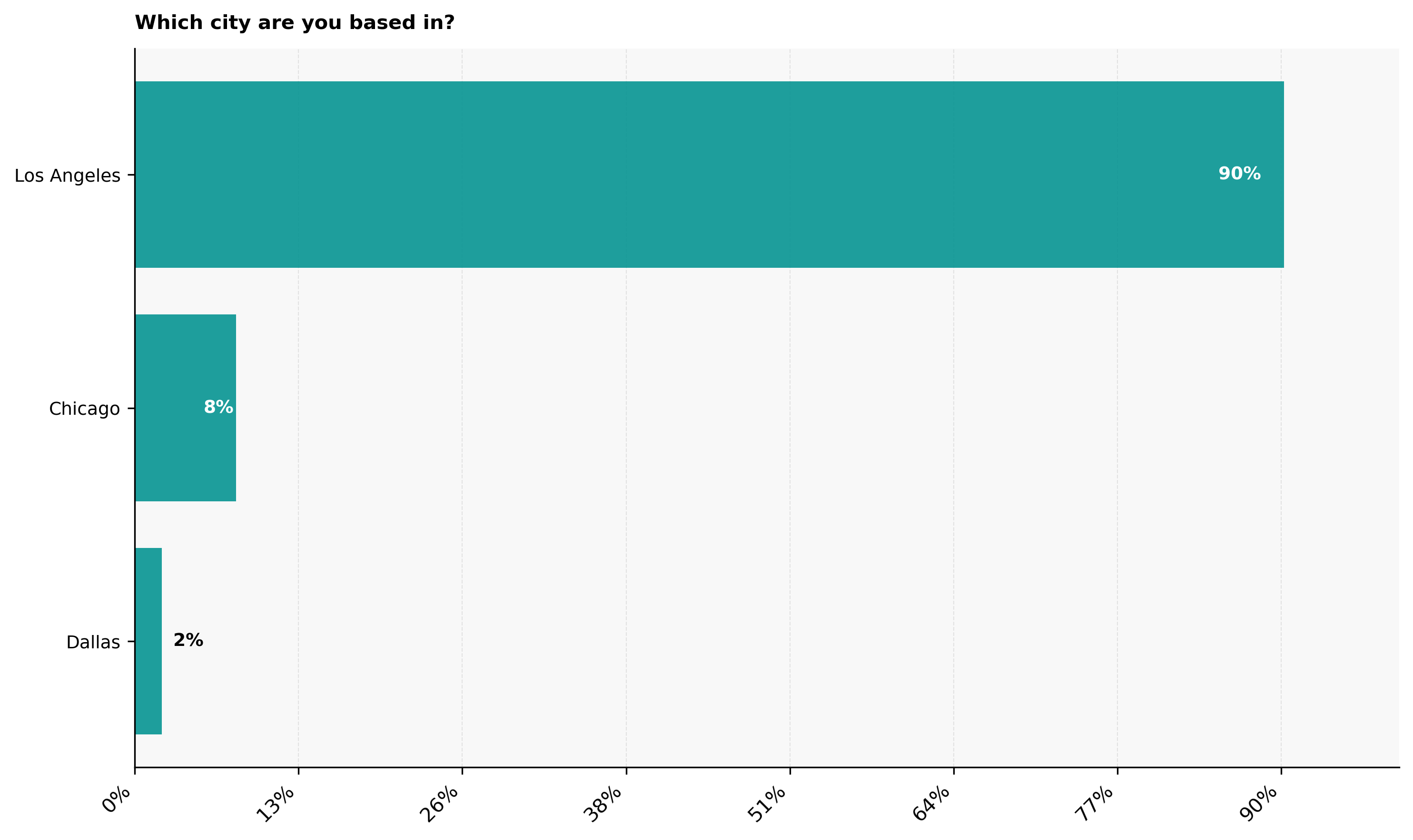
Our audience of facilities managers and building specifiers is spread across three major US cities. 90% are based in Los Angeles. The Greater LA area is served by six major commercial airports and more than 24 general aviation or military airfields. The main commercial airports include Los Angeles International Airport, Hollywood Burbank, Long Beach, John Wayne, Ontario, and LA/Palmdale Regional.
As for the remainder, 8% say they are based in Chicago, which is home to Chicago O'Hare International Airport, Chicago Midway International Airport, and smaller regional airports, and 2% say they’re based in Dallas. Dallas is served by Dallas/Fort Worth International Airport, Dallas Love Field, and smaller general aviation airports, such as Addison and Dallas Executive.
A Shift Toward Smarter Water Management in US Airports
Given what we’ve seen from these statistics, airports in the US are well aware of the importance of water management and conservation, which looks set to be a non-negotiable aspect of these facilities in the future. However, while some airports are making great strides in their water management efforts, others seem to take a more haphazard approach that doesn’t account for visibility, cost, or staff actions (as opposed to passenger actions).
Some airports may be taking a trial-and-error approach to find what works best for them, while others seem to have already found workable solutions. From these statistics, it’s clear that airports’ approach to water management is changing, paving the way for greener, more sustainable facilities.
About the Data
Sourced using Artios from an independent sample of 28,370 opinions of Facilities Managers or Building Specifiers in the USA across X, Quora, Reddit, Bluesky, TikTok, and Threads. Responses are collected within a 95% confidence interval and 5% margin of error. Results are derived from what people describe online, from opinions expressed online, not actual questions answered by people in the sample.