

Airport Water Consumption Statistics: USA 2026
Airport Water Consumption Statistics USA 2026 | Chicago Faucets
With up to thousands of planes and hundreds of thousands of passengers passing through them every day, America’s airports use an incredible amount of water. Some estimates put daily water consumption at these facilities anywhere between 1.4 million and 11 million liters. This precious resource is used in airport restrooms, drinking fountains, restaurants, evaporative cooling towers, and chillers. It’s also used for cleaning, landscaping, and irrigation, and for specialized uses such as fire suppression and deicing planes.
To find out what 6,861 opinions of facilities managers in the US were about airport water consumption, we utilized AI-driven audience profiling to synthesize insights from online discussions for 12 months, ending on April 20, 2026, to a high statistical confidence level. Our findings reveal current sentiments on water consumption, where airports could improve, and what’s driving or restricting change.
- 54% of facilities managers rate US airports' water efficiency as excellent
- 33% of airport facilities managers agree that leaks and aging pipes cause significant water loss
- 100% of facilities managers say that tenant water use is fully integrated into airport reporting
- Strong conservation programs keep airport water consumption stable for 100% of facilities managers
- Every season puts a different type of strain on airport water use
- 100% of facilities managers are neutral about airport design’s impact on water use
- 72% of facilities managers believe touchless sensor faucets in restrooms strongly impact airport water consumption
- Smart leak detection infrastructure is most effective for reducing water consumption for 100% of airport facilities managers
- AI data reporting and compliance tracking will reduce 100% of facilities managers' airport water consumption
- Insufficient knowledge or expertise on-site prevents 100% of airport facilities managers from adopting water recycling systems
- 50% of facilities managers say funding for airport water efficiency projects is available
- 50% of facilities managers share water consumption best practices with each other
- LEED green building certification matters most for airport facilities managers
- 100% of facilities managers want regulatory decisions left up to individual airport operators
- Airport water consumption innovation is not moving fast enough
- Dallas is home to 100% of airport facilities managers
- Building a more water-wise airport future
- About The Data
How do facilities managers rate US airports' overall water efficiency?
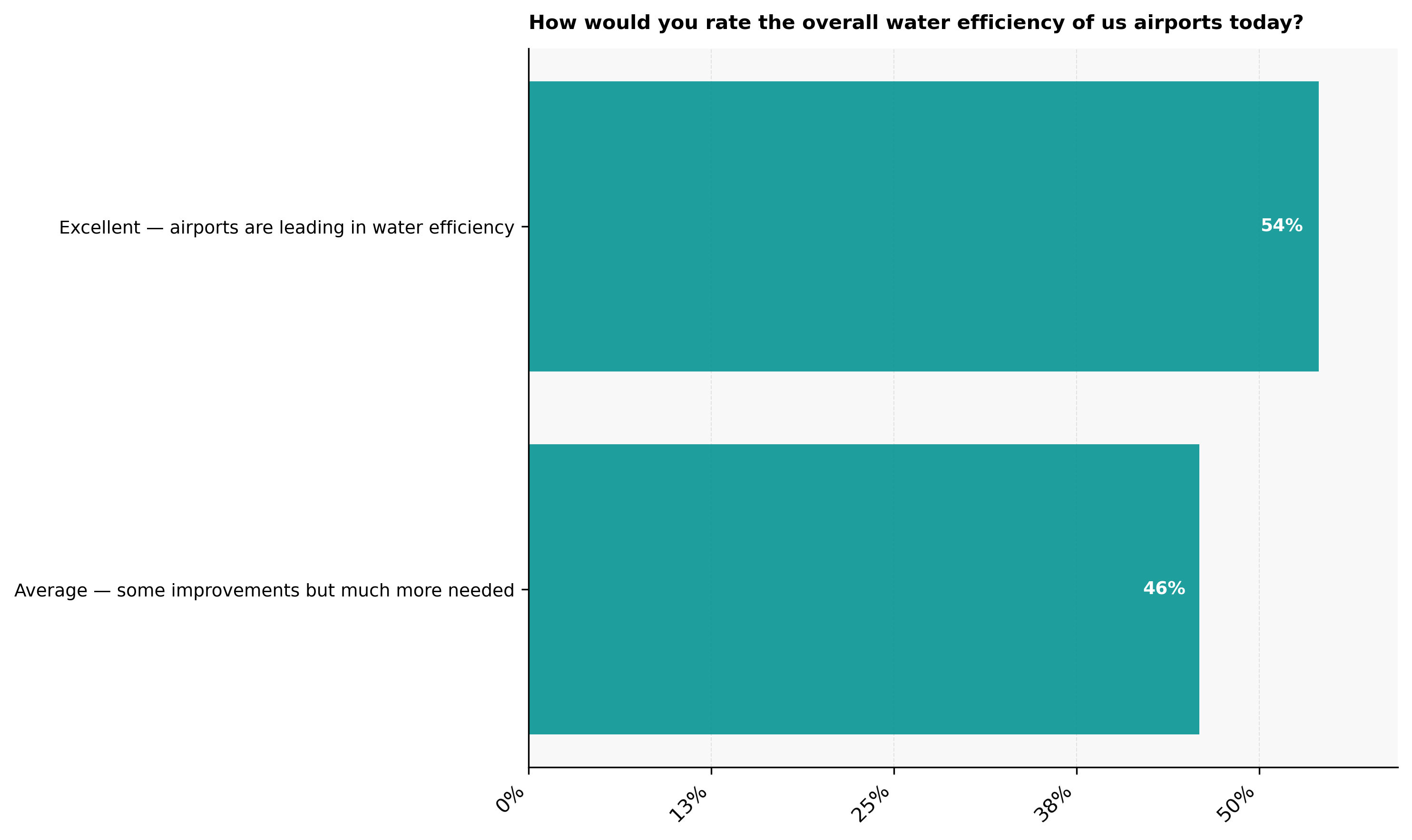
54% of facilities managers rate US airports' water efficiency as excellent
Facilities managers are almost evenly split in their rating of the overall water efficiency of US airports today. According to 54%, water efficiency is excellent, with airports leading in this regard. This opinion is likely based on these managers’ experiences at their own airports and on what they’ve read or heard about water consumption and efficiency initiatives at other airports. The remaining 46% weren’t quite as enthusiastic, saying that water efficiency at US airports is average and, while there has been some improvement, much more is needed. Again, this is probably based on what they’ve seen at their own facilities.
These opinions echo the fact that some airports are more water-efficient than others. According to one report, sustainable irrigation practices at Salt Lake City Airport in Utah reduced water consumption by 74% in 10 years, and the Dallas Fort Worth International Airport managed to reduce water use by 24% between 2011 and 2016. In addition, Los Angeles International Airport reduced water consumption by 6% over 1 year, while Orlando International Airport reduced it by 12% between 2010 and 2016.
Greg Hunt, Commercial Product Manager at Chicago Faucets adds, “Airport facility managers are under growing pressure to improve sustainability without disrupting passenger experience or increasing maintenance complexity. Chicago Faucets helps airports achieve both goals through a series of touchless faucets available at 0.35GPM, 0.50GPM and 1.50GPM to reduce waste, improve operational visibility through the CF Connect app, and we support long-term infrastructure resilience with durable products and long-term parts availability.
How much airport water loss do facilities managers attribute to leaks and aging pipes?
33% of airport facilities managers agree that leaks and aging pipes cause significant water loss
The amount of water loss due to infrastructure differs:
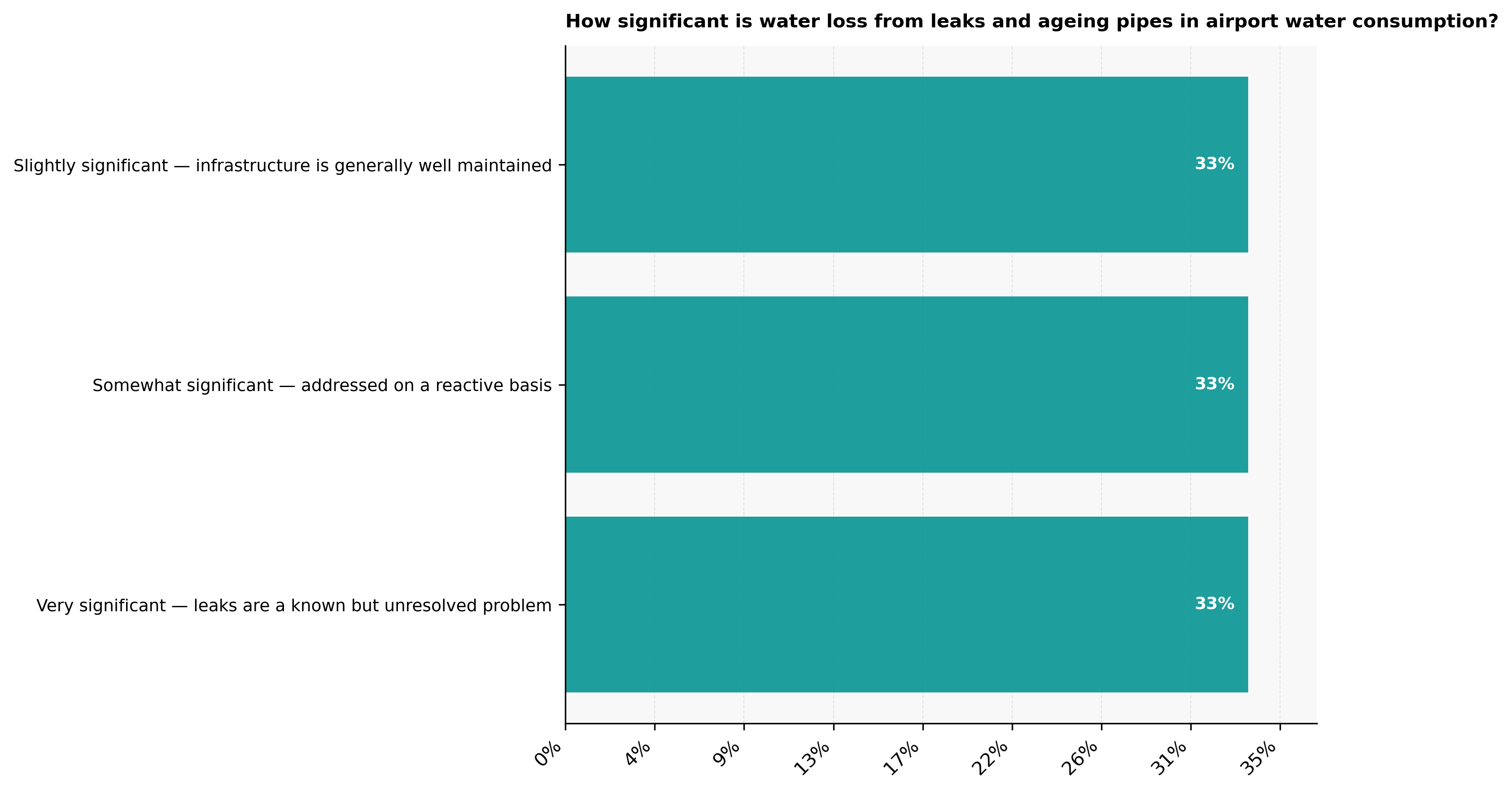
Three distinct opinions emerged from facilities managers regarding the significance of water loss from leaks and aging pipes in airport water consumption. 33% feel this is only slightly significant, as infrastructure is generally well maintained, suggesting they perform preventative maintenance to reduce the chances of leaks and similar problems.
Another 33% agree that water loss due to aging pipes and leaks is somewhat significant, adding that they address these issues on a reactive basis. According to the remaining 33%, this issue is very significant, with leaks being a known but unresolved problem. This points to these facilities managers dealing with leaks on a reactive basis rather than performing preventative maintenance.
“Aging infrastructure is one of the biggest hidden costs in airport operations. By combining durable fittings with smart monitoring technologies, airports can identify issues earlier, reduce emergency maintenance events, and improve water efficiency across terminals,” comments Greg Hunt of Chicago Faucets.
The problem with aging water infrastructure
Aging water pipes at airports are part of a wider problem facing towns and cities around the US. According to McKinsey, the average US water network pipe is about 45 years old. However, many of the country’s water pipes were installed in the early to mid-20th century. Even though most of the country’s water pipes were estimated to last between 75 and 100 years, many are reaching the end of their useful life. While water leaks can be a major issue, this isn’t the only worry when it comes to aging pipes.
Deteriorating pipes (depending on where they’re located) can pose environmental contamination risks and health hazards, strain maintenance and repair budgets, increase energy consumption and non-compliance due to various inefficiencies, and create capacity limitations that put airports at risk of service outages and untreated discharges.
How do facilities managers view tenant impact on airport water use?
100% of facilities managers say that tenant water use is fully integrated into airport reporting
Opinions on tenant water use integration is unanimous:
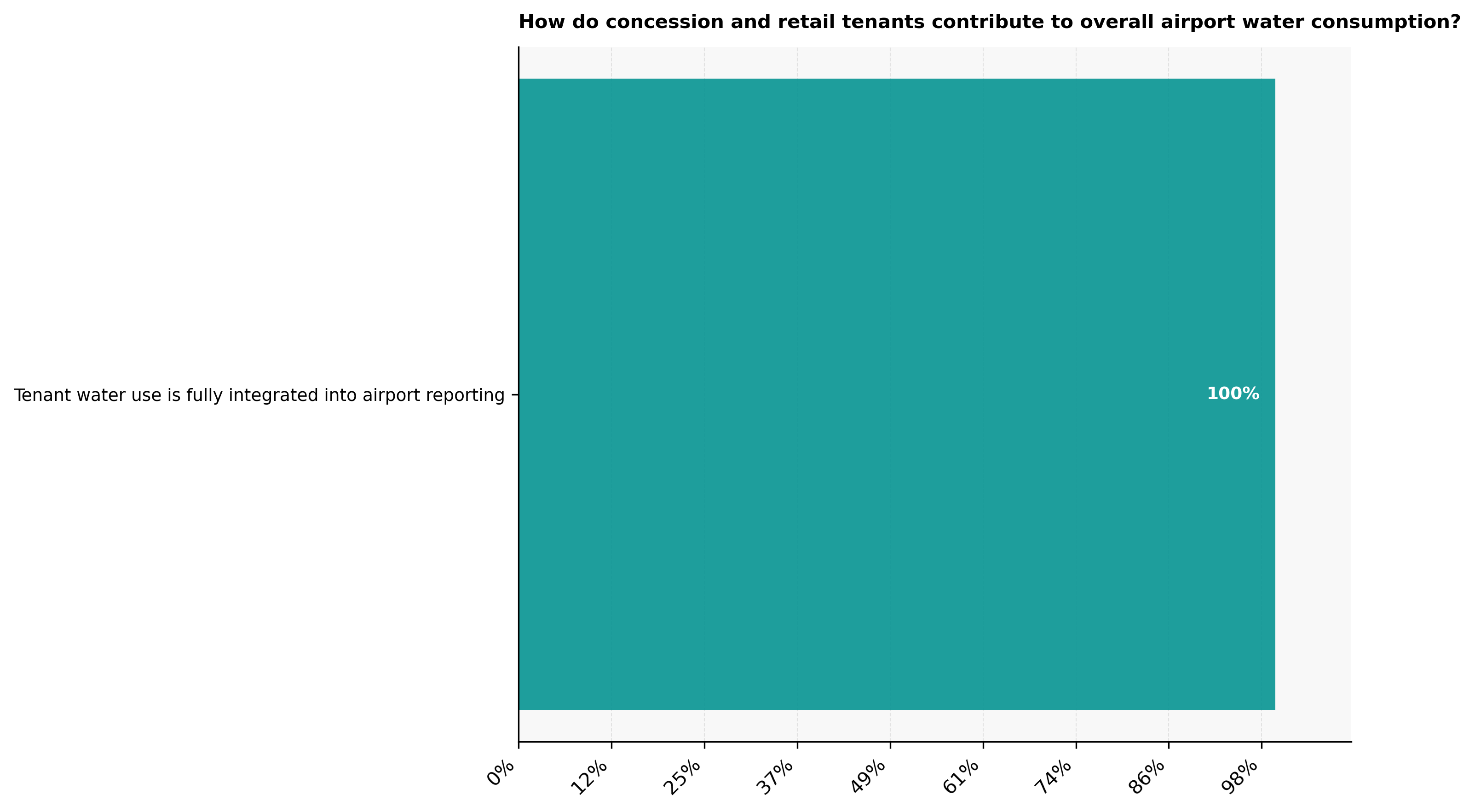
Our entire audience agrees on the contribution of concession and retail tenants to overall airport water consumption. 100% of facilities managers say tenant water is fully integrated into airport reporting, which undoubtedly takes the guesswork out of gauging their water consumption.
The impact of Green Concession Programs
That concession and retail tenants are fully integrated into reporting is in keeping with a wider trend influencing various decisions at airports across the US: Green Concessions Programs. With around 68% of consumers, from Baby Boomers to Gen Z, willing to pay more for sustainable products, airport concessionaire shareholders, investors, and service providers are combining sustainability requirements with investment decisions.
Green Concessions Programs encourage airport restaurants, retail shops, and other concessionaires to adopt sustainable practices and procedures, such as water-conservation measures and the use of energy-efficient lighting and equipment. Apart from potentially attracting more customers as a result of airports' marketing green concession participants, concessionaires who implement sustainable initiatives could receive financial incentives that reduce their rent.
How do facilities managers link passenger growth to airport water use?
Strong conservation programs keep airport water consumption stable for 100% of facilities managers
Conservation is key to consumption:

Anyone might reasonably expect the continued growth in passenger volume to affect airport water consumption, but according to the facilities managers, this isn’t the case. Instead, 100% believe that water consumption will remain flat due to strong conservation programs. Given that water consumption is part of regular reporting in airports, our audience is likely to monitor it regularly, as drastic increases could lead to increased damage, leaks, and the need for maintenance and repairs.
Passenger demand on the rise
It’s good news that airports have strong water-conservation measures in place, as passenger volume in the US is certainly increasing. According to the International Air Transport Association, North American carriers reported a 7% annual traffic rise in 2024 compared to 2023, with capacity also increasing by 7% and load factor decreasing by -0.5% to 84%. In December 2024, traffic rose by 5% compared to the same month in 2023.
It’s worth noting that the increase in the number of passengers means many more people could become ill if airlines provided them with poor-quality drinking water. The 2026 Airline Water Study found that Delta Airlines and Frontier Airlines had the best quality drinking water, followed by Alaska Airlines. However, almost all regional airlines (except GoJet Airlines) need to improve their onboard water safety.
Which season presents the greatest strain on airport water use?
Every season puts a different type of strain on airport water use
If the strong conservation programs mentioned by our audience were not in place, airport water consumption would be significantly affected by passenger volume and seasonality. Traditionally, vacationers in the US have taken shorter flights to warm, popular destinations year-round. As a result, leisure travel was spread more evenly across the calendar, even if there were noticeable peaks between June and August and during the year-end holiday season.
Airports function like small towns, with water demand varying by season. Many of the factors driving this demand vary according to season. Passenger traffic peaks in summer, which means more water is used in restaurants and restrooms, as well as for cleaning. Airports also see spikes in cooling demand and landscaping/irrigation demand in summer. Winter brings demand for water for deicing planes and runways, and it brings a spike in passenger traffic during the holiday season.
This is in keeping with a study published by Argonne National Laboratory. The study found that of 401 counties with thermoelectric power plants using fresh water for cooling, 160 counties in August and 80 counties in February had fresh water withdrawal requirements that exceeded the sustainable fresh water available.
How well do facilities managers think airport design reduces water use?
100% of facilities managers are neutral about airport design's impact on water use
Due to design variations, no strong opinions are clear:

Facilities managers at US airports have neutral feelings about how well current airport design supports the reduction of water consumption. 100% of our audience points to the fact that design varies significantly across airports, suggesting it works much better in some airports than others.
Among those airports that are taking advantage of contemporary design innovations and smart technology to become more sustainable, some use advanced materials for insulation, thereby reducing heating and cooling costs. Others use smart systems to track energy consumption in real time and adjust temperature and lighting according to occupancy. Yet other airports use sensors and low-flow fixtures to reduce water wastage, or they harvest rainwater or recycle greywater for landscaping or use in toilets. Many airports also use signs to educate passengers about the importance of conserving water.
What fixture upgrades do facilities managers see as most impactful for water savings?
72% of facilities managers believe touchless sensor faucets in restrooms strongly impact airport water consumption
Touchless sensor faucets are a major water saver:

Continuing on the topic of sensors, the overwhelming majority (72%) of facilities managers agree that touchless sensor faucets in restrooms would have a strong impact on airport water consumption. This is likely because they have already installed these faucets in their airport restrooms and have seen them make a difference to water consumption, or it may be because they’re aware of passengers leaving traditional faucets running unnecessarily and reasonably surmise that touchless sensor faucets can prevent this.
The remaining 28% don’t fully agree with the majority, saying these faucets would only have a limited impact. This suggests that passengers’ use of faucets isn’t the main factor driving water consumption at their airports.
We know from experience that water conservation is one of the immediate benefits of touchless faucets, which turn on when they sense movement and only stay on when they detect motion or when the metering time has passed. When rated at 0.35 GPM, these faucets can cut up to 85% of annual water usage. A few other benefits of these faucets include ease of use, cost savings, easy installation, and reducing the spread of germs.
“For airport operators, sensor technology delivers measurable value beyond hygiene alone. Properly engineered touchless fittings can significantly reduce water waste, lower maintenance demands, and support sustainability targets without sacrificing performance. Chicago Faucets E-Tronic® 80 sensor fittings are specifically engineered for high-traffic commercial environments like airports, where reliability and accuracy are critical. The E-Tronic® 80 features advanced Dual Beam Detection technology with overlapping 40-degree viewing angles and an alternating scanning method that improves user detection while minimizing false activations. Its intelligent sensing system combines Static Mode, which continuously measures infrared levels to confirm user presence, with Dynamic Mode, which functions like a motion detector to overcome environmental obstacles and prevent ghosting. This level of sensor precision helps airports reduce unnecessary water flow, improve restroom uptime, and deliver a more consistent passenger experience while supporting long-term water conservation goals,” notes Greg Hunt, Chicago Faucets Commercial Product Manager.
Which technologies do facilities managers say best reduce airport water use?
Smart leak detection infrastructure is most effective for reducing water consumption for 100% of airport facilities managers
Smart leak detection is the way to go:

100% of facilities managers agree that smart leak detection infrastructure is extremely effective for reducing airport water consumption. Either their airports have already installed such infrastructure and have seen the benefits firsthand, or they know managers at other airports that have installed it and have heard good reports about it.
According to Market Intelo, the global smart water leak detector market size was valued at $1.7 billion in 2024 and is forecast to grow at a CAGR of 14.2% to reach $5.8 billion by 2033. This impressive growth rate is due to increased demand for intelligent water management solutions across the commercial, industrial, and residential sectors, driven by greater awareness of water conservation, rising water damage incidents, the integration of IoT technologies, and building codes and insurance mandates requiring leak detection systems.
“Smart leak detection is no longer a luxury feature for major transportation hubs. It is becoming operationally essential. Airports need real-time insight into how water is being used across their facilities to improve efficiency, minimize costly disruptions, and support long-term sustainability goals. Chicago Faucets solutions help facility teams combine intelligent monitoring with durable, high-performance restroom infrastructure designed specifically for demanding commercial environments.
The E-Tronic® 80 touchless fitting platform supports these goals with above-deck electronics and integrated ASSE 1070 certified scald protection that simplify installation and ongoing maintenance. Its patented thermostatic protection helps prevent scalding while reducing installation time by up to 50% and eliminating as many as six potential leak points. By minimizing hidden connections below the deck and improving service accessibility, airports can reduce maintenance complexity, lower leak risks, and improve long-term system reliability in high-traffic restroom applications, ” informs Greg Hunt of Chicago Faucets.
How do facilities managers see AI helping reduce airport water use?
AI data reporting and compliance tracking will reduce 100% of facilities managers' airport water consumption
AI integration cente:

Among the entire audience (100%), AI is primarily used to monitor and reduce airport water consumption through data reporting and compliance tracking. This allows facilities teams to maintain a clearer, more consistent view of water usage across airport operations. By automating these processes, AI also reduces the administrative burden on facilities managers’ teams and helps minimize the risk of human error, improving the accuracy and reliability of reported data.
In addition to data reporting, compliance monitoring, and leak detection mentioned above, AI has other potential uses for managing water consumption in airports. This technology can be used for ongoing real-time water quality monitoring, and it can use real-time data to measure and adjust flow pressure and velocity for greater energy efficiency and reduced operating costs.
What do facilities managers see as the biggest barrier to airport water recycling?
Insufficient knowledge or expertise on-site prevents 100% of airport facilities managers from adopting water recycling systems
Two main barriers to entry are noted:

While a few US airports have installed water-recycling systems and are enjoying the benefits, many haven’t. According to 100% of facilities managers, insufficient knowledge or expertise on-site is the biggest barrier to adopting these systems for airport water consumption. This indicates that their airports have investigated these systems but have chosen other water-conservation methods instead.
How do facilities managers view funding for airport water efficiency projects?
50% of facilities managers say funding for airport water efficiency projects is available
Funding availability levels vary:

The availability of funding for water efficiency projects related to airport water consumption varies greatly from airport to airport. 25% of facilities managers know that funding is available, but competitive and difficult to access. Another 25% say funding is limited, with most of it coming from internal budgets. These budgets are likely to be relatively small, limiting the scope of potential projects.
Yet another 25% say funding is readily available through federal and state grant programs. One source is the Bureau of Reclamation’s WaterSMART Water and Energy Efficiency Grants, which provide 50/50 cost-share funding for projects aimed at conserving and using water more efficiently, increasing the production of hydropower, mitigating conflict risk in areas at a high risk of future water conflict, and accomplishing other benefits that contribute to a more reliable water supply in the western US.
The remaining 25% of our audience feels that funding is very limited and water projects are low on the funding priority list. This is probably because they’ve already discussed potential projects with their airports’ financial teams and senior management, only to have their requests denied.
How effectively do airport facilities managers share water best practices?
50% of facilities managers share water consumption best practices with each other
information sharing is either effective or poor:

We’ve mentioned the possibility of facilities managers at different airports sharing knowledge with each other a couple of times. While this does happen, it’s not always done as effectively as it could be. In fact, opinions are evenly split on how effectively US airports share best practices for water consumption.
50% are of the opinion that knowledge sharing happens poorly, with airports operating in silos on this topic. The other 50% 's airports do this very effectively, as there are active industry-wide programs that enable it.
Which water standards matter most for facilities managers in airports?
LEED green building certification matters most for airport facilities managers
One certification stands out:
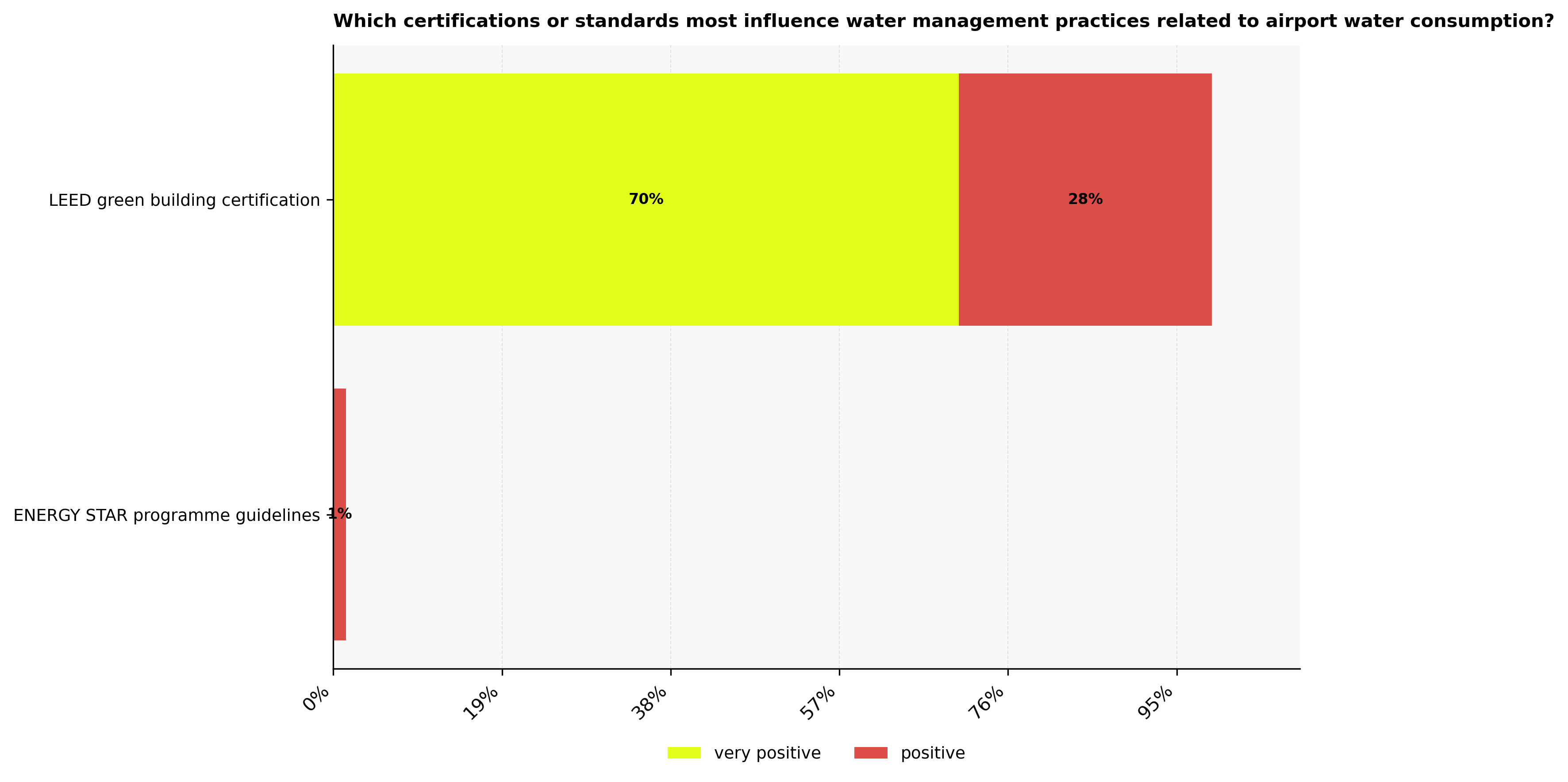
Some certifications or standards are more influential than others for water management practices related to airport water consumption. One of the most influential of these is the Leadership in Energy and Environmental Design, or LEED green building certification. For 70% of facilities managers, this certificate has a very positive influence, while 28% say it has a positive influence.
LEED is the world’s most widely used green building rating system and provides a framework for cost-saving, efficient, and healthy green buildings. This certification is available for almost all types of buildings.
For the remaining 1% of our audience, the ENERGY STAR program guidelines have a positive influence on water management practices related to airport water consumption. Administered by the US Environmental Protection Agency (EPA), this program has thousands of partner organizations, including 40% of the Fortune 500. Together with the EPA, these organizations deliver cost-saving energy efficiency solutions.
It is surprising that no one mentions the ISO 14046 standard. This international standard is verified by Switzerland-based SGS, which performs a comprehensive analysis of organizations’ water usage and water management systems.
Greg Hunt notes, “Water-efficient fittings play an important role in helping airports pursue sustainability objectives and support green building initiatives. Chicago Faucets works closely with facility teams, engineers, and specifiers to deliver solutions designed for performance, durability, and conservation in some of the most demanding commercial environments. Many Chicago Faucets water-saving fittings are engineered to help support compliance with leading sustainability standards and programs, including CALGreen, LEED v5, and EPA WaterSense specifications. By combining low-flow performance, advanced sensor technology, and durable commercial construction, these solutions help airports reduce potable water consumption, support green building certification goals, and improve long-term operational efficiency without compromising user experience or reliability. Airports and facility managers can also estimate potential conservation and cost savings using the Chicago Faucets Water Savings Calculator.”
What role do facilities managers think federal or state regulations play in airport consumption?
For 100% of facilities managers want regulatory decisions left up to individual airport operators
Case-by-case basis trumps federal or state regulation:
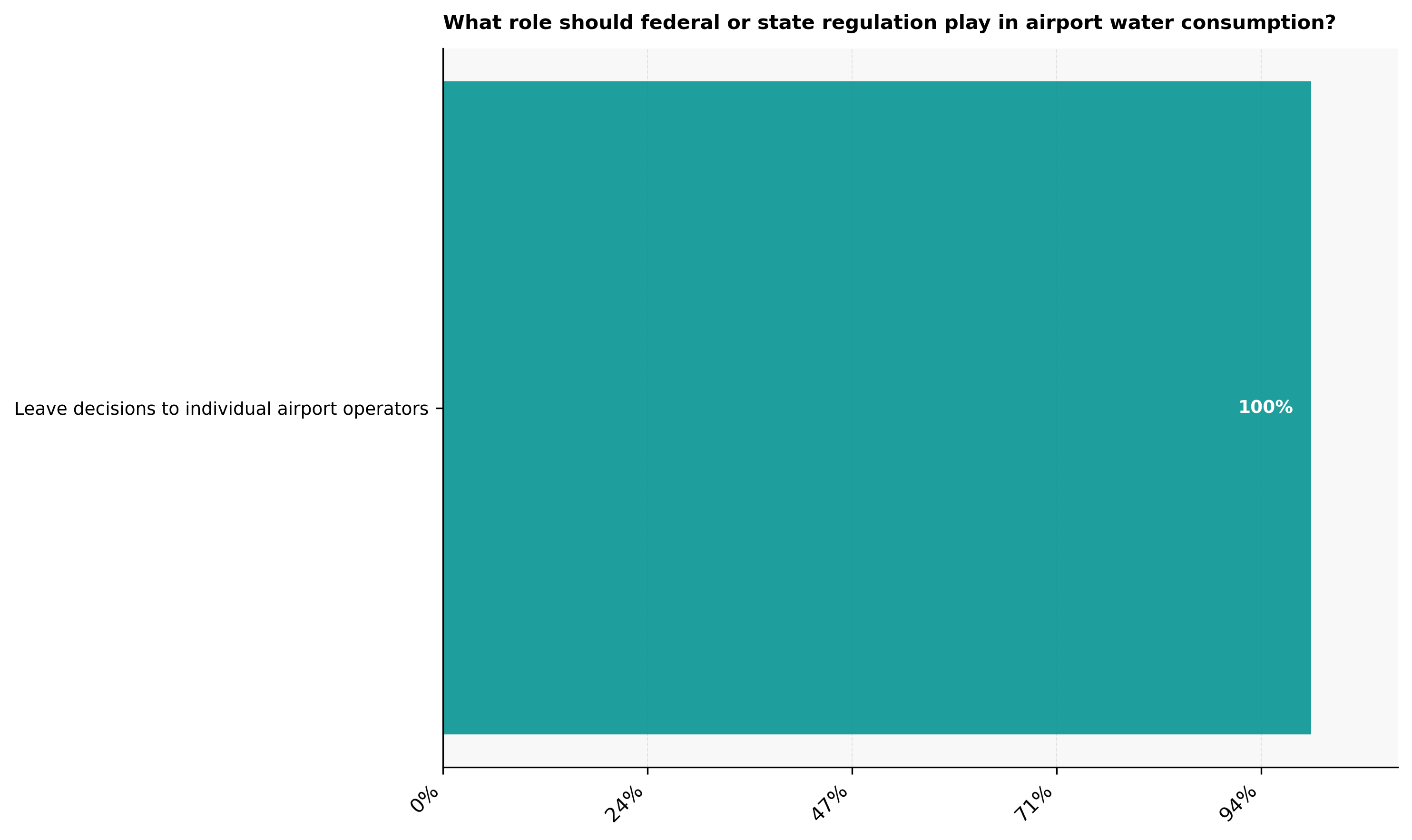
Even though a small percentage mentions a program run by a federal agency above, our audience doesn’t think federal or state regulation should play a role in airport water consumption.
100% of airport facilities managers feel that decisions around water consumption should be left to individual airport operators. Every airport is a unique ecosystem, and federal or state regulators probably wouldn’t take their nuances into account. Instead, they would probably take a one-size-fits-all approach that wouldn’t be as effective.
What is the pace of innovation in solutions targeting airport water consumption?
Airport water consumption innovation is not moving fast enough
Although there has been some progress in innovation in solutions targeting airport water consumption over the past few years, it’s clear it’s not happening fast enough. The relatively slow pace isn’t because only a few organizations are developing solutions – numerous companies are exploring ways to reduce consumption and increase conservation. Rather, it’s largely an issue of funding and government support.
According to the World Bank, political leadership and will in government are essential for expanding innovation in this area. However, the current administration has deprioritized environmental issues and reduced staffing at environmental agencies. The sector responsible for water consumption reduction and conservation innovations remains underfunded and lacks skilled personnel. That said, the World Bank continues to work to increase opportunities for the private sector and to support collaboration through platforms from development partners, local communities, and national governments.
One initiative, the Utility of the Future Program, creates new ways for organizations to identify, test, and deploy water-related innovations, while trust funds such as the Global Water Security & Sanitation Partnership and the 2030 Water Resources Group enable collaboration on water issues, support crowd-in private sector participants, and prompt private sector investment.
Which city are facilities managers primarily based?
Dallas is home to 100% of airport facilities managers
Our audience is located in one region:
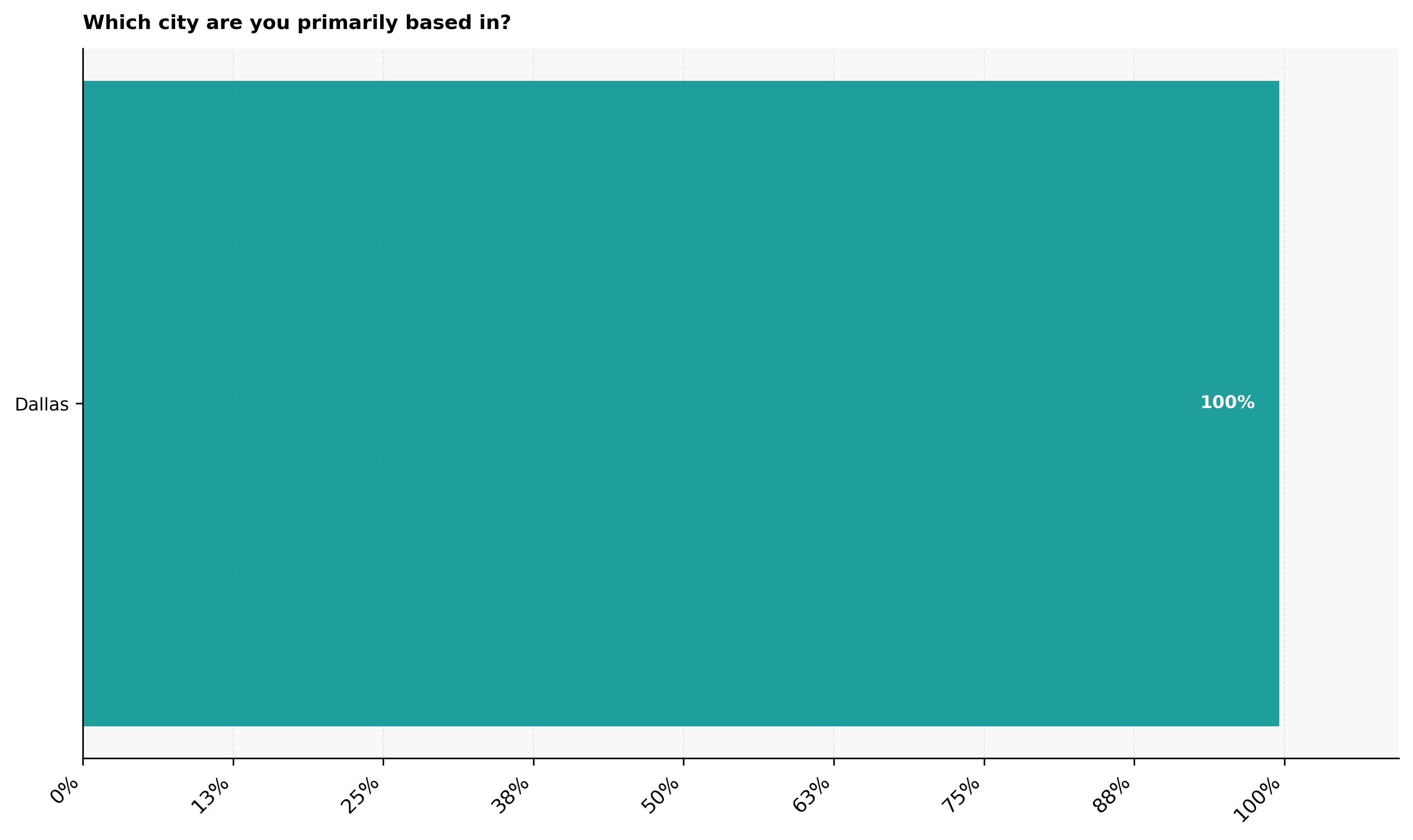
100% of our audience is primarily based in Dallas, Texas. This is particularly relevant given the scale of water management challenges faced by major infrastructure hubs in the region. Dallas Fort Worth International Airport’s goal is to become net water positive, which means putting more water back into the environment than the airport extracts from it.
To achieve this, the airport is focusing on reducing potable water consumption, matching the appropriate water resource to each application, implementing more ways to reuse onsite water, and improving and protecting the quality of surface water. The airport also has a target to meet 90% of its non-potable water needs using closed-loop systems, recycled or reclaimed water, harvested rainwater, or other non-potable sources.
Building a more water-wise airport future
With the environment and water resources under increasing pressure as the climate continues to change and weather events become more extreme, it’s clear that airports’ relationship with water needs to change.
While great strides are being made in this regard, more needs to be done. The good news is that facilities managers are aware of this, and as innovative water-saving technologies like touchless faucets continue to be developed, we’re likely to see airports become greener, more water-wise places in the future.
About the Data
Sourced using Artios from an independent sample of 6,861 opinions of Facilities Managers in the USA across X, Quora, Reddit, Bluesky, TikTok, and Threads. Responses are collected within a 95% confidence interval and 5% margin of error. Results are derived from what people describe online, from opinions expressed online, not actual questions answered by people in the sample.