Chicago Faucets helps meet LEED® certification.
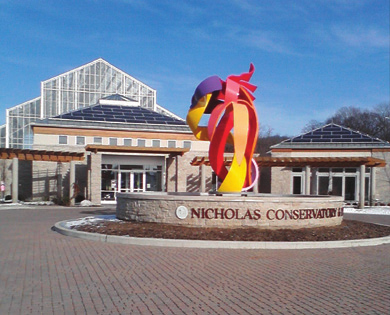
The Sinnissippi Greenhouse served visitors to the Rockford, Illinois, attraction well for more than 86 years. But the Rockford Park District had big plans, which included building a new facility on the site—specifically, a sustainably built facility along the Rock River that would also lower operating costs.
The Challenge
Located about 90 miles outside Chicago, the new $13.5 million, 2,000 sq. ft. Nicholas Conservatory & Gardens and $1.43 million Eclipse Lagoon is the third largest conservatory in Illinois with over 50,000 visitors a year. Rockford Park District’s plans for the site included lowering operating costs and meeting LEED® certification standards. This required a whole-building approach from underground geo-water for heating and cooling, to solar power, to low-flow, water-efficient faucets.
To achieve LEED certification, the conservatory had to earn a certain amount of credit points in key areas of sustainable design, including water use. LEED (Leadership in Energy and Environmental Design) Green Building Rating System™ was developed by the U.S. Green Building Council (USGBC) as the national accepted benchmark for the design, construction, and operation of high-performance green buildings.
“The conservatory is a working plant exhibit that requires durable materials and fixtures that will endure for years to come.”
—Kelly Moore
Facility Manager
The Solution
To help achieve LEED certification points, reduce water costs, and improve overall environmental stewardship, the faucets in the building had to be water efficient. Moreover, the faucets had to have one-percent or less lead content, be recyclable, have low-flow outlets and metering cartridges, and be sensor operated.
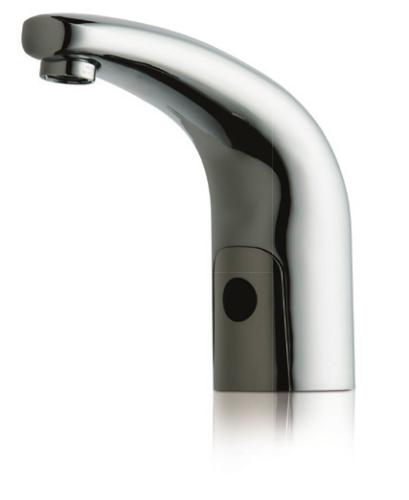
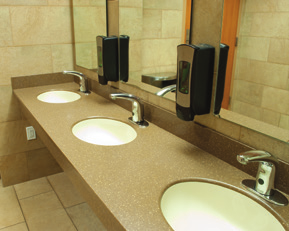
HyTronic® sensor faucets from Chicago Faucets met the requirements. The facility installed 10 ADA-compliant, vandal-resistant, single-hole faucets, model 116.211.AB.1. The faucets are powered by lithium batteries, are compatible with the Chicago Faucets Commander® handheld programming unit, and feature internal temperature control and above deck electronics. They are also made with ECAST® brass, a special formulation from Chicago Faucets that meets low-lead specifications for plumbing fittings.
“Chicago sensor-operated faucets were chosen for the Nicholas Conservatory project because of their quality and ability to stand up to the daily requirements of a large greenhouse.”
“The conservatory is a working plant exhibit that requires durable materials and fixtures that will endure for years to come,” says Kelly Moore, Facility Manager, Nicholas Conservatory & Gardens. “Together, all of the plumbing components create a water-efficient facility, a testament to the Rockford Park District’s stewardship of the environment.”
Our Commitment to Conservation and Sustainability
Chicago Faucets has a long-standing commitment to water conservation and sustainability. An extensive product offering incorporates low-flow outlets, adjustable metering cartridges, and sensor-operated faucets that conserve water by limiting the flow rate and controlling operation time.
Chicago Faucets is a member of the U.S. Green Building Council, developer of The Leadership in Energy and Environmental Design (LEED) Green Building Rating System.™ Chicago Faucets also partners with WaterSense®, a program sponsored by the EPA, and promotes water effi ciency by enhancing the market for water efficient products, programs, and practices. We are also a charter sponsor of the Alliance for Water Efficiency, a non-profit organization dedicated to the efficient and sustainable use of water.